
Voice is the primary tool families use to build trust, teach values, and create emotional safety across every stage of childhood. The role of voice in family relationships goes far beyond the words spoken. Tone, rhythm, storytelling, and singing each carry distinct neurological and emotional weight. Recent 2026 research confirms that parental voice exposure accelerates language development in infants, even in NICU settings where physical presence is limited. For parents and caregivers, understanding how vocal communication shapes family bonds is the first step toward using it with greater intention.
How does vocal tone shape emotional connection in families?
Tone conveys emotion more powerfully than word choice alone. A warm, steady voice signals safety. A sharp or dismissive tone signals threat, even when the words themselves are neutral. Children's brains are wired to detect these differences from birth, and the patterns they learn early become the emotional templates they carry into adult relationships.
Positive vocal tone builds what researchers call emotional safety. When a parent speaks calmly during a hard moment, a child learns that conflict is survivable and that connection remains intact. Negative vocal patterns, including blaming, shaming, or raised voices used as control, erode that safety over time. The impact of voice in relationships is cumulative. Small daily interactions add up to either a reservoir of trust or a pattern of guardedness.
Infant-directed speech, sometimes called "motherese," uses exaggerated pitch, slower pace, and clear rhythm. Infants' neurobiology is hardwired to track a familiar caregiver's voice with higher brain engagement than a stranger's voice. This means the simple act of talking to your baby, narrating a diaper change or a walk outside, is doing real neurological work.
Key vocal habits that support emotional connection:
- Speak at eye level with children during important conversations
- Use a slower pace when a child is upset or overwhelmed
- Name your own emotions aloud so children learn emotional vocabulary
- Avoid sarcasm with young children, who process tone before meaning
- Offer verbal affirmations daily, not only during achievements
Pro Tip: When a conversation gets tense, lower your voice instead of raising it. A quieter tone often de-escalates conflict faster than matching a child's emotional volume.
How does parental voice and storytelling affect child brain development?
Parental voice actively shapes the architecture of a child's developing brain. This is not a metaphor. Maternal voice recordings given to premature infants in NICU settings accelerated maturation of the left arcuate fasciculus, the brain tract most critical for language processing. Babies who heard their mother's voice showed more developed language pathways than those who did not. That finding reframes storytelling from a comfort ritual into a developmental necessity.
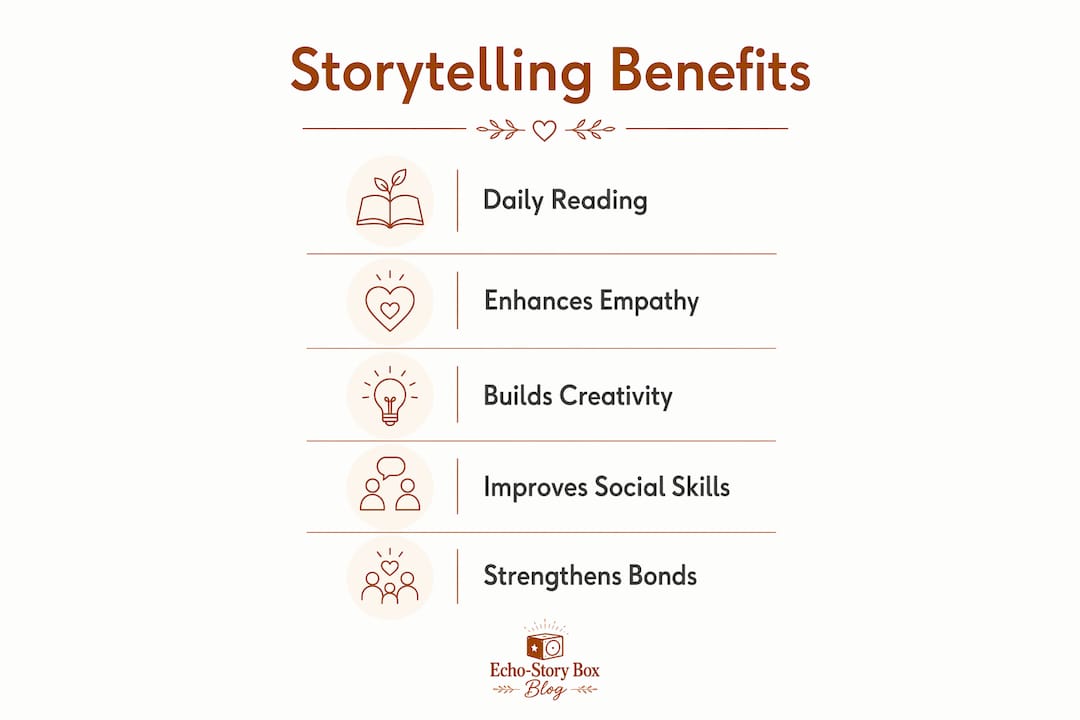
Daily reading builds on this foundation. As little as 15 minutes of reading aloud each day boosts children's creativity, empathy, and social skills. The format matters less than the consistency. Whether you pause to ask questions or read straight through, the benefit holds. That removes a common source of parental pressure and replaces it with a simple, repeatable habit.
Focused, undivided attention during reading engages children's brain neurons in ways that digital media does not replicate. Physical proximity and a familiar voice together create a level of brain engagement and attachment that a screen simply cannot match. The voice carries the relationship, and the relationship carries the learning.
Four ways to build storytelling into daily life
- Morning narration. Describe what the day holds in simple, story form. "First we'll go to the store, then we'll make lunch together." Predictability told through voice builds security.
- Bedtime stories. Consistent nightly reading, even for five minutes, creates a ritual that signals safety and closeness before sleep.
- Family history moments. Share one short story about your own childhood each week. Children who know their family's history show stronger emotional resilience.
- Car ride storytelling. Use travel time for oral storytelling without books. Improvised stories with a child's name and favorite characters build brain development in kids through imagination and language together.
| Vocal Activity | Developmental Benefit |
|---|---|
| Daily reading aloud | Builds empathy, creativity, and social skills |
| Maternal voice recordings | Accelerates language tract maturation in infants |
| Oral storytelling | Strengthens vocabulary and narrative thinking |
| Singing and rhymes | Supports auditory pattern recognition and bonding |
Pro Tip: You do not need a perfect reading voice or elaborate story ideas. Children value authentic connection over polished performance. A simple, genuine story told in your own voice is always enough.
How can families use voice intentionally to strengthen bonds?
Voice becomes a tool for family unity when used with purpose. The "one voice" concept in family communication describes how a household develops a shared emotional tone. When caregivers speak with consistency, warmth, and clarity, children internalize those patterns as the family's identity. That shared vocal culture becomes a source of belonging.
Family storytelling creates a relational legacy that passes values and history across generations. Parents actively choose which stories to tell and which moments to highlight. Those choices shape how children understand who they are and where they come from. Storytelling is not passive entertainment. It is one of the most direct ways a family transmits its character.
"Shared reading and storytelling act as emotional presence, lowering stress for both parents and children and reinforcing security and curiosity. Familiar family stories and simple rhymes build emotional regulation without needing constant new materials."
Conflict is where voice either builds or breaks trust. Raising volume rarely resolves disagreement. Naming feelings aloud, using "I" statements, and giving each person space to speak without interruption are vocal practices that shift conflict from power struggle to problem solving. Techniques like emotional regulation through storytelling give children a framework for processing hard emotions before they escalate.
Practical habits for intentional vocal communication:
- Give every family member a turn to speak at dinner without interruption
- Use storytelling to introduce family values rather than direct instruction
- Acknowledge a child's feelings aloud before offering solutions
- Replace commands with invitations: "Let's clean up together" instead of "Go clean your room"
- Record your voice reading a favorite story for times when you cannot be present
What is the unique role of singing in family bonding?
Singing does something spoken language cannot. It delivers rhythm, melody, and linguistic content simultaneously, giving an infant's brain a structured scaffold for learning speech patterns. Songs provide melodic and linguistic patterns that help infants extract the rules of language more easily than speech alone. That dual input is why lullabies have existed in every culture across recorded history.
Neural research shows that singing activates bilateral brain regions tied to both language and melody. Spoken language tends to favor the left hemisphere. Singing engages both sides, which means it builds broader neural connections during the critical early years. For families with infants, singing is not just sweet. It is one of the most neurologically rich things a caregiver can do.
Singing is also a universal practice that requires no skill level. A parent who believes they "can't sing" still provides their child with the same bonding and language benefits as a trained vocalist. The child's brain responds to the familiar voice and the rhythmic structure, not the pitch accuracy. Lullabies, simple folk songs, and even made-up songs about daily routines all count. The emotional learning through children's stories and songs a family shares become part of a child's earliest emotional memory.
Pro Tip: Create a simple family song for transitions, like bath time or bedtime. Sung routines reduce resistance in young children because the melody signals what comes next before words are even processed.
Key Takeaways
Voice is the most direct tool families have for building emotional safety, language development, and lasting connection across childhood.
| Point | Details |
|---|---|
| Tone shapes emotional safety | A calm, warm vocal tone builds trust and security in children daily. |
| 15 minutes of reading matters | Daily read-aloud sessions boost empathy, creativity, and social skills in children. |
| Parental voice builds brain pathways | Maternal voice exposure accelerates language tract development even in premature infants. |
| Storytelling creates family legacy | Intentional storytelling passes values and identity across generations, strengthening family bonds. |
| Singing offers unique neural benefits | Songs engage both brain hemispheres simultaneously, supporting language and emotional bonding. |
Why I think we underestimate the simplest vocal moments
Most caregivers I talk with worry about doing enough. They wonder if they read the right books, ask the right questions, or tell stories the right way. That worry is understandable, but it misses the point. The research is clear: authenticity matters more than performance. Children do not need a polished narrator. They need a present one.
What I have come to believe, after spending years thinking about how families connect, is that the smallest vocal moments carry the most weight. The way you say good morning. The tone you use when a child makes a mistake. The story you tell about your own grandmother on a quiet afternoon. These are not filler moments. They are the relationship.
Families who preserve voices and stories across generations give children something no curriculum can replicate: a sense of where they belong and who came before them. That sense of identity is protective. It builds resilience that lasts well into adulthood.
My honest encouragement is this: stop waiting for the perfect story or the right moment. Your voice, today, in whatever form it takes, is already enough to do the work.
— Bob
How Echostory-box supports screen-free family storytelling
Echostory-box was built for exactly this kind of intentional, voice-centered family life. The platform gives families a simple, screen-free way to listen together, preserve voices, and share stories that matter.

Parents and grandparents can record bedtime stories, family history, and personal messages directly onto story cards. Children tap a card and hear a familiar voice, even when the person is not in the room. Original audio adventures featuring characters like Theo the Rabbit make listening a calm, imaginative experience without ads or notifications. Whether you want ready-made stories or a place to store your own, Echostory-box gives your family's voice a home it can return to again and again.
FAQ
How does a parent's voice affect a baby's brain development?
Parental voice exposure accelerates maturation of the brain's language tracts, including the left arcuate fasciculus. Research on premature infants shows that hearing a maternal voice recording produces measurably more developed language pathways than no voice exposure.
How much time does daily reading actually require?
As little as 15 minutes of daily read-aloud time improves children's empathy, creativity, and social skills. Consistency matters more than duration or reading technique.
Does singing to a baby really make a difference?
Yes. Singing activates bilateral brain regions tied to language and melody simultaneously, giving infants a richer neural scaffold for learning speech patterns than spoken language alone provides.
What is a relational legacy in family communication?
A relational legacy is the collection of stories, values, and history that parents intentionally pass to children through storytelling. Research shows this practice strengthens family identity and emotional resilience across generations.
How does voice help families resolve conflict?
Using calm tone, "I" statements, and active listening during disagreements shifts conflict from power struggle to problem solving. Naming emotions aloud and giving each person space to speak without interruption are the most effective vocal strategies for family conflict resolution.