
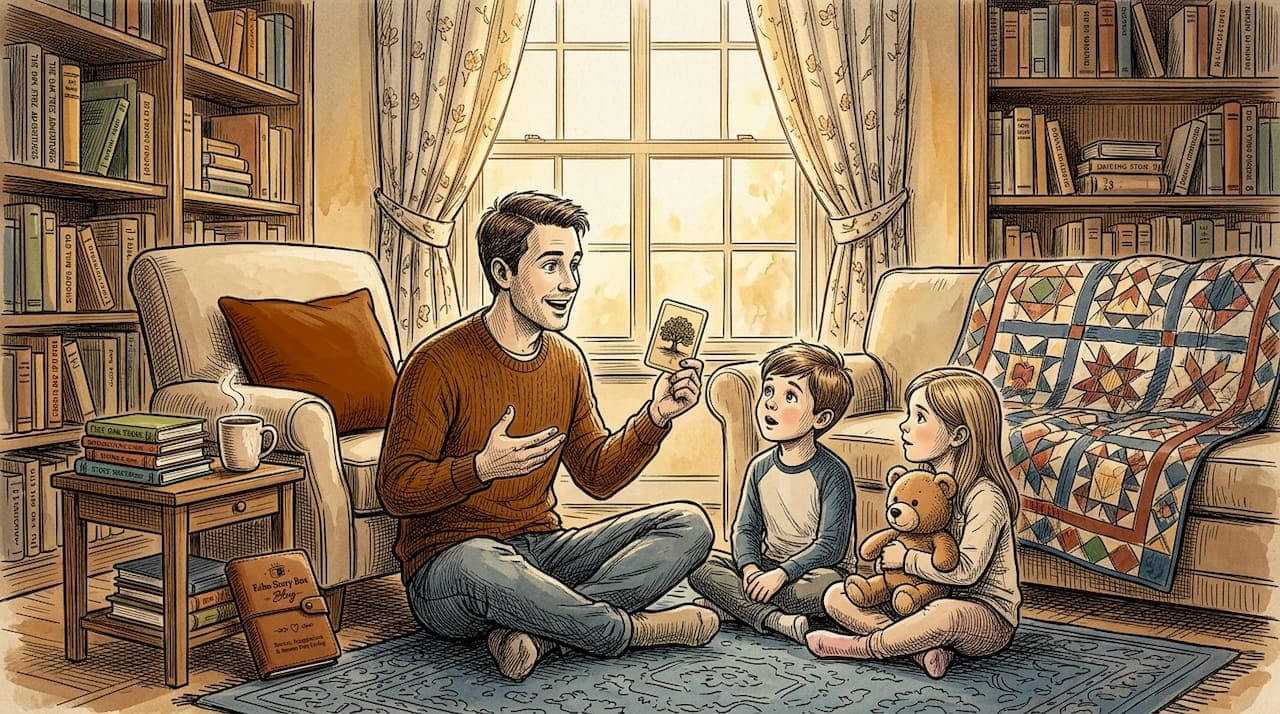
When a child hears a story, something remarkable happens inside their brain. The role of storytelling in brain development goes far beyond simple entertainment. Stories physically change how a child's brain is wired, activating memory centers, emotional regions, and social processing areas all at once. Research now confirms what grandparents have always known: stories are one of the most powerful learning tools a child can experience. This guide breaks down exactly what happens in a child's brain during storytelling and what you can do about it today.
Table of Contents
- Key takeaways
- The role of storytelling in brain development
- Cognitive benefits of storytelling for kids
- Storytelling and social-emotional development
- How parents and educators can use storytelling effectively
- Storytelling versus traditional fact-based learning
- My take on storytelling and the modern child
- Give your child the gift of intentional stories
- FAQ
Key takeaways
| Point | Details |
|---|---|
| Stories reshape neural architecture | Storytelling activates multiple brain regions simultaneously, building stronger cognitive connections in children. |
| Oxytocin drives empathy and attention | Emotionally engaging stories trigger hormones that increase focus, empathy, and prosocial behavior in kids. |
| Oral storytelling outperforms picture books | Listening to stories without images demands more active imagination, producing higher and more sustained brain activation. |
| Stories beat facts for memory retention | The brain retains stories far longer than isolated facts, making narrative learning more effective for children. |
| Parents and educators can act now | Simple daily storytelling habits, like predictive questioning and story mapping, produce measurable cognitive benefits. |
The role of storytelling in brain development
Most people think of stories as a way to entertain children at bedtime. The science tells a very different story. When a child listens to a narrative, their brain does not just passively receive information. It actively mirrors the brain of the person telling the story.
This phenomenon is called neural coupling. Neuroimaging research shows that listener brains synchronize with the storyteller's brain across emotional, memory, and social understanding regions. When researchers introduced a language barrier between storyteller and listener, that synchronization disappeared entirely. Language and shared narrative are the bridge.
Stories also activate far more of the brain than plain facts do. When a child hears a list of information, only the language processing areas light up. When they hear a story, the brain recruits regions tied to sensory experience, emotion, and movement as well. A sentence like "The rabbit sprinted through the cold mud" activates the motor cortex and sensory areas in ways that "the rabbit moved quickly" simply does not.
Here is what storytelling triggers in the developing brain:
- Neural coupling: The child's brain synchronizes with the storyteller's, building shared understanding
- Oxytocin release: Emotional story moments trigger oxytocin, which sharpens attention and builds empathy
- Cortisol response: Tension in a narrative raises cortisol, keeping the child alert and engaged
- Prefrontal cortex activation: Story comprehension exercises planning, prediction, and decision-making areas
- Memory consolidation: Stories link new information to emotional memory, making it stick
One finding that surprises many parents: oral storytelling sustains higher brain activation than picture book reading. Japanese neuroimaging studies found that when children listen to stories without images, the prefrontal cortex stays active longer. Picture books, by contrast, showed decreased activation with repeated exposure. The brain has less work to do when images are provided.
Pro Tip: Try telling a familiar story to your child without showing any pictures. Watch how they lean in. Their brain is working harder, and that effort is exactly what builds stronger cognitive connections.
Cognitive benefits of storytelling for kids
Storytelling and cognitive growth are deeply connected, and the benefits show up in several specific areas that matter for school readiness and lifelong learning.
Language and vocabulary growth
Children who hear rich, varied stories develop stronger vocabularies than those who do not. Stories expose kids to words in context, which is far more effective than learning definitions from a list. When a character in a story feels "reluctant" to cross the bridge, a child absorbs the meaning through the emotional situation, not a dictionary entry. This is how literacy and listening skills develop naturally through narrative exposure.
Sequential thinking and cause-and-effect reasoning
Stories follow a structure: something happens, then something else happens because of it. That pattern teaches children how to think in sequences. Research in early childhood education confirms that storytelling builds sequential thinking by walking children through narrative arcs involving motivation, obstacles, and consequences. When you ask a child "What do you think will happen next?" you are not just making the story more fun. You are exercising their ability to predict outcomes and reason through cause and effect.
Moral development
A six-week storytelling program for children produced measurable gains in moral reasoning, including honesty and empathy scores, after just 12 structured sessions. Stories give children a safe space to process ethical dilemmas through characters rather than through personal experience. They can ask "Was that fair?" about a fox in a fable before they have to answer that question about a friend on the playground.
Here is how storytelling supports key cognitive skills step by step:
- Listening and attention: Following a narrative trains sustained focus, which transfers to classroom learning
- Vocabulary in context: New words appear naturally within emotional situations, making them memorable
- Prediction and inference: Story gaps invite children to fill in meaning, building higher-order thinking
- Retelling and recall: Asking children to retell a story activates memory consolidation and language production
- Moral reasoning: Character decisions give children frameworks for evaluating right and wrong
| Learning method | Brain regions activated | Memory retention | Engagement level |
|---|---|---|---|
| Storytelling | Multiple (emotional, sensory, motor, language) | Very high | High |
| Fact-based instruction | Primarily language areas | Lower | Moderate |
| Rote memorization | Language and repetition circuits | Low without context | Low |
Pro Tip: After finishing a story, ask your child three questions: What happened first? Why did the character do that? What would you have done differently? These three questions alone exercise sequential thinking, empathy, and moral reasoning at once.
Storytelling and social-emotional development
The impact of storytelling on development extends well beyond academics. Stories are one of the primary tools children use to understand other people's feelings, motivations, and inner lives.
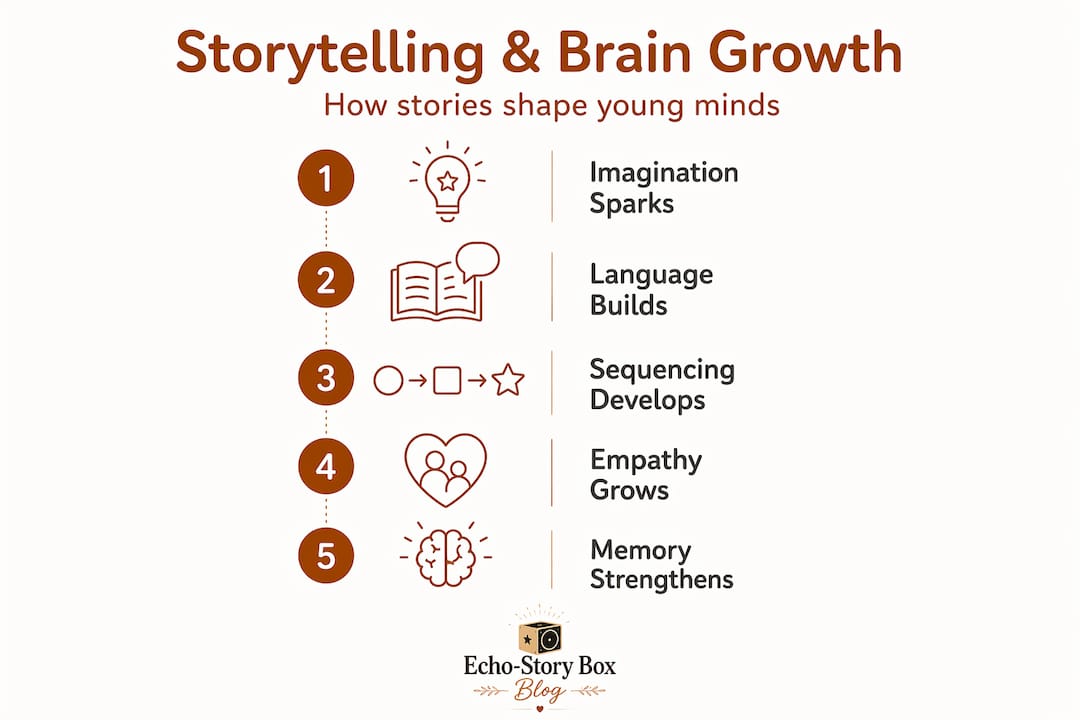
When a child becomes emotionally invested in a character, they practice what psychologists call "theory of mind." This is the ability to understand that other people have thoughts, feelings, and perspectives different from their own. Research from Ohio State University shows that language and theory of mind develop from distinct brain regions, and storytelling exercises both simultaneously. A child who regularly engages with rich narratives gets a workout in both areas at the same time.
The hormone oxytocin plays a direct role here. Emotionally charged stories trigger oxytocin release, which increases feelings of connection and trust. One study found that exposure to emotionally engaging stories produced a 261% increase in generosity in participants immediately afterward. For children, this means stories are not just teaching empathy in theory. They are producing measurable changes in how children behave toward others.
Cultural storytelling adds another layer. When children hear stories from different traditions and backgrounds, they build what researchers call cognitive empathy: the ability to understand perspectives shaped by experiences very different from their own. This is one reason diverse story libraries matter, not just for representation, but for genuine brain development.
"Stories are how we learn to be human. They teach children not just what the world is, but how to feel about it."
Stories also shape identity. The narratives children hear about their own family, community, and culture become part of how they understand themselves. This is why audio stories at bedtime carry such weight. The calm, repeated ritual of hearing a story from a trusted voice creates emotional security alongside cognitive growth.
How parents and educators can use storytelling effectively
Knowing that storytelling builds brains is one thing. Knowing how to do it well is another. The good news is that you do not need to be a professional storyteller. You just need a few simple habits.
Here are practical ways to make storytelling more effective for children's brain development:
- Ask predictive questions during the story. Pause and say, "What do you think will happen next?" This activates the prefrontal cortex and builds inference skills.
- Use story mapping after the story. Draw a simple arc together: beginning, problem, solution, ending. This reinforces sequential thinking and helps children internalize narrative structure.
- Alternate between oral storytelling and reading. Oral stories demand more imagination. Reading together builds different skills, including print awareness and shared attention. Both matter.
- Adapt stories to your child's developmental stage. Younger children need simpler arcs and familiar characters. Older children can handle moral complexity, multiple perspectives, and open-ended endings.
- Include your child in the story. Let them name a character, choose a setting, or decide what happens next. Participation deepens engagement and makes the story personally meaningful.
- Use stories to process real experiences. If a child is nervous about starting school, tell a story about a character who feels the same way. Narrative frameworks reduce emotional load and help children find language for their feelings.
For educators, creative storytelling builds critical thinking across subjects. History becomes memorable when it is told as a story with real people making difficult choices. Math concepts stick when they are wrapped in a problem a character needs to solve. Narrative learning frameworks have been shown to raise classroom engagement by over 60% in educational settings, with a 57% improvement in learning efficiency.
Pro Tip: You do not need a special occasion to tell a story. A five-minute story during a car ride, at the dinner table, or before bed is enough to make a real difference in your child's brain development over time.
Storytelling versus traditional fact-based learning
There is a reason children remember the story of the tortoise and the hare but forget what they read in a textbook last week. The brain is built for narrative, not for isolated facts.
Neuroscience is clear on this point. The brain retains stories up to 22 times more efficiently than it retains disconnected facts. That is not a small difference. It is the difference between a lesson that lasts a lifetime and one that disappears by Friday. Stories work because they engage emotional memory, sensory processing, and social cognition all at once. Facts, delivered without context or emotion, activate only the language centers.
There is also the question of cognitive load. When information is delivered as a list of facts, children must work hard to organize it, find meaning in it, and connect it to what they already know. Stories do that organizing work for them. The narrative structure carries the meaning, which frees up mental energy for deeper understanding. This is why stories teach better than lectures for children at almost every age.
The motivational difference matters too. Children choose to engage with stories. They ask for them again. They think about them after they are over. That level of voluntary engagement simply does not happen with a worksheet.
My take on storytelling and the modern child
I have spent years watching families navigate the tension between screens and simpler forms of connection. What I keep coming back to is this: storytelling is not a nostalgic preference. It is brain architecture in action.
Every time a child listens to a story told by a human voice, their brain is being shaped in ways that no app or video can fully replicate. The neural coupling, the oxytocin release, the active imagination required when there are no pictures to look at. These are not small effects. They are foundational.
What concerns me most is how quietly storytelling traditions are disappearing. Not because families do not care, but because screens are simply easier to reach for. I understand that. But the research is consistent: children who grow up in storytelling-rich environments show stronger language skills, deeper empathy, and better emotional regulation than those who do not.
My advice is simple. Start small. Tell one story today. It does not have to be perfect. It just has to be yours.
— Bob
Give your child the gift of intentional stories
If you are ready to make storytelling a real part of your family's daily life, Echostory-box was built exactly for that purpose.

Echostory-box is a screen-free audio player that lets children tap a story card and instantly hear a rich, imaginative story. No ads, no scrolling, no complicated menus. Just a child and a story. The platform supports original adventures, personalized experiences, family voice recordings, and educational content designed to align with everything the research shows about how stories affect brain development. Whether you are a parent, grandparent, or educator, Echostory-box storytelling tools make it simple to bring the proven benefits of storytelling into your home or classroom every single day. Explore the full range of story cards and bundles and find the right fit for your family.
FAQ
What is the role of storytelling in brain development?
Storytelling activates multiple brain regions simultaneously, including areas tied to emotion, memory, sensory experience, and social understanding. This broad activation builds stronger neural connections in children compared to fact-based instruction.
How does oral storytelling differ from reading picture books for brain development?
Oral storytelling requires children to build mental images on their own, which sustains higher prefrontal cortex activity. Neuroimaging research found that picture books produce decreased brain activation with repeated exposure, while oral stories maintain engagement longer.
At what age should parents start storytelling with their children?
Storytelling benefits begin from infancy, when children start recognizing rhythm, tone, and language patterns. By ages 3 to 4, children can actively engage with narrative structure, prediction, and character emotions, making this a key window for cognitive development through narratives.
Can storytelling improve a child's empathy?
Yes. Emotionally engaging stories trigger oxytocin release, which increases prosocial behavior. Research found a 261% increase in generosity after exposure to emotionally charged stories, showing that empathy built through narrative is measurable and real.
How many stories does a child need to hear to see cognitive benefits?
Even short, consistent storytelling sessions make a difference. A structured six-week program with 12 sessions produced significant gains in moral reasoning and empathy scores, suggesting that regular exposure matters more than the length of any single session.