
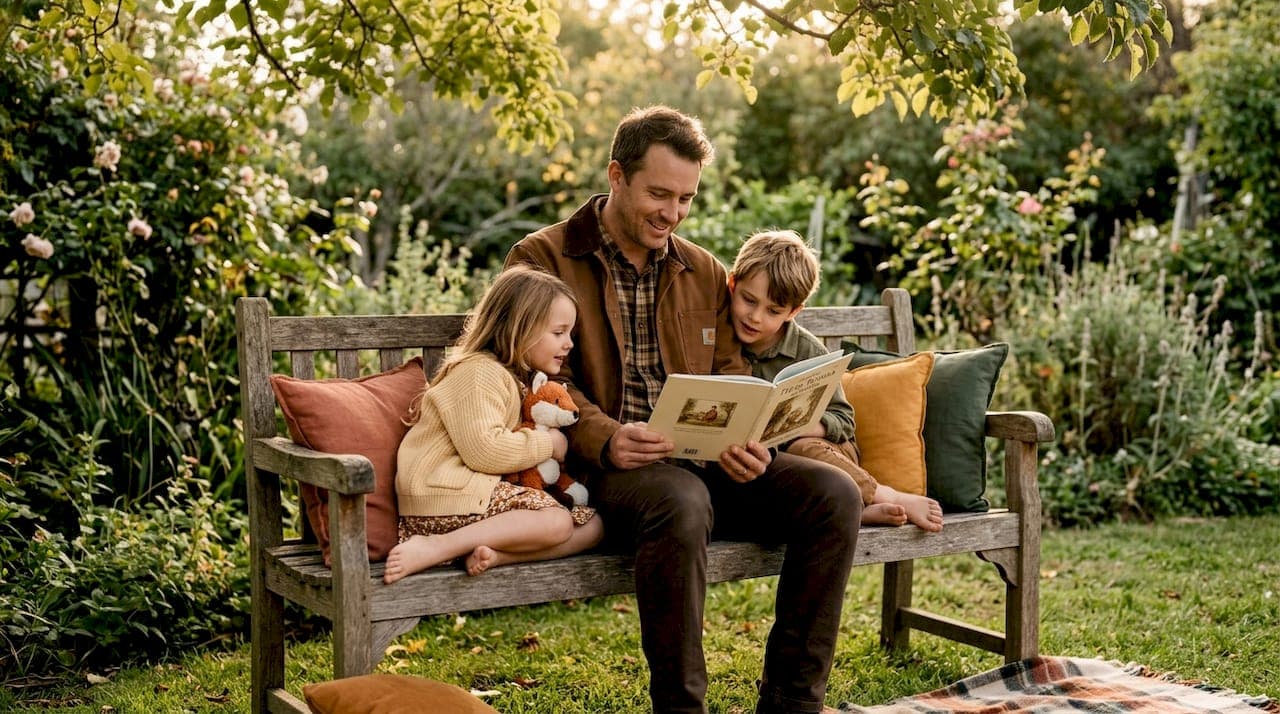
Most parents already sense it: a bedtime story holds a child's attention far better than any explanation ever could. But why stories teach better than lectures goes much deeper than keeping kids entertained. Research shows that narrative presentations are remembered 20 to 30% better than disconnected facts. For parents of children aged 4 to 10 who want screen-free ways to spark real learning, storytelling is not just a nice tradition. It is one of the most powerful teaching tools you already have.
Table of Contents
- Why stories outperform lectures for children's learning
- How storytelling's structure boosts young children's memory and attention
- Why storytelling strengthens family bonds and sustained attention
- How to harness storytelling to teach your child effectively at home
- Rethinking teaching: why stories should be the heart of your child's learning
- Get started with screen-free storytelling at home
- Frequently asked questions
Key Takeaways
| Point | Details |
|---|---|
| Stories boost memory | Children remember information presented as stories about 20–30% better than lectures or disconnected facts. |
| Active engagement matters | Asking questions and sharing attention during storytelling significantly improves learning outcomes. |
| Story structure aids recall | Clear event boundaries in stories create meaningful memory anchor points that help children encode and retrieve information. |
| Storytelling builds connection | Telling stories promotes family bonding, sustained attention, and imagination without screens. |
| Use stories then explain | Starting with stories to create context helps children better understand and apply concepts later. |
Why stories outperform lectures for children's learning
Science has a clear answer for why storytelling works so well. When a child hears a story, their brain does not just passively receive words. It lights up across multiple regions at once. Stories recruit multiple cognitive systems simultaneously, including meaning-making, emotional connection, visualization, and logical reasoning. A lecture, by contrast, mostly activates the language processing centers. That is a much smaller portion of the brain doing the work.
Think of it this way. A lecture says, "Bees pollinate flowers." A story puts your child inside a garden with a curious bee named Buzz who is trying to find his way home. Suddenly your child is feeling the urgency, picturing the flowers, and rooting for Buzz to succeed. The lesson about pollination arrives wrapped in emotion and context. It sticks.
Here is what makes stories neurologically superior to lectures for young children:
- Multiple memory pathways. Stories engage emotional, spatial, social, and logical brain areas at the same time, creating several routes back to the same memory.
- Cause and effect structure. Stories naturally organize information into "this happened, so that happened" sequences, which are far easier for young minds to follow and recall than isolated facts.
- Emotional anchoring. Feelings act as memory markers. When a child cares about a character, they remember what happens to that character.
- Reduced cognitive load. A story's narrative arc does the organizing work for the child, freeing up mental energy for understanding rather than just keeping track of information.
Lectures depend heavily on passive verbal memory, which is one of the weakest memory systems in children under 10. Stories bypass that weakness entirely. Explore more screen-free storytelling insights to see how this plays out in everyday family life.
How storytelling's structure boosts young children's memory and attention
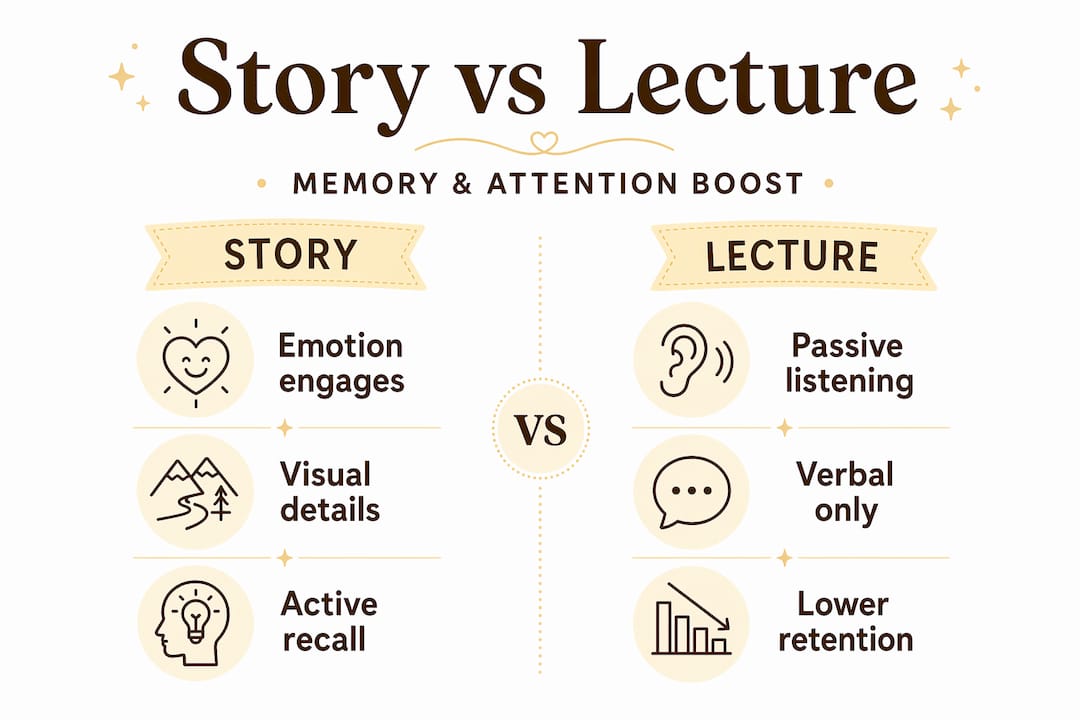
Now that we understand stories' overall advantage, let's uncover how their structure and interaction style make storytelling especially effective for young children.
One of the most important discoveries in recent learning research involves what scientists call event boundaries. These are the natural transition points in a story, like when a scene changes, a new character appears, or a problem shifts. Event boundaries in stories act as cognitive anchor points that improve memory formation in children. Each boundary gives the brain a moment to consolidate what just happened before moving forward. A well-told story is essentially a series of natural memory checkpoints.
But structure alone is not enough. How you tell the story matters just as much. Face-to-face storytelling with active scaffolding leads to higher learning outcomes and stronger neural synchrony than passive listening or remote learning. Neural synchrony means the adult's and child's brains begin to align, which is a remarkable thing. It is part of why reading together or telling a story in person feels so connecting.
Here is how structure and interaction combine to boost learning:
| Story element | Why it helps learning |
|---|---|
| Clear scene changes | Create memory anchor points for easier recall |
| Character goals and obstacles | Build cause-effect understanding |
| Active questions ("What do you think happens next?") | Increase engagement and prediction skills |
| Face-to-face telling | Promotes brain synchrony and emotional connection |
| Repetition of key ideas within the story | Reinforces concepts without feeling like drilling |
Pro Tip: Ask your child one simple question before the story begins, like "I wonder what problem this character will face today." This primes their brain to listen actively rather than passively. It takes five seconds and meaningfully improves how much they absorb.
Passive listening, like watching a video or sitting through a lecture, loses most of these benefits. The interaction is not a bonus. It is a core part of how the learning actually happens. You can find more storytelling scaffolding techniques to use with children at different ages.
Why storytelling strengthens family bonds and sustained attention
Beyond memory and brain benefits, storytelling offers emotional and relational gains parents will value just as much.
When you tell your child a story without a screen involved, something simple and important happens. They have to build the pictures in their own mind. That mental work is not a burden. It is exercise for imagination. It also means their attention has to stay engaged in a way that a flashing screen never requires.
Storytelling promotes bonding, memory skills, and attention in children without screens or visual distractions. That combination is rare. Most learning activities strengthen one or two of those areas. Storytelling develops all three at the same time, and it does so in a calm, low-pressure environment.
"Stories invite shared dialogue and active prediction, unlike lectures that encourage passive reception." — The magic of storytelling
That shared dialogue is where the family connection lives. When your child guesses what happens next, argues that the dragon should be friendly, or asks why the princess made that choice, they are not just learning. They are thinking alongside you. Those moments build trust and closeness in ways that a lecture or a screen simply cannot replicate.
Here is what regular storytelling time gives your child beyond academic learning:
- Sustained attention. Stories train children to follow a thread of meaning over time, which directly supports focus in school and daily life.
- Richer vocabulary. Children absorb new words naturally through story context rather than memorizing definitions.
- Emotional intelligence. Following characters through challenges builds empathy and emotional understanding.
- A sense of safety. Predictable story rhythms and familiar storytelling routines create calm, especially at bedtime.
Discover more about family storytelling benefits and how to build these moments into your daily routine.
How to harness storytelling to teach your child effectively at home
To fully benefit from storytelling's powers, here are practical steps parents can follow to teach and connect with children effectively at home.
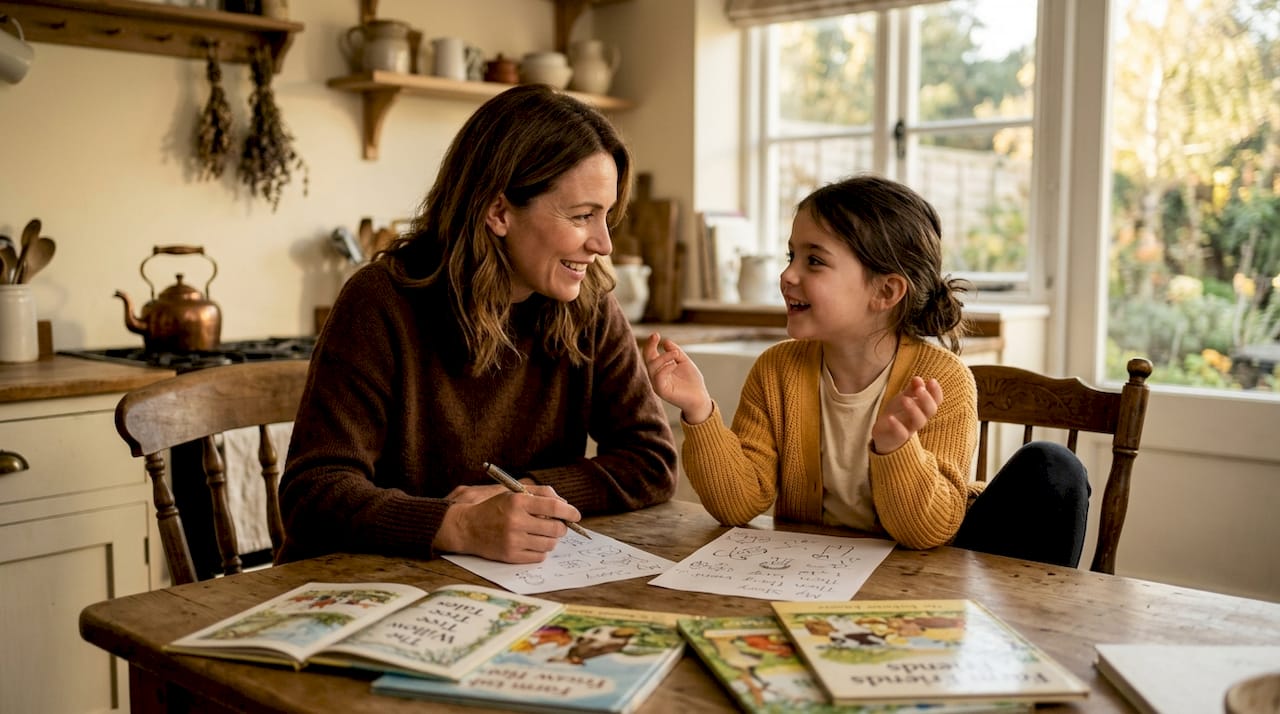
Turning adults into coaches by asking questions during storytelling maintains child engagement and improves learning. You do not need to be a professional storyteller. You just need a few simple habits.
- Ask brief, frequent questions. Pause at natural story moments and ask, "What do you think she'll do?" or "Why do you think that happened?" Keep questions short and open-ended.
- Choose stories with clear event boundaries. Look for stories where scenes shift, goals change, or problems resolve in stages. These natural checkpoints help your child's brain organize and store what they hear.
- Make eye contact and use gestures. Look at your child when you tell a story. Use your hands. Change your voice for different characters. These physical cues signal that this moment matters and keep attention focused.
- Follow the story with a short conversation. A practical approach is to open with stories then follow with explanations for concepts, helping children connect context with reasoning. Two or three simple questions after the story is enough.
- Keep stories appropriately short. For ages 4 to 6, aim for 5 to 10 minutes. For ages 7 to 10, 10 to 20 minutes works well. Shorter and focused beats long and wandering every time.
Pro Tip: You do not need a book. Some of the most effective storytelling happens when you make up a story together. Start with "Once there was a child who could talk to animals," then hand it to your child. Let them add the next part. This builds language skills, creativity, and confidence all at once.
Here is a quick comparison of storytelling versus lecture-style teaching at home:
| Approach | Child engagement | Memory retention | Family connection |
|---|---|---|---|
| Interactive storytelling | High | High (20-30% better recall) | Strong |
| Passive lecture or explanation | Low to medium | Low | Minimal |
| Screen-based video | Medium | Variable | Low |
| Story followed by discussion | Very high | Highest | Very strong |
The pattern is clear. The more interactive and story-centered the experience, the better the outcome across every measure that matters to parents. Find more storytelling coaching tips to put these ideas into practice right away.
Rethinking teaching: why stories should be the heart of your child's learning
Here is something most parenting advice gets wrong. Storytelling is treated as a supplement, a fun add-on after the real teaching is done. But learning through storytelling is an active, human-centered process that integrates emotion, context, and interaction rather than passive data transfer. That is not a description of a supplement. That is a description of how human beings are wired to learn.
Conventional wisdom still leans toward direct instruction. Sit down, listen, here are the facts. That model made sense when the goal was filling children with information. But the children who thrive are the ones who know how to make meaning, not just receive it. Stories teach meaning-making. Lectures teach reception.
We are also living through a moment when children's attention is being pulled in dozens of directions at once. Screens are designed to capture attention through novelty and stimulation. Storytelling builds attention through something different: genuine interest in what happens next. That is a much healthier form of focus, and it transfers to reading, school, and relationships in ways that screen time simply does not.
When you become a storytelling coach rather than a lecturer, something shifts in your relationship with your child too. You are no longer delivering information to them. You are thinking alongside them, building something together. That shared meaning-making is where the deepest lessons live, the ones about courage, kindness, curiosity, and what it means to be part of a family. You can explore more about interactive storytelling and how it reshapes learning at home.
Get started with screen-free storytelling at home
You now have a clear picture of why storytelling works and how to use it well. The next step is making it a consistent, easy part of your family's day.

Echo-Story Box was built for exactly this. It is a simple, screen-free audio player that lets children tap a story card and hear a story begin. No menus, no ads, no scrolling. Just a story. The Echo-Story screen-free storytelling experience is designed to support the coaching techniques shown to boost learning, with stories built around clear event boundaries, meaningful characters, and values-driven adventures. Whether you want ready-made stories, personalized experiences with your child's name, or a way to record your own voice for them to keep, Echo-Story Box makes it simple to build a storytelling habit your family will return to for years.
Frequently asked questions
Why do children remember stories better than lectures?
Children remember stories better because stories engage multiple brain systems including emotion, visualization, and reasoning, creating richer memory connections than lectures. Narrative presentations are remembered about 20 to 30% better than facts or lectures.
How can I make storytelling more effective for my child's learning?
Make storytelling interactive by asking your child questions during the story and use clear event boundaries to help them follow and remember the narrative. Active scaffolding like asking predictions improves learning more than passive listening.
Can storytelling at home really promote attention without screens?
Yes. Storytelling naturally engages children's attention and imagination by encouraging them to visualize and discuss stories, which sustains focus better than passive screen viewing. Storytelling promotes long sustained attention and imagination without distracting stimuli.
Is it better to only tell stories or to explain concepts after?
Start with stories to build context and engagement, then explain concepts afterward to deepen understanding, as stories provide meaningful relevance that supports learning. Storytelling opens the door; explanation follows for deeper understanding.
What age is storytelling most beneficial for teaching?
Storytelling is particularly effective for children ages 4 to 10, supporting their developing memory, attention, and imagination during these key learning years.