
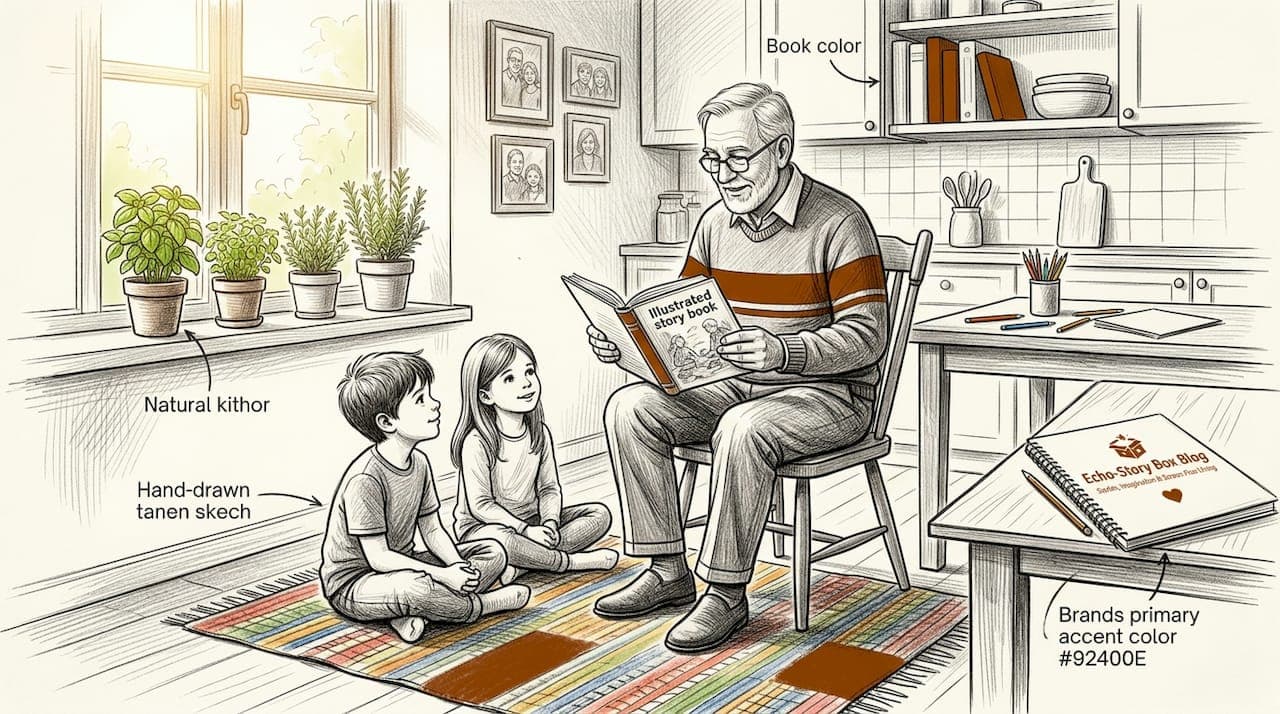
Most people think of storytelling as entertainment. A bedtime ritual. A way to keep kids quiet for a few minutes. But understanding how creative storytelling develops critical thinking changes that picture entirely. Stories are not just enjoyable. They are one of the most powerful cognitive tools children have. When a child follows a character through a problem, weighs a moral choice, or wonders what happens next, their brain is doing serious work. This article walks you through the science, the research, and the practical strategies you can use at home or in the classroom to make storytelling work harder for the children in your life.
Table of Contents
- Key Takeaways
- How creative storytelling develops critical thinking in the brain
- What the research says about storytelling and critical thinking
- Practical techniques for developing critical thinking through stories
- Storytelling builds more than just critical thinking
- My take on why we underestimate storythinking
- Bring storytelling to life with Echostory-box
- FAQ
Key Takeaways
| Point | Details |
|---|---|
| Stories activate the whole brain | Storytelling engages both emotional and reasoning centers simultaneously, building integrated thinking skills. |
| Research backs the benefits | Studies show creative storytelling interventions can raise critical thinking scores by as much as 25%. |
| Practical methods matter | Asking reflective questions and encouraging alternative endings turns passive listening into active thinking. |
| Benefits go beyond thinking | Storytelling also builds empathy, communication, and the creative flexibility children need for the future. |
| Screen-free listening deepens focus | Calm, distraction-free story experiences help children slow down and engage more deeply with narratives. |
How creative storytelling develops critical thinking in the brain
Most people picture critical thinking as a logic exercise. A worksheet. A debate. But the brain does not separate emotion from reasoning the way we might expect. Storytelling activates both the limbic system, which handles emotion and memory, and the frontal cortex, which manages reasoning and judgment. Both fire at the same time during a good story. That combination is exactly what critical thinking requires.
This is not accidental. Researchers describe a process called "neural coupling," where a listener's brain begins to mirror the patterns of the storyteller's brain. The child is not just hearing a story. They are mentally simulating it. They are living inside the problem alongside the character. That mental simulation builds empathy and perspective-taking, two skills that sit at the heart of critical thinking in education.
There is also a concept worth knowing called storythinking. Storythinking evolved as a survival mechanism, a way for humans to mentally rehearse scenarios and hatch escape plans before danger arrived. It is not a soft skill. It is a core cognitive process that promotes resilience and adaptive reasoning. When children engage with stories that have genuine tension, unexpected turns, or ambiguous outcomes, they are exercising that ancient mental muscle.
Here is what separates passive story consumption from active narrative literacy:
- Passive consumption means hearing a story and accepting it at face value, no questions asked.
- Active narrative literacy means noticing character motivations, questioning the fairness of outcomes, and imagining how things could have gone differently.
- The goal for parents and educators is to move children from the first mode to the second through guided conversation and intentional story choices.
Pro Tip: Choose stories with morally complex characters rather than clear heroes and villains. When a child cannot easily decide who was right, they are already thinking critically.
What the research says about storytelling and critical thinking
The evidence for creative storytelling benefits is growing, and it is specific enough to be genuinely useful.
One study involving 300 secondary students found that a 12-week storytelling intervention produced a 25% increase in critical thinking scores among participants. The control group, which received standard instruction, improved by only 5%. That gap is meaningful. It suggests that storytelling is not just a nice supplement to learning. It is a direct driver of cognitive development when used with intention.
The benefits show up in younger children too. A six-week program with 60 rural children aged 10 to 12 demonstrated that structured storytelling improves moral reasoning, specifically in areas like honesty and fairness. These are not abstract virtues. They require children to weigh competing interests, consider consequences, and evaluate what is right when the answer is not obvious. That is critical thinking applied to real life.
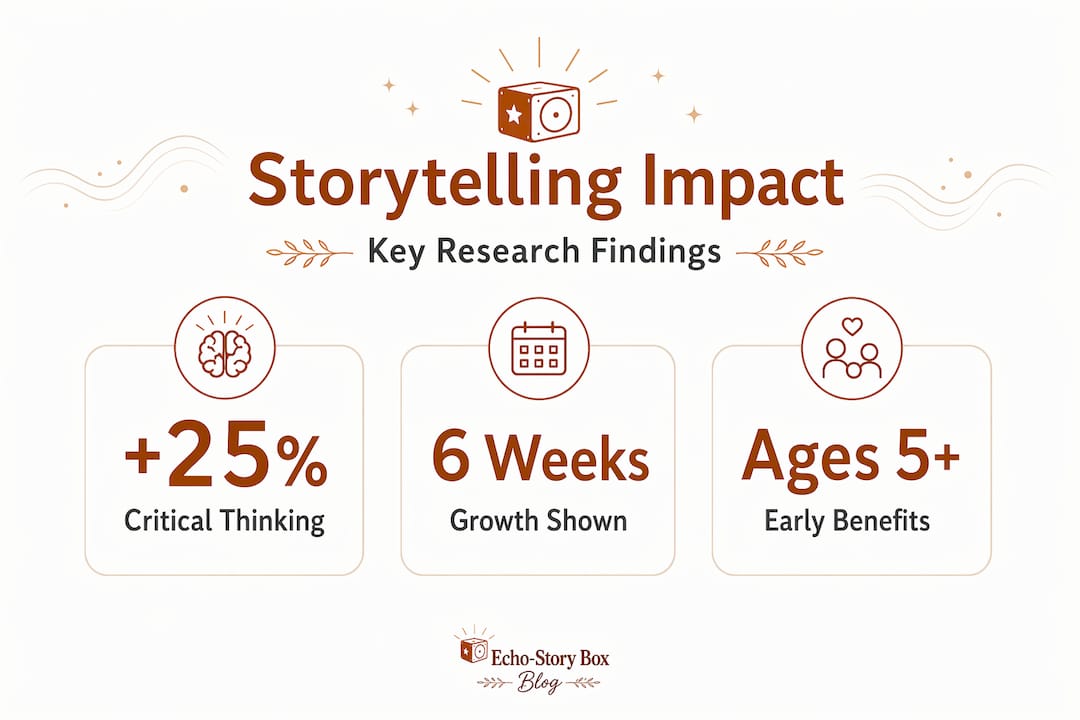
Even preschoolers benefit. Research on fairy tale therapy shows that reflection on character motivations develops metacognitive skills in children as young as five. Metacognition, the ability to think about your own thinking, is one of the highest-order skills we can nurture in early childhood.
Here is a quick summary of what the research shows across age groups:
| Age Group | Storytelling Approach | Outcome |
|---|---|---|
| Ages 5 to 7 | Fairy tale therapy with reflective discussion | Improved metacognitive awareness |
| Ages 10 to 12 | Six-week structured storytelling program | Higher scores in moral reasoning |
| High school | 12-week creative writing and storytelling | 25% increase in critical thinking scores |
One more finding worth noting: stories with illogical or unpredictable elements require more cognitive effort than predictable ones. When a child encounters a story that surprises them or does not follow the expected rules, their brain works harder to make sense of it. That extra effort builds mental flexibility, which is a core component of critical thinking.
Practical techniques for developing critical thinking through stories
Knowing the science is one thing. Putting it to work in your living room or classroom is another. Here are concrete methods you can start using today.
-
Ask "why" and "what if" questions during and after stories. Instead of asking "Did you like that story?", try "Why do you think the character made that choice?" or "What would have happened if they had chosen differently?" These questions push children to analyze rather than just recall.
-
Use perspective-shifting exercises. After hearing a story, ask your child to retell it from a different character's point of view. The villain's perspective. The bystander's. This builds the kind of multi-angle thinking that defines good critical reasoning.
-
Encourage alternative endings. Invite children to create their own ending before you reveal the real one. Then compare. Discuss why each version works or does not work. This is not just creative play. It is structured practice in evaluating cause and effect.
-
Build problem-solving scenarios into stories. When telling a story yourself, pause at a key decision point and ask the child what the character should do. Let them reason through it out loud. This turns listening into active problem-solving.
-
Choose stories with tension and ambiguity. A story where the "right" answer is obvious teaches very little. A story where two good characters want opposite things, or where a kind action leads to a bad outcome, invites genuine analysis.
Pro Tip: For younger children aged 4 to 6, keep the reflective questions simple and concrete. "Was that fair?" or "How do you think she felt?" are enough to start building the habit of thinking beyond the surface of a story.
Multimodal listening experiences, ones that engage narrative, sound, and emotion together, foster deeper learning that resists rote memorization. Audio stories, especially those heard without a screen, give children space to visualize and process at their own pace. That internal visualization is itself a form of critical engagement. You can also explore how storytelling supports literacy and language development alongside thinking skills, which makes it a particularly efficient tool for families and educators working across multiple learning goals.
Storytelling builds more than just critical thinking
The creative storytelling benefits extend well beyond analysis and logic. When children engage regularly with stories, they develop a broader set of skills that will serve them for life.
- Creativity and flexible thinking. Children's creativity declines around third and fourth grade when education shifts heavily toward logic-based tasks. Storythinking interventions have been shown to reverse this trend by keeping imaginative reasoning active and valued.
- Empathy and emotional intelligence. Narrative immersion places children inside another person's experience. Over time, this builds genuine empathy, not just the ability to name emotions, but the capacity to understand why someone feels the way they do.
- Communication and collaboration. Sharing stories, whether listening together or creating them as a group, builds the ability to express ideas clearly and listen generously. These are skills no algorithm can replace.
- Resilience and adaptability. Stories model how characters face setbacks and keep going. Children who hear many such stories internalize that pattern. They learn, almost without realizing it, that problems can be worked through.
The importance of storytelling in education has never been more relevant. As AI takes on more routine cognitive tasks, the skills that remain distinctly human, creative reasoning, moral judgment, empathy, and narrative thinking, become more valuable. Education must shift toward immersive, narrative-based approaches that develop these capacities. Stories are not a break from serious learning. They are serious learning.
My take on why we underestimate storythinking
I have watched educators spend enormous energy on logic puzzles, structured debates, and analytical frameworks to build critical thinking in children. Those tools have their place. But in my experience, the most durable gains come from something simpler and older. A well-chosen story, followed by a genuine conversation.
What I have found is that traditional education tends to treat creativity and reasoning as separate tracks. Logic on one side, imagination on the other. But that separation is artificial. The brain does not work that way, and children do not learn that way either. When we give a child a story with real tension and then ask them to think about it, we are doing something that no worksheet replicates. We are asking them to use their whole mind.
The creativity crisis is real. Creativity declines measurably across a 30-year documented trend when schools prioritize rote learning over narrative and imaginative engagement. I think the solution is not a new curriculum. It is a return to something families have always known: sit down, tell a story, and talk about it afterward.
The families and educators who do this consistently are giving children a gift that compounds over time. Not just better test scores, but a more flexible, empathetic, and curious way of moving through the world.
— Bob
Bring storytelling to life with Echostory-box
If you are looking for a simple, calm way to put these ideas into practice, Echostory-box was built for exactly that. It is a screen-free audio storytelling player that lets children tap a story card and listen, no scrolling, no ads, no overstimulation. Just a story and a child's imagination.

Echostory-box features original adventures, personalized stories, and educational content designed to spark the kind of reflective thinking this article describes. Characters like Theo the Rabbit guide children through moments of courage, curiosity, and moral choice, the exact ingredients that build critical thinking over time. It is a gentle, intentional tool for families who want more connection and less noise. Explore screen-free storytelling for families and see how a simple tap can open a world of thinking.
FAQ
How does storytelling build critical thinking in children?
Storytelling activates both the emotional and reasoning areas of the brain at the same time, encouraging children to analyze character choices, weigh consequences, and consider multiple perspectives. These are the core habits of critical thinking.
What age is best to start storytelling for critical thinking?
Research shows benefits as early as age five, where fairy tale therapy supports metacognitive development in preschoolers. The earlier children are guided to reflect on stories, the more naturally critical thinking becomes part of how they engage with the world.
How storytelling enhances thinking compared to direct instruction?
Direct instruction typically engages one part of the brain at a time. Storytelling triggers emotional, social, and logical processing together, which leads to deeper comprehension and more flexible reasoning than rote learning approaches.
What kinds of stories work best for developing critical thinking?
Stories with unexpected twists, morally complex characters, or ambiguous outcomes require more cognitive effort and build greater mental flexibility than straightforward narratives with obvious lessons.
Can parents use storytelling at home to develop critical thinking skills?
Absolutely. Simple practices like asking "why" questions after a story, encouraging alternative endings, and discussing a character's choices are enough to turn everyday story time into a meaningful thinking exercise.