

Storytelling is defined as one of the most direct tools for emotional regulation, giving children and adults a structured way to process feelings, reduce distress, and build lasting self-control. The role of storytelling in emotional regulation goes far beyond entertainment. When a child narrates a scary experience through a bedtime story, or a parent reads aloud from a picture book and pauses to ask "How do you think she feels?", something real happens in the brain and body. Research from Frontiers in Public Health, Talkspace, and Verywell Mind confirms that narrative participation changes both psychology and physiology. This guide explains exactly how it works and what you can do about it today.
How does storytelling regulate emotions?
Storytelling regulates emotions through three overlapping processes: externalization, physiological change, and narrative structure. Each one plays a distinct role, and together they make storytelling one of the most accessible mental health tools a family can use.
Externalization is a concept from narrative therapy, developed by therapists Michael White and David Epston. It means treating a problem or emotion as something separate from the person. When a child says "the angry feeling came back today," instead of "I am angry," they gain psychological distance. That distance makes the emotion easier to examine and manage. Externalization in narrative therapy helps clients separate identity from emotional distress, which reduces the feeling of being overwhelmed.

Storytelling also produces measurable physical changes. A single storytelling session increased oxytocin and decreased cortisol in hospitalized children. Oxytocin supports bonding and calm, while lower cortisol means a reduced stress response. That is not a small effect. It means a story read at bedtime is doing biological work, not just passing time.
The third mechanism is what researchers call narrative-affect discrepancy. This describes how people regulate emotional expression intensity by adjusting the pacing and structure of a story rather than its emotional content alone. A parent who slows down during a tense part of a story, or skips ahead to the resolution, is instinctively using this tool. Children learn to do the same when they retell their own experiences.
"Stories give feelings a shape. Once a feeling has a shape, it becomes something a child can hold, examine, and set down."
Structured storytelling with clear beginnings, middles, and ritual closings provides emotional containment. Predictable story arcs reduce the anxiety that comes from emotional "messiness." Children feel safer exploring hard feelings when they know the story will end in a familiar, calm place.
How does storytelling support children's emotional development?
Children develop emotional skills through narrative long before they can name what they feel. The connection between story and emotion is not abstract. It shows up in measurable developmental outcomes.
Shared reading and picture book interventions improve sustained attention, working memory, and inhibitory control in preschool children. These are the same cognitive skills that underpin emotional regulation. A child who can hold attention and pause before reacting is a child who can manage frustration without a meltdown.
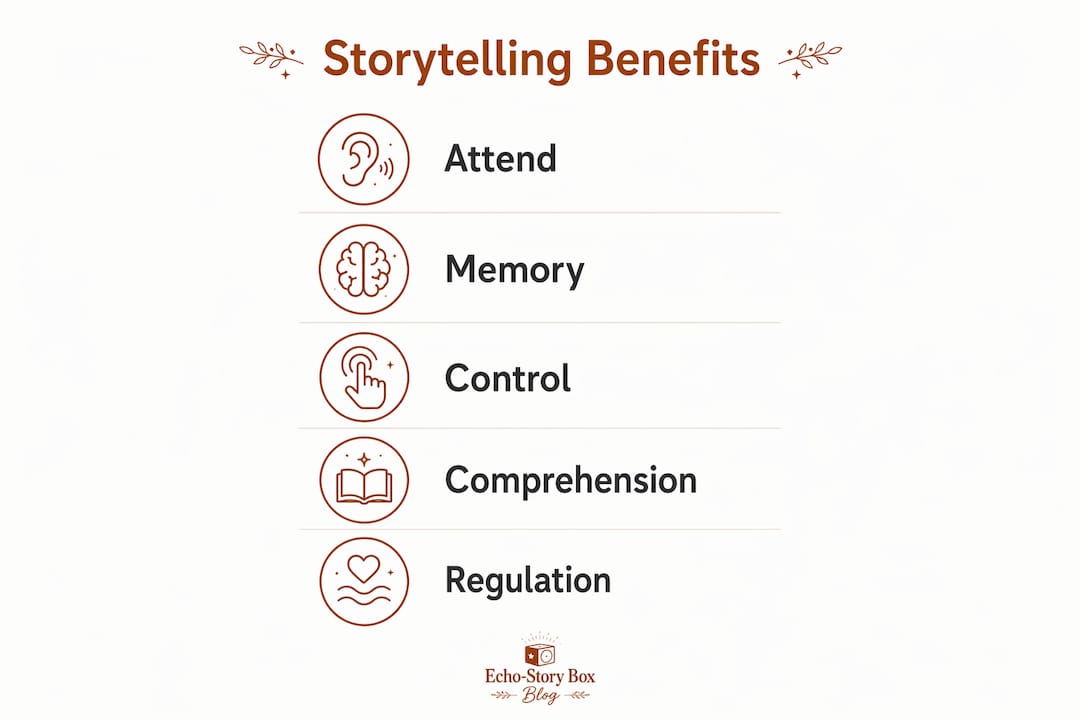
Research also shows that a child's ability to produce their own narratives relates more to emotion comprehension than to vocabulary size alone. This finding matters for parents. Encouraging your child to tell you what happened at school, or to make up a story about a toy, builds emotional intelligence more directly than drilling vocabulary words.
The way parents respond during storytelling also shapes outcomes. Here is a simple breakdown of how different parenting responses during story conversations affect children over time:
| Parent Response Style | Effect on Child Emotion Regulation |
|---|---|
| Positive evaluation of child's input | Predicts stronger regulatory ability over time |
| Elaborative reminiscing (adding detail) | Builds richer emotional vocabulary and memory |
| Dismissive or corrective responses | Reduces child's willingness to share feelings |
| Open-ended questions about feelings | Supports reflective thinking and empathy |
Positive parental responses during story conversations forecast improved regulatory abilities in children. This means the way you react when your child shares a story matters as much as the story itself.
Social-emotional learning programs in schools, including those used in Montessori and Waldorf settings, rely heavily on storytelling to teach children how to recognize and name emotions in others. The same principle applies at home. When you read a picture book and ask "Why do you think the rabbit felt scared?", you are doing social-emotional learning without a curriculum.
Pro Tip: After reading a story, ask your child one feeling question before any plot question. "How do you think the character felt when that happened?" builds emotional comprehension faster than "What happened next?"
Narrative therapy vs. traditional approaches: what works better?
Narrative therapy and cognitive-behavioral therapy (CBT) are the two most widely used talk-based approaches for emotional regulation. They share some goals but differ significantly in method and philosophy.
CBT focuses on identifying and changing distorted thought patterns. It is structured, goal-oriented, and widely supported by clinical research for conditions including anxiety and depression. Narrative therapy takes a different path. It does not treat the person as the problem. Instead, it treats the story the person tells about themselves as the starting point for change.
Narrative therapy externalizes problems, helping clients re-author their life stories to regain agency. A person who says "I am a failure" is invited to examine that story, find exceptions to it, and write a new version. This process builds meaning and personal strength rather than correcting deficits.
Narrative therapy is as effective as CBT for depression and PTSD, according to clinical comparisons. Some clients prefer it because it does not feel like diagnosis. It feels like collaboration. The therapist and client work together as co-authors of a new story.
Key differences between the two approaches:
- CBT identifies cognitive distortions and replaces them with more accurate thoughts.
- Narrative therapy separates the person from the problem and builds alternative life stories.
- CBT is typically more structured and time-limited.
- Narrative therapy is more open-ended and client-led.
- Both approaches support emotional regulation, but narrative therapy is especially useful for identity-based distress and trauma.
For families, narrative therapy principles translate directly into everyday practice. When a child says "I always mess up," a parent trained in narrative thinking responds with "Tell me about a time when you got something right." That single reframe is narrative therapy in action.
You can also explore therapeutic storytelling for adults as a way to apply these same principles to your own emotional healing outside of a clinical setting.
What are practical ways to use storytelling for emotional regulation at home?
Parents do not need a therapy degree to use storytelling as an emotional regulation tool. The strategies below are grounded in research and designed for real family life.
Use structured story rituals. A consistent bedtime story routine with a clear beginning and a calm ending gives children a predictable emotional container. The ritual itself signals safety. Bedtime stories reduce child anxiety by creating a reliable transition from the stimulation of the day to the calm of sleep.
Ask predictive and reflective questions. Interactive scaffolding during storytelling engages the prefrontal cortex, the part of the brain responsible for emotional control. Prompting children to predict what a character will do next, or to reflect on how a character feels, activates regulatory brain function. This goes well beyond passive listening.
Validate your child's emotional contributions. When your child says "I think the bear was sad because nobody played with him," respond with warmth and curiosity. Do not correct or redirect. Positive evaluation of a child's input during parent-child story conversations predicts better emotion regulation over time.
Use social stories for tricky emotions. Social stories are short, simple narratives that walk a child through a specific emotional situation. They are widely used in speech therapy and special education, but any parent can write one. A story about a child who feels nervous on the first day of school, and finds a way through it, gives your child a script for their own experience.
Tell family stories. Sharing real memories, including hard ones, teaches children that difficult feelings are survivable. How family life stories become teachable moments is well documented in developmental research. Children who hear family stories about overcoming challenges show greater resilience and emotional flexibility.
Pro Tip: Keep a "feelings story jar" in your home. Write simple emotional scenarios on slips of paper, draw one each evening, and take turns telling a short story about it. This builds emotional vocabulary in a low-pressure, playful way.
Key takeaways
Storytelling is the most accessible emotional regulation tool families have, because it works on the brain, the body, and the relationship at the same time.
| Point | Details |
|---|---|
| Physiological impact | A single storytelling session raises oxytocin and lowers cortisol, reducing stress in children. |
| Externalization builds control | Treating emotions as separate from identity gives children and adults more agency over their feelings. |
| Parent response shapes outcomes | Positive, warm reactions during story conversations predict stronger emotion regulation in children over time. |
| Narrative therapy vs. CBT | Both are effective for depression and PTSD, but narrative therapy focuses on re-authoring identity rather than correcting thought patterns. |
| Daily rituals compound benefits | Consistent storytelling routines with clear structure provide emotional containment and reduce anxiety. |
Why i think we underestimate what stories actually do
Most parents think of bedtime stories as a wind-down routine. A nice thing to do. I used to think the same way. What changed my view was looking at the research on what happens inside a child during a story, not after it.
The prefrontal cortex, the part of the brain that manages impulse control and emotional response, is actively engaged when a child is asked to predict what a character will do next. That is not passive entertainment. That is a workout for the regulatory brain. And it happens in the living room, on the couch, with a picture book.
What I find most compelling is the parent-child dynamic during storytelling. The way you respond when your child says something emotionally insightful during a story shapes how they regulate feelings for years. A dismissive "just listen to the story" closes a door. A curious "that's interesting, why do you think she felt that way?" opens one.
Storytelling also does something no worksheet or feelings chart can do. It gives a child a character to project onto. When a child says "the rabbit was scared," they are often saying "I was scared." The story creates safe distance. That distance is not avoidance. It is the beginning of processing.
The ritual matters too. A story told at the same time, in the same chair, with the same opening phrase, tells a child's nervous system that this is a safe place. Calm is not just a feeling. It is a learned response to a familiar context. Storytelling builds that context, one evening at a time.
— Bob
Bring calm and connection into your home with Echostory-box
Stories do more than entertain. They teach children how to feel, how to think, and how to recover. Echostory-box is built around exactly that idea.

Echostory-box is a screen-free audio storytelling player designed for families with children ages 4–10. Children tap a story card onto the box and a story begins. No scrolling, no ads, no notifications. Just a calm, focused listening experience that supports imagination and emotional well-being. Original adventures, personalized stories, family voice recordings, and faith-based content are all available. If you are looking for a simple, meaningful way to bring the emotional benefits of storytelling into your daily routine, Echostory-box is built for your family.
FAQ
What is the role of storytelling in emotional regulation?
Storytelling helps individuals process and manage emotions by externalizing feelings, creating psychological distance from distress, and providing a structured narrative container. Research shows it also produces physiological changes, including lower cortisol and higher oxytocin, that directly support calm and self-control.
Can stories improve emotional control in young children?
Yes. Shared reading and picture book interventions improve sustained attention, working memory, and inhibitory control in preschool children, all of which are core components of emotional regulation. Interactive storytelling that prompts children to predict and reflect on feelings also activates the prefrontal cortex.
What are the benefits of narrative therapy for mental health?
Narrative therapy externalizes problems, helping clients separate their identity from their emotional distress and re-author their life stories. Clinical research shows it is as effective as CBT for depression and PTSD, with a focus on personal strengths rather than pathology.
How does a parent's storytelling style affect their child's emotions?
Positive parental responses during story conversations, such as warmly validating a child's emotional observations, predict stronger emotion regulation in children over time. Dismissive or corrective responses reduce a child's willingness to share feelings and slow emotional development.
How does bedtime storytelling reduce anxiety in children?
Structured bedtime story routines with clear, predictable arcs provide emotional containment and signal safety to a child's nervous system. The ritual itself reduces anxiety by creating a reliable, calm transition from the stimulation of the day to rest.