

A screen-free bedtime routine for kids typically lasts an hour for children ages 6–10, and longer for preschoolers ages 3–5. Start the wind-down before your child gets overtired, swap screens for a tactile audio story, and finish with a short connection ritual. Most families see real improvement within two weeks.
Tonight's one-night plan:
- Give a 10-minute heads-up before screens go off.
- Move devices to a charging station outside the bedroom.
- Run through hygiene tasks together (10–15 minutes).
- Offer one calm activity: a puzzle, drawing, or audio story (25–35 minutes).
- Close with a connection ritual: one highlight from the day, then lights down.
Expect some pushback the first few nights. That's normal. The goal tonight is simply to complete the sequence, not to do it perfectly. Routines that become rituals tend to become self-sustaining within about two weeks once children internalize what happens at that time each evening.
Pediatric guidance note: The American Academy of Pediatrics and Mayo Clinic both recommend no screens at least one hour before bed for school-age children, and 90 minutes for children ages 2–5.
Table of Contents
- Why does a screen-free audio routine actually help kids sleep?
- How do you build a step-by-step screen-free bedtime sequence?
- How do you introduce the change without meltdowns?
- What should you look for in a bedtime audio player?
- How do you personalize audio stories for your child?
- What are the most common mistakes when switching to a screen-free routine?
- Key Takeaways
- Why rituals matter more than rules at bedtime
- Echostory-box: a screen-free audio player built for this exact routine
Why does a screen-free audio routine actually help kids sleep?
Screens delay sleep in two ways: blue light suppresses melatonin, and stimulating content keeps the brain in an alert state. A systematic review and meta-analysis published in JAMA Pediatrics found that bedtime device access was associated with significantly higher odds of inadequate sleep quantity and excessive daytime sleepiness in children. A separate meta-analysis of 21 cohort studies found that increased daily screen time was linked to a measurable delay in bedtime.
Audio storytelling works differently. Listening to a calm story lowers physiological arousal without the light exposure. Research from the Ulm SPATZ Health Study found that substituting book reading for screen time improved multiple domains of preschoolers' sleep health, including sleep anxiety, daytime sleepiness, and bedtime resistance. Audio stories carry similar benefits: no screen, no blue light, and a natural endpoint when the story ends.
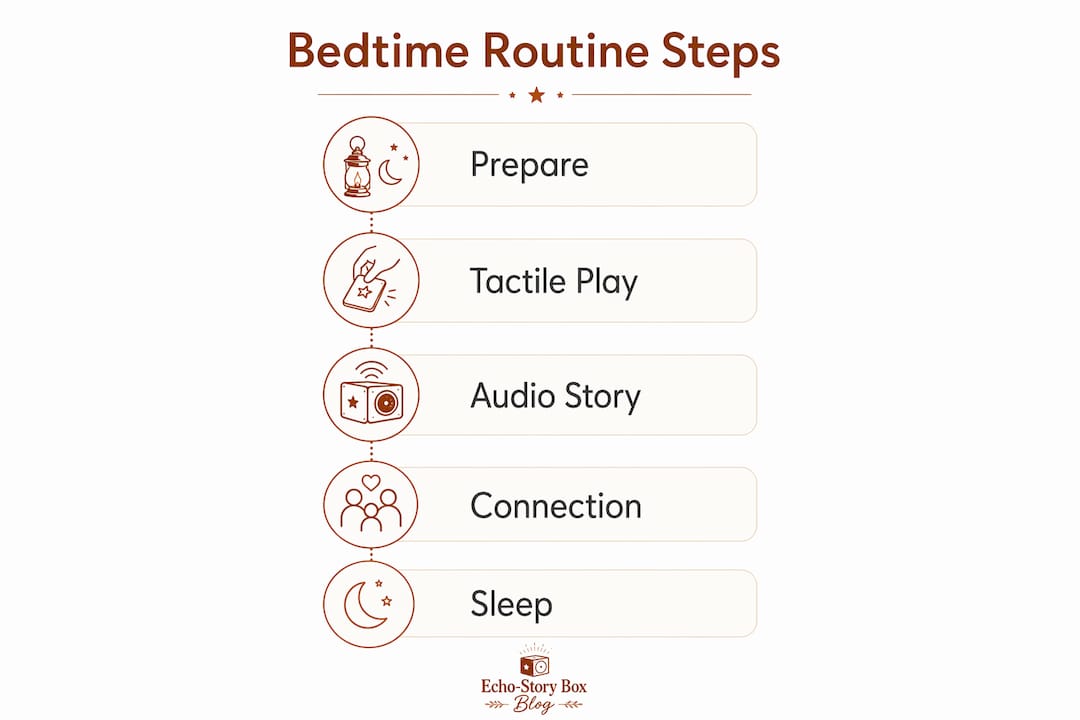
The connection ritual at the close of the routine adds another layer. A brief, warm conversation signals safety and emotional closure, which helps children settle faster. These bedtime listening habits compound over time, making the whole routine feel less like a rule and more like something your child looks forward to.
How do you build a step-by-step screen-free bedtime sequence?
The Wind-Down Hour is a simple, repeatable framework. For preschoolers, extend it to 90 minutes and add more tactile play before the story.

The Wind-Down Hour template
| Phase | Duration | What it looks like |
|---|---|---|
| Clean break + hygiene | 10–15 min | Screens off, devices out of room, pajamas, teeth, face |
| Calm activity | 15–20 min | Puzzle, drawing, threading beads, or quiet small-world play |
| Audio story | 15–20 min | One story or chapter; child chooses the card or topic |
| Connection ritual | 5–10 min | One highlight from the day, one thing to look forward to tomorrow |
| Lights down | 1–2 min | Dim lamp, soft music or silence, goodnight |
Sample transition scripts you can use tonight:
- "Five more minutes, then we're going to pick your story card."
- "You can choose the puzzle or the audio story first. Which one?"
- "The timer is on. When it beeps, devices go to their charging spot."
Age variations
Ages 3–5: Keep activities short and tactile. A simple puzzle, a few sticker pages, or a single short story (10–12 minutes) works well. Use a visual timer so the transition feels predictable rather than arbitrary. The 90-minute window gives preschoolers time to decompress without rushing.
Ages 6–8: One longer story or a short board game followed by a story fits this group. They can handle a 20-minute audio chapter and often enjoy choosing their own story card. Explore slow bedtime routine examples for more timing ideas.
Ages 9–10: A brief dialogue about the day, a longer audio chapter (20–25 minutes), and a short reflection question ("What was the best part?") work well here. Older children respond to being treated as capable of managing the routine themselves with light guidance.
How do you introduce the change without meltdowns?
The most common mistake is flipping the switch overnight. A gradual ramp works far better. Reduce screen time in 15-minute increments each evening over one week, so the change feels like a drift rather than a ban.
Practical tactics:
- Use a visible countdown timer (a simple kitchen timer works fine) so children can see the transition coming.
- Set up a charging station outside the bedroom and make plugging in the device a shared ritual, not a punishment.
- Offer a genuine choice within the routine: "Do you want the puzzle or the story first?" Choice shifts the dynamic from coercion to cooperation.
- Let children earn morning screen time by completing evening routine steps. This reframes the routine as currency rather than a rule.
Pro Tip: Start the routine before your child is overtired. An overtired child has far less capacity to cooperate. If you notice the window closing, skip the calm activity and go straight to the audio story and connection ritual. A short routine done consistently beats a perfect routine done occasionally.
For families with twins or multiple children, coordinating the routine across siblings adds consistency and actually reduces resistance. Both children follow the same sequence, which removes the "why does she get more time?" negotiation. A twin bedtime routine guide covers the logistics of syncing routines for two children at once.
What should you look for in a bedtime audio player?
Not every audio device is built for calm bedtime use. The features that matter most are different from what you'd want for daytime listening.
Non-negotiable features for bedtime:
- No ads, notifications, or autoplay recommendations
- Simple, tactile controls a child can operate independently
- Physical story triggers (cards, figures, or buttons) rather than menus or touchscreens
- Offline playback so Wi-Fi drops don't interrupt the story
- Easy volume control and a sleep timer
- Durable enough to survive a tired child's handling
Echostory-box is built around exactly these priorities. Children tap an NFC story card onto the box and the story starts. No scrolling, no menus, no screen. The how it works page walks through the full setup, which takes only a few minutes.
| Feature category | What to look for | Echostory-box |
|---|---|---|
| Interface | Tactile, no menus | NFC card tap-to-play |
| Content control | Ad-free, curated | No ads, no recommendations |
| Personalization | Family voice recording | Grandparent messages, custom cards |
| Setup | Quick, child-friendly | Ready-made or DIY kit |
| Audio variety | Stories, lullabies, nature sounds | Original stories, old-time radio, family recordings |
For families who prefer to build their own, the Echo-Story Box parts kit includes everything needed for a DIY setup.
How do you personalize audio stories for your child?
Personalized audio is more emotionally resonant than generic content, and children stay engaged longer when they hear their own name or a familiar place in the story.
Step-by-step recording tips:
- Find a quiet room with minimal echo (a closet or carpeted bedroom works well).
- Keep clips short: 1–3 minutes per recording is ideal for bedtime.
- Speak clearly and use your child's name naturally within the first 30 seconds.
- Hold the microphone or phone at a consistent distance (about 6–8 inches from your mouth).
- Save recordings with simple labels so you can rotate them weekly.
Ideas by age:
- Ages 3–5: Mention a favorite stuffed animal or toy in the story. "Bunny was waiting at the door when [child's name] got home..."
- Ages 6–8: Include a short family memory or a place you've visited together.
- Ages 9–10: Record a brief encouragement message or a family story from a grandparent. These become keepsakes children return to for years.
Grandparent recordings are especially powerful. A grandparent's voice telling a short family history story or a bedtime blessing creates a nightly story ritual that no streaming platform can replicate.
What are the most common mistakes when switching to a screen-free routine?
Most families who abandon the routine do so in the first week, usually because of one or two fixable problems.
Common mistakes and quick fixes:
- Switching at bedtime instead of before: Start the screen-free period 60 minutes before lights-out for older children, or 90 minutes for preschoolers. Screens off at 7:00 PM for an 8:00 PM bedtime.
- No absorbing alternative ready: Set up the calm activity before screens go off. A puzzle already on the table is far easier to transition to than one you have to find.
- Device left in the bedroom: Physical removal is more effective than turning a device to sleep mode. Presence alone correlates with worse sleep outcomes.
- Inconsistent timing: Same time, same sequence, every night. Variation is what keeps resistance alive.
For children with sensory sensitivities or anxiety, lower the audio volume slightly below what feels natural, use the same story or recording for several nights in a row, and introduce new content gradually. Predictability is calming for sensitive children. The bedtime routine mistakes guide covers additional fixes for common first-week problems.
Pro Tip: On a night of strong resistance, shorten the routine to its two most important parts: the audio story and the connection ritual. Consistency over completeness. Two minutes of connection beats a skipped routine every time.
Key Takeaways
A consistent screen-free audio routine, started 60–90 minutes before bed and anchored by a tactile story and a brief connection ritual, produces measurable sleep improvements within about two weeks.
| Point | Details |
|---|---|
| Start early enough | Begin the screen-free period 60 minutes before bed (90 minutes for ages 3–5). |
| Remove devices physically | Move devices to a charging station outside the bedroom — not just to sleep mode. |
| Use an absorbing alternative | Set up a calm activity or audio story before screens go off so the transition is easy. |
| End with connection | A short highlight-of-day conversation is the emotional anchor that makes the routine stick. |
| Echostory-box fits this routine | NFC tap-to-play, no ads, family recordings, and a simple interface make it a natural bedtime audio solution. |
Why rituals matter more than rules at bedtime
The families who struggle most with screen-free bedtimes are usually trying to enforce a rule. The ones who succeed have built a ritual. That distinction is everything.
Rules require enforcement every night. Rituals become automatic. When a child knows that story time follows teeth brushing, they stop fighting the transition because they know what comes next. The nighttime ritual becomes the thing they expect, even look forward to.
The connection ritual at the end of the routine is the piece most parents underestimate. It doesn't need to be long. One question, one answer, a moment of warmth. That's the emotional glue that makes a child feel safe enough to let go of the day. Skip the story if you must on a hard night, but don't skip the connection.
If you're just starting out, try the one-night plan at the top of this article tonight. Keep it simple. Share what worked and what didn't in the comments or reach out through the Echostory-box blog. Every family's routine looks a little different, and that's exactly as it should be.
Echostory-box: a screen-free audio player built for this exact routine
Echostory-box gives your child a calm, screen-free listening experience with no ads, no menus, and no notifications. Children tap an NFC story card and the story begins. That's it.

The box supports original adventures, family voice recordings, grandparent messages, faith-based stories, and educational audio. You can personalize stories with your child's name, record your own bedtime messages, or subscribe to monthly story card deliveries so the content stays fresh. Setup takes minutes, and the tactile tap-to-play design means even a 3-year-old can run it independently.
Ready to try it tonight? Visit the Echo-Story Shop to browse starter packs and story card collections, or explore the DIY kit if you'd like to build your own.