
Generational faith stories are the lived accounts of belief, doubt, grace, and perseverance that families pass from one generation to the next. These narratives are not decorative traditions. Research shows that regular family faith storytelling increases the likelihood of children maintaining their faith into adulthood by over 20 percentage points. That gap is not small. It represents the difference between a faith that takes root and one that quietly fades. Understanding why generational faith stories matter is the first step toward making them a real and lasting part of your family's life.
Why generational faith stories matter for children's faith and moral growth
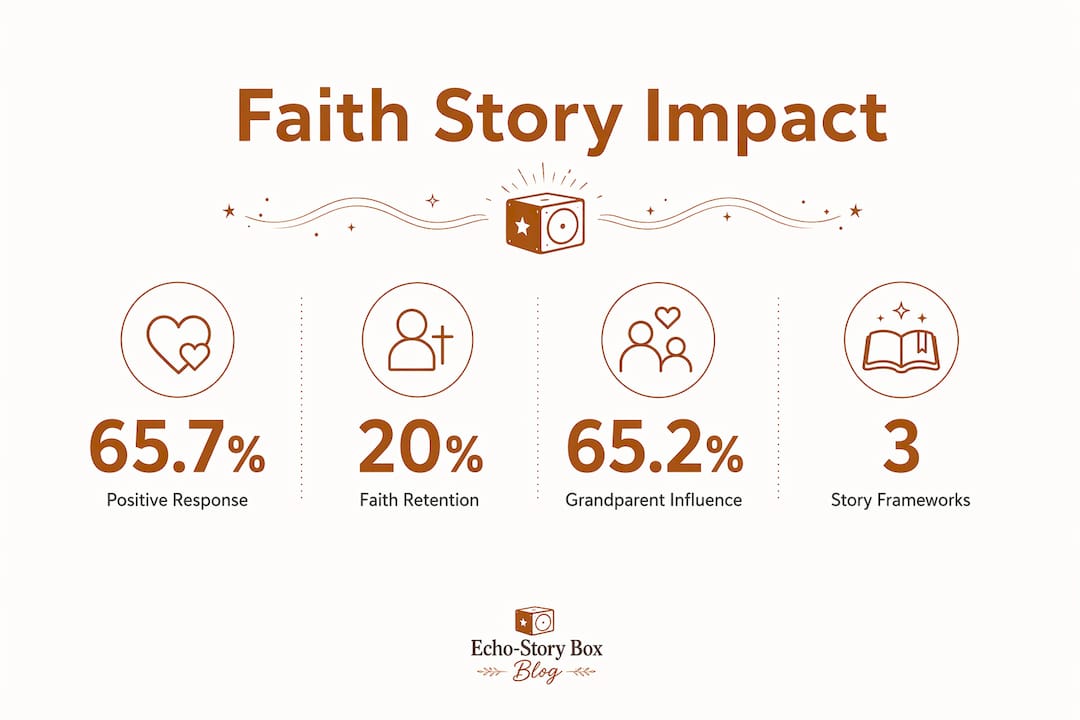
The family home is the single most critical factor in whether children carry their faith into adulthood. A 2026 study confirmed that parental faith storytelling raises faith retention by more than 20 percentage points compared to families where faith is rarely discussed through personal narrative. That finding reframes how families should think about faith formation. Sunday school and church programs matter, but the stories told at the dinner table and at bedtime carry more weight.
Grandparents add a distinct layer of influence. Research on grandparent-led religious formation found that direct storytelling by grandparents produced a 65.7% positive behavioral and spiritual response among grandchildren. The same study linked grandparent storytelling to a 67.4% reduction in risky behaviors among youth. Those numbers point to something families often underestimate: a grandparent's voice carries authority that no curriculum can replicate.
Two frameworks explain why storytelling works so well. Social Learning Theory holds that children absorb behaviors and values by watching and listening to trusted adults. Faith Development Theory, associated with the work of James Fowler, describes how children move through stages of belief formation shaped heavily by the stories and models around them. Both frameworks confirm that narrative is not a supplement to faith formation. It is the mechanism.
Pro Tip: Start with a single story. Ask a parent or grandparent to share one moment when their faith felt real to them. Specific, personal stories land far more deeply with children than general statements about belief.
Effective faith storytelling for children focuses on concrete moments rather than abstract theology. A study of children aged 5–6 found that faith-infused storytelling produced significantly higher gains in both language development and religious understanding compared to non-story-based approaches. Children do not need doctrinal explanations. They need to hear about the time Grandma prayed through a hard season and saw things change.
How faith stories build resilience through adversity
Faith stories serve as meaning-making frameworks. That phrase comes from religious coping research, and it describes something families experience but rarely name. When a child hears how a parent lost a job and found their footing through prayer and community, they gain a mental model for handling their own future hardships. Religious coping research confirms that faith narratives reduce the psychological burden of stress by helping people reinterpret adversity as growth rather than defeat.
The stories that build the most resilience are not the triumphant ones. They are the honest ones.
Sharing stories of faith setbacks and failures is vital for teaching children resilience and realistic faith navigation. Families that tell only success stories create idealized but fragile faith constructs. Children who hear about doubt, struggle, and perseverance build a faith that can actually hold up under pressure.
A strong family narrative is a key factor in emotional health, resilience, and identity formation across generations. Families that share both victories and failures give children a realistic picture of what faith looks like in real life. That picture is far more useful than a polished version that crumbles the first time something goes wrong.
Stories of adversity also connect children to something larger than themselves. When a child learns that their great-grandmother held onto faith through genuine hardship, they inherit more than a story. They inherit a proven framework for their own life. That is the quiet power of faith stories across generations.
How parents and grandparents uniquely shape children's faith through stories
Harvard research makes a clear distinction between telling children about faith and showing them what it looks like. The study found that children experience God's love through consistent adult presence and modeled behaviors, not through abstract words. A parent who prays openly, serves others, and talks about their own faith journey gives a child something to hold onto. Words without aligned actions lose their power quickly.
Grandparents occupy a unique position in this process. Their stories carry the weight of decades. They have lived through enough to speak with genuine authority about what faith has cost them and what it has given them. Research confirms that grandparents' lived testimony engages grandchildren more deeply than abstract instruction, with 65.2% of grandchildren going on to emulate their grandparents' faith practices after direct storytelling. That is not a small effect. It is a generational transfer of values in action.
Here is what makes grandparent storytelling especially effective:
- Authenticity. Grandparents have lived long enough to tell stories with real texture, including the hard parts.
- Relational closeness. Grandchildren often feel safe with grandparents in a way that allows deeper listening.
- Time. Grandparents frequently have more unhurried time to sit and tell stories than busy parents do.
- Perspective. A grandparent can show a child how faith played out across an entire lifetime, not just a single season.
Children process God's love best through concrete relational moments narrated in stories, such as experiences of trust, protection, and encouragement. Abstract theology rarely lands with young children. A story about the night Grandpa felt peace in a hospital waiting room gives a child something real to hold.
Pro Tip: Record grandparent stories before the opportunity passes. A simple audio recording of a grandparent sharing a faith memory becomes a gift that children and grandchildren can return to for the rest of their lives. Echostory-box makes this kind of legacy audio recording simple and lasting.
Practical ways families can nurture faith stories across generations
Families do not need a formal program to pass on faith through story. They need intention and a few consistent habits. The most effective approaches are simple enough to start this week.
- Tell stories at natural moments. Bedtime, car rides, and meals are all low-pressure settings where children are naturally receptive. A two-minute story about a moment of answered prayer fits easily into any routine.
- Include the hard stories. Share moments of doubt, loss, and confusion alongside the victories. Children need to see that faith is not fragile. It bends but does not break.
- Connect stories to community. Help children understand that their family's faith story is part of a larger one. Storytelling builds church community in children by showing them they belong to something beyond their household.
- Celebrate faith milestones with stories. Baptisms, confirmations, and faith anniversaries are natural moments to gather and share what faith has meant across generations.
- Record and preserve grandparent voices. A grandparent's recorded story outlasts any object they could leave behind.
The table below shows how different storytelling approaches compare in terms of their impact on children's faith formation:
| Approach | Primary benefit |
|---|---|
| Parent-led bedtime faith stories | Builds daily habit and emotional security |
| Grandparent testimony sharing | Transfers lived wisdom and deepens emulation |
| Family faith milestone celebrations | Anchors identity in shared spiritual history |
| Recorded audio stories and messages | Preserves voices and stories for future generations |
| Community storytelling in faith groups | Connects children to a broader spiritual family |
Faith stories also shape how children see themselves. A child who grows up hearing "our family has always trusted God through hard times" carries that identity into their own challenges. Family stories matter because they answer the question every child is quietly asking: Who am I, and do I belong somewhere?
Pro Tip: Create a simple "faith story jar." Write prompts on slips of paper, such as "Tell me about a time God surprised you" or "What is the hardest thing faith has asked of you?" Pull one out at family dinners. The conversation that follows will do more than any formal lesson.
Key Takeaways
Generational faith stories are the most direct and measurable way families transmit belief, resilience, and identity across generations.
| Point | Details |
|---|---|
| Faith retention impact | Parental faith storytelling raises children's faith retention by over 20 percentage points. |
| Grandparent influence | Grandparent-led storytelling produces a 65.7% positive spiritual response and reduces risky behaviors by 67.4%. |
| Resilience through honest stories | Sharing setbacks alongside victories builds realistic, durable faith in children. |
| Actions over words | Harvard research confirms children absorb faith through modeled behavior, not abstract instruction. |
| Preservation matters | Recording grandparent voices and stories creates lasting faith keepsakes for future generations. |
What I have learned from a lifetime of family stories
I grew up in a home where stories were the currency of faith. My grandmother did not teach me theology. She told me about the winter her family had nothing and how a neighbor showed up with groceries the same morning she had prayed. That story has stayed with me longer than any sermon I have ever heard.
What I have come to believe, after years of watching families and thinking about how faith actually transfers from one generation to the next, is that most families underestimate what they already have. They think they need a program or a curriculum. They do not. They need someone willing to sit down and say, "Let me tell you what I have seen."
The research backs this up, but the research is really just confirming what families have always known intuitively. Vulnerability in storytelling is not weakness. It is the thing that makes a story worth hearing. A grandparent who admits they once doubted gives a grandchild permission to doubt and keep going. That is not a small gift.
My honest encouragement is this: do not wait for the perfect moment to start sharing your faith story. The imperfect, unpolished version is the one your children will remember. Authenticity is the ingredient that no program can manufacture. Your story, told honestly, is enough.
— Bob
How Echostory-box helps families preserve faith stories
Families know their faith stories matter. The harder part is capturing them before they are lost.

Echostory-box is built for exactly this. The screen-free audio platform lets parents and grandparents record faith testimonies, bedtime prayers, life lessons, and encouragement messages that children can listen to again and again. A grandparent's voice telling a story of God's faithfulness becomes a keepsake that outlasts any physical object. Echostory-box removes the complexity so families can focus on the story itself. See how it works and find out how simple it is to start preserving the voices and stories your family will carry forward for generations.
FAQ
Why do generational faith stories matter for children?
Generational faith stories increase children's faith retention by over 20 percentage points compared to families that do not share personal faith narratives. They also give children a meaning-making framework for handling adversity throughout their lives.
What makes grandparent storytelling so effective?
Grandparent-led faith storytelling produces a 65.7% positive spiritual response among grandchildren and leads 65.2% of grandchildren to emulate their grandparents' faith practices. The combination of lived experience, authenticity, and relational closeness makes grandparent stories uniquely powerful.
Should faith stories include failures and doubts?
Religious coping research and practitioner insight both confirm that stories of setbacks and doubt are essential. Children who only hear success stories develop fragile faith. Honest stories of struggle and perseverance build realistic, durable belief.
How can families start sharing faith stories if they have no tradition of it?
Start with one story at a natural moment, such as bedtime or a car ride. Ask a grandparent to share a single memory of when their faith felt real. Specific, personal stories require no preparation and land more deeply than formal lessons.
How does recording faith stories benefit future generations?
Recorded audio preserves a grandparent's voice, tone, and personality in a way that written notes cannot. Children and grandchildren can return to those recordings throughout their lives, making them one of the most lasting forms of family faith legacy a family can create.