

Most families assume they have more time. A holiday gathering will come, a weekend visit will happen, and grandma will tell that story again. But why recording grandparent wisdom matters becomes painfully clear only after the moment passes. A voice goes quiet. A memory fades. And the story that held decades of lived experience simply disappears. Family stories are not just nostalgic keepsakes. Research now shows they are direct contributors to how children form identity, handle adversity, and understand where they belong in the world. This article gives you the evidence and the practical steps to preserve those stories before it's too late.
Table of Contents
- Key takeaways
- Why grandparent wisdom is irreplaceable
- How to document grandparent stories well
- Common obstacles and how to get past them
- The lasting benefits for your whole family
- My honest take on why families keep waiting
- Preserve your family's stories with Echo-Story Box
- FAQ
Key takeaways
| Point | Details |
|---|---|
| Stories shape identity | Children who know their family history show higher self-esteem and resilience, according to research on the "Do You Know?" scale. |
| Time is the real risk | Oral history projects confirm that the window to capture firsthand stories closes as elders age, making early action critical. |
| Method matters | Short, intentional recording sessions with specific prompts produce richer stories than open-ended conversations or single long interviews. |
| Emotional safety first | Framing sessions around joy and meaning rather than loss protects children and grandparents emotionally during the recording process. |
| Audio archives are lasting gifts | Recorded grandparent voices become keepsakes children return to for comfort, learning, and connection throughout their lives. |
Why grandparent wisdom is irreplaceable
Family stories feel optional until you realize what they actually do. The importance of family stories goes well beyond passing down names and dates. According to research using the "Do You Know?" scale, children with greater knowledge of their family history score consistently higher in self-esteem, resilience, and a sense of control over their own lives. These are not small effects. They show up in how kids handle school stress, friendship conflict, and personal setbacks.
The reason is something psychologists call narrative identity. When a child hears that grandpa lost his job during a hard year and rebuilt from nothing, or that grandma immigrated alone at nineteen and built a life in a new country, they absorb a pattern. Hard things happen and people survive them. That pattern becomes part of how the child sees themselves. Stories with both hardship and triumph are especially powerful. Research shows that oscillating family narratives reflecting both struggle and recovery produce stronger resilience in the next generation than stories that are purely triumphant or purely sorrowful.
There is also the historical dimension. Oral history places a person's lived experience inside a larger social and historical setting. When your grandfather describes what his neighborhood looked like during a recession, or your grandmother explains what it felt like to vote for the first time, those details create something no textbook offers: a human being experiencing history. That kind of context enriches understanding across generations in ways that bare facts simply cannot.
Here is what most families miss: grandparent stories are not history lessons. They are operating instructions. They carry values, judgment calls, and hard-won perspective. That is the real reason capturing ancestral wisdom is worth your time and energy.
"The true value of oral histories is not just in facts recounted but in how people experienced events, enriching understanding across generations." — Oral History Association
How to document grandparent stories well
Knowing you should record stories and knowing how to do it well are two different things. Most families approach it casually, which produces casual results. Here is a better way.
-
Start with specific prompts, not open questions. Asking "Tell me about your life" produces nothing useful. Asking "What was the hardest decision you ever made, and how did you decide?" produces a story. The Do You Know? family stories game uses exactly this kind of intentional prompting to move beyond surface conversation into genuine memory capture.
-
Choose short sessions over one long interview. An hour-long recording marathon is exhausting for everyone. Three twenty-minute sessions spaced across different visits produce far more detail and energy. Grandparents often remember more between sessions, arriving at the next one with a story they forgot to share.
-
Record audio or video AND create a written transcript. Audio captures tone, laughter, and rhythm in a way text never can. But a transcript makes the story searchable and shareable. Comprehensive oral history projects consistently use both formats along with consent forms to protect everyone involved.
-
Frame the experience as a gift, not a project. Tell your grandparent you want to remember their voice and stories. That framing matters. It signals joy and care, not obligation or urgency about their age. Research on emotionally safe storytelling shows that life-focused framing reduces emotional risk for both grandparents and children.
-
Back up recordings immediately and in multiple places. A single recording on one device is not preservation. Upload to cloud storage, share a copy with other family members, and consider a physical archive like a USB drive stored safely.
Pro Tip: Before any recording session, send grandparents the questions a few days in advance. This gives them time to think and remember, and it almost always produces richer, more detailed stories.
Common obstacles and how to get past them
Families who want to start recording often get stuck before they begin. The obstacles are real, but none of them are insurmountable.
-
"We'll do it next visit." This is the most common and most costly delay. Oral history practitioners are explicit about this: the window to capture firsthand stories shrinks every year. The 2026 Black Oral Histories of Beaufort County project was launched specifically because the elders who held those memories were aging and the stories were at risk of disappearing permanently. That same urgency applies to your own family.
-
Memory decline in grandparents. Cognitive changes can make long or complex interviews difficult. The solution is not to avoid recording but to use shorter, gentler sessions with familiar, concrete prompts. Asking about specific sensory memories, a smell from childhood, a sound from a particular place, often unlocks stories that abstract questions cannot.
-
Children in the room. Some families worry that recording grandparent stories will bring up difficult topics around aging or death, especially with young children present. Research on family-led story pacing offers a clear solution: let the family control the pace and choose developmentally appropriate language. Focus questions on life, joy, and meaning rather than endings.
-
Grandparents who say they have nothing interesting to share. Almost every grandparent says this. Almost none of them are right. The key is asking about specific decades, specific places, or specific moments rather than asking for a general life summary. "What was your first job, and what was the most surprising thing about it?" produces a story. "Tell me about yourself" does not.
Pro Tip: Keep a small voice recorder or your phone on the table during family meals. Some of the best stories come out naturally in conversation, not in formal recording sessions. Capture them when they happen.
The lasting benefits for your whole family
Recording grandparent stories is not just a gift to the future. It changes how your family feels right now.
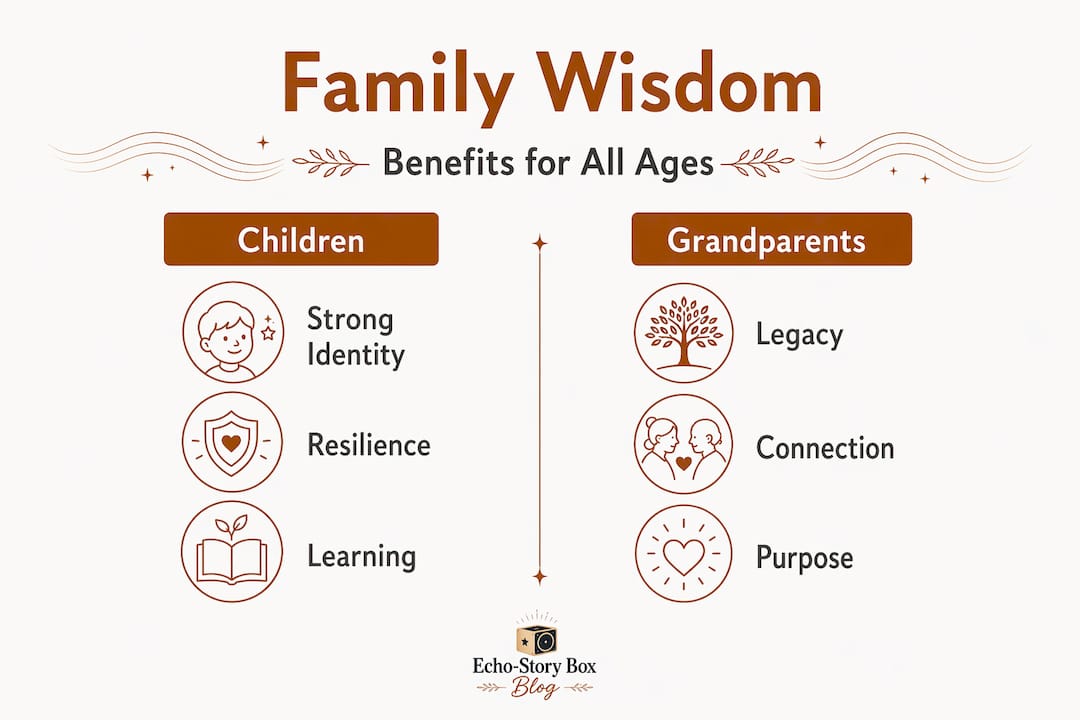
| Benefit | For children | For grandparents |
|---|---|---|
| Stronger identity | Family story knowledge builds self-worth and a clear sense of personal history | Sharing stories reinforces purpose and legacy |
| Emotional resilience | Hearing how family overcame hardship gives children real tools for hard moments | Reflecting on a life well-lived brings comfort and satisfaction |
| Intergenerational connection | Children feel known and rooted across generations | Grandparents feel seen, valued, and remembered |
| Educational value | Recorded stories support learning about history, values, and real-life decisions | Contributing to family knowledge creates pride |
| Legacy gifts | Audio recordings become keepsakes revisited for decades | Stories live on long after the storyteller is gone |
The benefits of recording family history extend into how children learn, not just how they feel. When a grandparent's recorded voice explains what it was like to grow up without certain technologies, or describes a moment of moral courage, children encounter history and values simultaneously. That combination is far more effective than any lecture. Research consistently shows that stories teach more deeply than direct instruction because they carry emotional weight and personal relevance.
For aging grandparents, the act of recording is itself a gift. Knowing that your voice will reach grandchildren who are not yet born, or that a story you carry alone will finally be shared, provides genuine comfort. Familiar stories and voices offer deep reassurance to aging parents, connecting them to purpose and relationship in meaningful ways.
My honest take on why families keep waiting
I've spent a lot of time thinking about why families delay this, and I don't think it's laziness. I think it's discomfort. Recording a grandparent's stories carries an unspoken acknowledgment that time is limited. It feels like facing something most of us would rather not face.
What I've learned is that the recording session itself almost never feels that way in practice. Once you sit down with a grandparent and ask a real question, something shifts. They light up. You lean in. The discomfort disappears because the conversation is alive and warm and full of things you genuinely did not know.
I've also seen what happens when families wait too long. Not just the sadness of loss, but the specific grief of knowing a story existed and is now simply gone. A voice that laughed in a particular way. A detail about a place that no longer exists. Those losses are quiet but permanent.
The other misunderstanding I see is that families treat this as a big formal project that requires equipment and planning and the right moment. It doesn't. A phone on the kitchen table, a good question, and fifteen minutes. That's enough to start. The grandparent storytelling significance is not in the production quality of what you capture. It's in the fact that you captured anything at all.
Start now. Not next holiday. Now.
— Bob
Preserve your family's stories with Echo-Story Box
At Echostory-box, we built our platform around exactly this belief: every family has stories worth saving, and every child deserves to hear them.

The Echo-Story Box makes it simple for grandparents to record bedtime stories, life lessons, and personal memories that children can listen to again and again, without a screen in sight. Just tap a story card and hear a beloved voice. No apps. No subscriptions to manage. No complicated setup. Whether you want a ready-made solution or prefer to build your own, Echostory-box has a path for your family. Visit our shop to explore story cards, legacy recording options, and tools that turn grandparent wisdom into something your family can hold onto forever.
FAQ
Why does recording grandparent wisdom matter so much?
Recorded grandparent stories preserve voices, values, and lived experiences that shape children's identity and resilience. Research on the "Do You Know?" scale shows that children who know their family history have stronger self-esteem and emotional health.
When is the right time to start documenting grandparent stories?
The best time is now. Oral history practitioners consistently emphasize that the window for capturing firsthand stories narrows as elders age, and waiting increases the risk of permanent loss.
How do you make a grandparent feel comfortable sharing stories?
Frame the session as a gift, use specific and gentle prompts, and let the grandparent set the pace. Research on emotionally safe storytelling shows that life-focused, meaning-centered framing reduces anxiety and produces richer stories.
What format is best for preserving grandparent stories?
Audio or video recordings paired with a written transcript give you the emotional warmth of a real voice plus the practical searchability of text. Storing copies in multiple places protects against loss.
Can young children be included in grandparent story recordings?
Yes, with the right approach. Use developmentally appropriate language, focus on joy and meaning rather than loss, and keep sessions short. Family-led pacing makes story recording safe and positive for children of all ages.