

The most effective starter plan for young children is a three-step routine: introduce a new word with a simple definition and visual, practice it through play or a short story, then check understanding with a quick, low-stakes prompt. Used for short daily sessions, this approach aligns with IES guidance on academic vocabulary instruction for PreK–1 classrooms and works equally well at home.
Here is your instant checklist:
- Introduce: Say the word aloud, give a child-friendly definition, and show a picture or gesture.
- Practice: Use the word in a short story, a playful game, or a listening activity.
- Check: Ask a simple question or use a thumbs-up/thumbs-down signal to confirm understanding.
Your starter pack for today: one read-aloud with targeted words, one quick word game (like "show me the word"), and one short audio listening moment at bedtime. That is all you need to begin. Research on book reading and vocabulary gains consistently shows that repeated, structured exposure through stories produces measurable vocabulary growth, even with very young children.
Table of Contents
- How do you introduce new words to young children?
- 12 engaging vocabulary activities your child will actually enjoy
- What does a realistic weekly vocabulary routine look like?
- How do you check vocabulary understanding quickly?
- How can you adapt activities for ELLs and struggling readers?
- Why does audio storytelling help children learn new words?
- What books and materials do you actually need?
- Key Takeaways
- Why storytelling is the heart of early word learning
- Echostory-box makes the audio step simple and screen-free
- Useful sources for educators and parents
How do you introduce new words to young children?
The oral-first approach works best for early learners. Before a child can read a word independently, he or she can hear it, say it, and use it in conversation. Listening removes the barrier of print decoding, which means young children can access richer vocabulary through stories and read-alouds long before they can read those same words on a page.
A simple three-step introduction sequence you can memorize:
- Say the word and give a child-friendly definition. Keep it one sentence. "Enormous means really, really big — bigger than a house."
- Use it in two or three sentence frames. "The elephant was enormous. The enormous tree filled the whole yard. Can you think of something enormous?"
- Check with a discrimination task. "Is a grape enormous? Is a mountain enormous? Give me a thumbs-up if I say something enormous."
Pair each new word with a visual — a picture card, a quick sketch, or a gesture. Children anchor meaning to images far more reliably than to definitions alone.
Ready-to-use sentence frames for a target word like curious:
- "I am curious about ____."
- "She felt curious when she saw ____."
- "A curious person likes to ____."
- "Is a cat curious? Is a rock curious?"
Pro Tip: Try the "miles on the tongue" technique: after introducing a new word, ask children to say it three times in three different sentences before the session ends. This builds phonological familiarity and confidence, not just passive recognition.
Choosing the right words matters as much as the method. Filter your list by removing words that are obvious from pictures or rarely reappear. Prioritize "high-mileage" words — sophisticated terms like enormous, curious, or determined — that show up across books, conversations, and subjects. These words pay off across every subject and grade level.


12 engaging vocabulary activities your child will actually enjoy
These activities cover oral storytelling, listening, movement, and word play. Each one is low-prep and works for PreK–2 learners at home or in a small classroom group.
-
Picture Card Sorting (Ages 4–6, 5–8 min, pairs or small group). Give children a set of picture cards and ask them to sort by a target word category (e.g., "things that are enormous" vs. "things that are tiny"). Materials: printed or hand-drawn picture cards. Works well as a center activity.
-
Thumbs-Up Listening (Ages 4–7, 5 min, whole group or family). Read aloud a short passage and ask children to raise a thumb every time they hear the target word. Follows directly from the IES shared book reading routine. Materials: any picture book with repeated target words.
-
Word of the Day Jar (Ages 5–8, 3 min daily, any group size). Write a new word on a slip of paper each morning. Pull it from a jar, say it together, and use it in one sentence before breakfast or morning circle. Materials: jar, index cards, marker.
-
Act It Out (Ages 4–7, 5–8 min, small group). Call out a vocabulary word and ask children to act it out with their bodies. "Show me what exhausted looks like." No materials needed. Kinesthetic repetition builds memory faster than passive review.
-
Story Retell with Word Cards (Ages 5–8, 8–12 min, pairs). After a read-aloud, give children two or three picture cards representing target words. Ask them to retell the story using those words. Materials: picture cards tied to the book's vocabulary.
-
Sentence Builder Game (Ages 6–8, 8 min, pairs or small group). Write target words on index cards. Children draw a card and build the longest sentence they can using that word. A partner judges whether the word is used correctly. Materials: index cards, pencil.
-
Word Web (Ages 5–8, 8–10 min, any size). Write a target word in the center of a paper. Children add branches: a definition, a picture, a sentence, and an opposite. The Frayer Model, a structured four-square graphic organizer, works especially well here. Materials: blank paper or a printed template.
-
Audio Story + Follow-Up Discussion (Ages 4–8, 10–15 min, family or small group). Listen to a short audio story together. Before listening, introduce two target words. After listening, ask: "Where did you hear determined? What did it mean in the story?" This pairs naturally with a screen-free audio player like Echostory-box, though any audiobook or read-aloud recording works. Materials: audio story, two pre-taught word cards.
-
Rhyme and Repeat (Ages 4–6, 5 min, any size). Choose a target word and find or make up a simple rhyme using it. Rhyme and rhythm help young children retain new words. Materials: none required.
-
Label the Room (Ages 5–7, 10 min setup, ongoing). Write vocabulary words on sticky notes and attach them to matching objects around the room or home. Children see the words repeatedly throughout the day. Materials: sticky notes, marker.
-
Mystery Word Clues (Ages 6–8, 8 min, small group). Give three clues about a target word without saying it. Children guess the word. Then switch: a child gives clues while others guess. Materials: word list for the clue-giver.
-
Bedtime Word Review (Ages 4–8, 3–5 min, family). Before lights out, ask your child to tell you one word they learned today and use it in a sentence. This low-pressure retrieval moment reinforces the day's learning. Pair it with a short bedtime audio story for a calm, vocabulary-rich close to the day.
Pro Tip: Combining gameplay with shared book reading produces larger vocabulary gains than shared reading alone, with the biggest benefits for children who start with lower receptive knowledge. If a child is struggling, add a game to your read-aloud rather than switching to a different activity.
What does a realistic weekly vocabulary routine look like?
Frequency matters more than session length. Children need multiple exposures to a word across different contexts before it sticks. Spacing practice into daily micro-sessions and using incidental moments — transitions, mealtimes, car rides — adds meaningful repetitions without overloading short attention spans.
| Day | Activity | Format | Time |
|---|---|---|---|
| Monday | Introduce 2–3 new words during morning read-aloud | Whole group / family | 8–10 min |
| Tuesday | Word game (Act It Out or Thumbs-Up Listening) | Small group / family | 5–8 min |
| Wednesday | Audio story with pre-taught words + follow-up discussion | Family / pairs | 10–12 min |
| Thursday | Picture card sort or Word Web at a center | Independent / pairs | 8–10 min |
| Friday | Exit-ticket check + Bedtime Word Review | Individual / family | 5–8 min |
Aim to revisit each focal word at least three times across the week, in different formats. Monday's read-aloud word should reappear in Tuesday's game and Wednesday's audio session.
Do:
- Reuse the same 2–3 words across multiple activities in a week.
- Use transition moments (lining up, washing hands) for a quick "what does enormous mean?" prompt.
- Keep sessions short and stop before children lose interest.
Don't:
- Introduce more than 3–4 new words in a single session.
- Rely on one activity type all week — variety drives retention.
- Skip the check-in step; without it, you won't know which words need more practice.
For a fuller picture of how to sequence vocabulary across weeks, the storytelling curriculum guide for early learners on the Echostory-box blog offers a practical multi-week framework.
How do you check vocabulary understanding quickly?
Quick formative checks take two minutes and tell you exactly which words need more work. The goal is low stakes and high frequency, not formal testing.
Four ready-to-use exit ticket formats:
- Picture choice: Show two pictures and ask, "Point to the one that shows curious." No reading required.
- Thumbs signal: Say a sentence using the target word correctly or incorrectly. Children give thumbs-up for correct use, thumbs-down for wrong use.
- One-sentence production: Ask, "Tell me one sentence using the word determined." Listen for whether the meaning is accurate.
- Example/nonexample: "Is a sleeping baby energetic? Is a puppy running in circles energetic?" Children answer yes or no with a gesture.
A simple weekly tracking template:
| Child's Name | Target Word | Receptive (can identify) | Expressive (can use) | Notes |
|---|---|---|---|---|
| ✓ / ✗ | ✓ / ✗ |
Fill this in during or right after a session. Two columns — receptive and expressive — capture the difference between a child who recognizes a word and one who can use it independently. That gap is where your next instruction should focus.
Scoring tips:
- A child who gets picture-choice right but cannot produce a sentence is at the receptive stage. Keep exposing, add more sentence frames.
- Anecdotal notes ("used enormous spontaneously at snack time") are as useful as formal checks.
- Track 2–3 words per week, not every word introduced.
How can you adapt activities for ELLs and struggling readers?
Children with limited English or weaker starting vocabularies need more direct instruction, not just more exposure. Vocabulary gains are moderated by prior knowledge: children who already know more words learn new ones faster from exposure alone, while others need explicit, repeated teaching to close the gap.
For English Language Learners (ELLs):
- Use bilingual picture cards with the word in both English and the child's home language.
- Slow your speech when introducing new words and pause after each sentence frame.
- Pair ELL students with a supportive peer for game activities.
- Allow responses in the home language initially; accept gestures and pointing as valid answers.
- Use visuals and physical demonstrations for every new word, not just some.
For struggling readers:
- Reduce the number of target words to 1–2 per session.
- Use the Act It Out and Thumbs-Up activities, which require no reading at all.
- Provide pre-made sentence frames on a card the child can hold and refer to.
- Small-group pull-aside (3–4 children) allows more repetitions and immediate feedback.
For advanced learners:
- Ask them to generate their own sentence frames or clues for the Mystery Word game.
- Introduce morphology: "If curious means wanting to know, what might curiosity mean?"
- Challenge them to find the target word in a different book or context during free reading.
Pro Tip: Running two simultaneous stations works well in a mixed classroom: one group plays a word game independently while you run a brief, explicit introduction session with the children who need more support. A parent volunteer or aide can manage the independent station with a simple scripted prompt card.
For more on small-group implementation, the small group storytelling guide offers practical grouping ideas that translate directly to vocabulary work.
Why does audio storytelling help children learn new words?
Listening to stories is one of the most natural ways young children build vocabulary. Oral presentation of stories is often more effective than written presentation for vocabulary acquisition in younger children, precisely because it removes the cognitive load of decoding print. A child who is still learning letter sounds can fully engage with rich, complex language when it comes through listening.
"Audio storytelling is an active engagement tool that encourages repeated listening and character familiarity; it can build a love of stories that sustains long-term exposure and vocabulary growth." — National Literacy Trust, Playful Storytelling report
Three evidence points worth knowing:
- Oral presentation often outperforms written-only input for young learners because listening frees attention for meaning rather than decoding.
- Repeated, interactive audio listening increases retention; children who hear the same story multiple times encounter target words in varied contexts, which deepens understanding.
- Combined audio and print can be especially strong when children are ready, but audio alone is a solid starting point for PreK–1.
How to use audio in your routine:
- Choose a short story (8–12 minutes) with rich, varied vocabulary.
- Pre-teach 2–3 target words before pressing play: say each word, show a picture, use a sentence frame.
- Listen together with an active prompt: "Raise your hand when you hear determined."
- After listening, revisit the words with a quick picture-choice or sentence-production check.
- Repeat the same story two or three times across the week. Familiarity with the plot frees children to focus on the language.
Echostory-box is one screen-free option that fits this routine naturally. Children tap a story card and the audio begins, with no menus, no ads, and no distractions. You can pre-load a story with two target words, listen together, and follow up with a word game the next morning. It is entirely optional; library audiobooks and free read-aloud recordings work just as well. The key is repeated, focused listening, whatever the source. Learn more about how vocabulary development through storytelling works in practice.
What books and materials do you actually need?
You do not need much. Most of these activities run on index cards, sticky notes, and a good picture book.
High-utility picture books for vocabulary work:
- The Enormous Crocodile by Roald Dahl: rich descriptive language, repeated target words, strong story arc.
- Chrysanthemum by Kevin Henkes: emotion vocabulary, character perspective, accessible for PreK–1.
- Jabari Jumps by Gaia Cornwall: courage and determination vocabulary, natural sentence frames.
- Each Kindness by Jacqueline Woodson: abstract social-emotional words, excellent for discussion.
- Any nonfiction picture book on animals or nature: content-area vocabulary with visual support built in.
Audio and listening resources:
- Public library audiobook collections (Libby, hoopla) offer free access to hundreds of children's titles.
- YouTube read-aloud channels (search "read aloud picture book" for any title) work well for one-time listening sessions.
- Echostory-box story card packs include original educational adventures with recurring characters like Theo the Rabbit, designed to introduce vocabulary through narrative rather than drill.
- For a broader look at audio story options for families, the storytelling tools that foster curiosity post covers several formats worth considering.
Low-cost materials shopping list:
- Index cards (for word cards, sentence frames, and exit tickets)
- Sticky notes (for Label the Room activity)
- A small jar or box (for Word of the Day)
- Printed or hand-drawn picture cards (free to make, or print from Teachers Pay Teachers)
- Markers and blank paper (for Word Webs and Frayer Model templates)
For practical classroom vocabulary strategies with accessible visuals, this writing and vocabulary guide offers additional scaffolding ideas that complement the activities above.
Key Takeaways
The most effective vocabulary building for young learners combines a three-step routine (introduce, practice, check) with repeated, varied exposures across the week, using stories and play as the primary delivery methods.
| Point | Details |
|---|---|
| Use the three-step routine | Introduce with a definition and visual, practice through play or story, check with a quick signal or sentence. |
| Repeat words across the week | Aim for 3+ exposures per word in different formats; repetition across contexts builds lasting retention. |
| Keep sessions short | Daily micro-sessions of 5–12 minutes outperform long, infrequent study blocks for young children. |
| Differentiate by need | Children with smaller starting vocabularies need more explicit instruction; advanced learners benefit from morphology and independent word exploration. |
| Echostory-box fits the audio step | Use Echostory-box as an optional screen-free audio tool for the listening session in your weekly routine. |
Why storytelling is the heart of early word learning
The conventional wisdom on vocabulary instruction tends to focus on word lists and flashcards. Those tools have their place, but they miss something children actually respond to: story. A word heard in a story, attached to a character and a moment of tension or joy, lands differently than a word on a card. Children remember determined because Jabari stood at the edge of the pool and jumped anyway, not because they read a definition.
What the research supports, and what practitioners have known for a long time, is that repeated listening to the same story builds both familiarity and vocabulary depth. The plot becomes a scaffold. Children stop tracking "what happens next" and start noticing language. That shift is where real word learning happens.
The screen-free piece matters more than it might seem. Audio without visual distraction asks children to build mental images from language alone. That is active, effortful processing, and it is exactly the kind of engagement that makes new words stick. A child who pictures an "enormous" crocodile in their mind has done more vocabulary work than one who watched it on a screen.
Start with one story, a small number of words, and a simple follow-up question. That is enough for today.
Echostory-box makes the audio step simple and screen-free
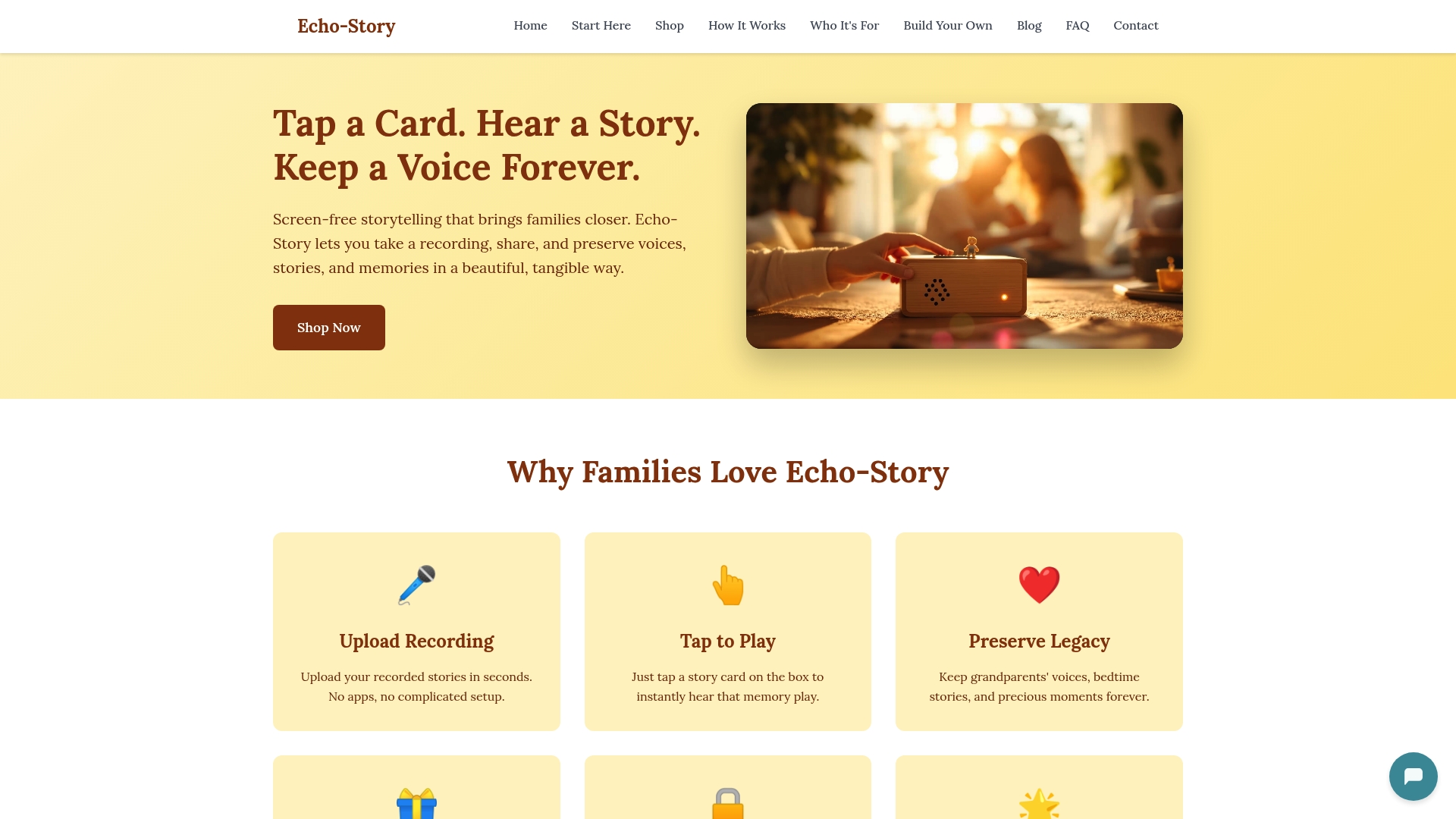
Repeated audio listening is one of the most research-supported ways to build vocabulary in young children, and Echostory-box makes it easy to build that habit at home without a screen in sight. Children tap a story card and the audio begins. No menus, no ads, no setup. Parents and grandparents can load original educational adventures, personalized stories, or classic tales, then follow up with a quick word game the next morning.
Here is a simple three-step pilot to try this week:
- Choose one Echostory-box story with rich descriptive language. Pre-teach two target words before listening.
- Listen together once, then again the next day. Ask your child to signal when they hear the target words.
- Follow up with one activity from this article: a picture sort, a sentence builder, or a bedtime word review.
Library audiobooks and free read-aloud recordings are always a solid alternative. The goal is consistent, focused listening, and Echostory-box is built to make that as simple as tapping a card. See how Echostory-box works and find the right story pack for your family.
Useful sources for educators and parents
These are the research reports and practitioner guides referenced throughout this article. Each one is worth bookmarking if you want to go deeper.
- IES Teaching Routine for Academic Vocabulary, Grades PreK–1 — The source for the three-step introduce/practice/check routine and the "miles on the tongue" technique.
- Going Nuts for Words (ERIC) — Practical recommendations for shared book reading with picture cards, thumbs-up prompts, and word selection criteria for young learners.
- Integrated Vocabulary Instruction (ERIC monograph) — Covers the National Reading Panel's recommendations for combining direct and incidental vocabulary instruction and building word consciousness.
- Teaching for Breadth and Depth of Vocabulary Knowledge (Temple Infant Lab) — Research on repeated read-alouds, book reading effect sizes, and how prior vocabulary moderates learning gains.
- Listening While Reading Promotes Word Learning from Stories — Evidence that oral presentation outperforms written-only input for vocabulary acquisition in young children.
- Combining Gameplay with Shared Book Reading Boosts Vocabulary — Study showing that pairing games with read-alouds produces larger gains than reading alone, especially for children with lower starting vocabulary.
- Integrating Vocabulary into Daily Routines — Research supporting micro-session spacing and incidental word use during transitions and mealtimes.
- IES Foundational Skills Practice Guide (Kindergarten–Grade 3) — Broad evidence-based recommendations for academic language, vocabulary, and narrative skills in early grades.
- Remote Text-Supplemented Audiobook Intervention (PMC) — Research on audiobook interventions supporting explicit and incidental vocabulary learning, particularly for children with reading difficulties.
- Boost ELA Success with Effective Vocabulary Strategies — Practitioner-focused overview of best-practice vocabulary strategies for PreK–1 instruction and activity recommendations.