
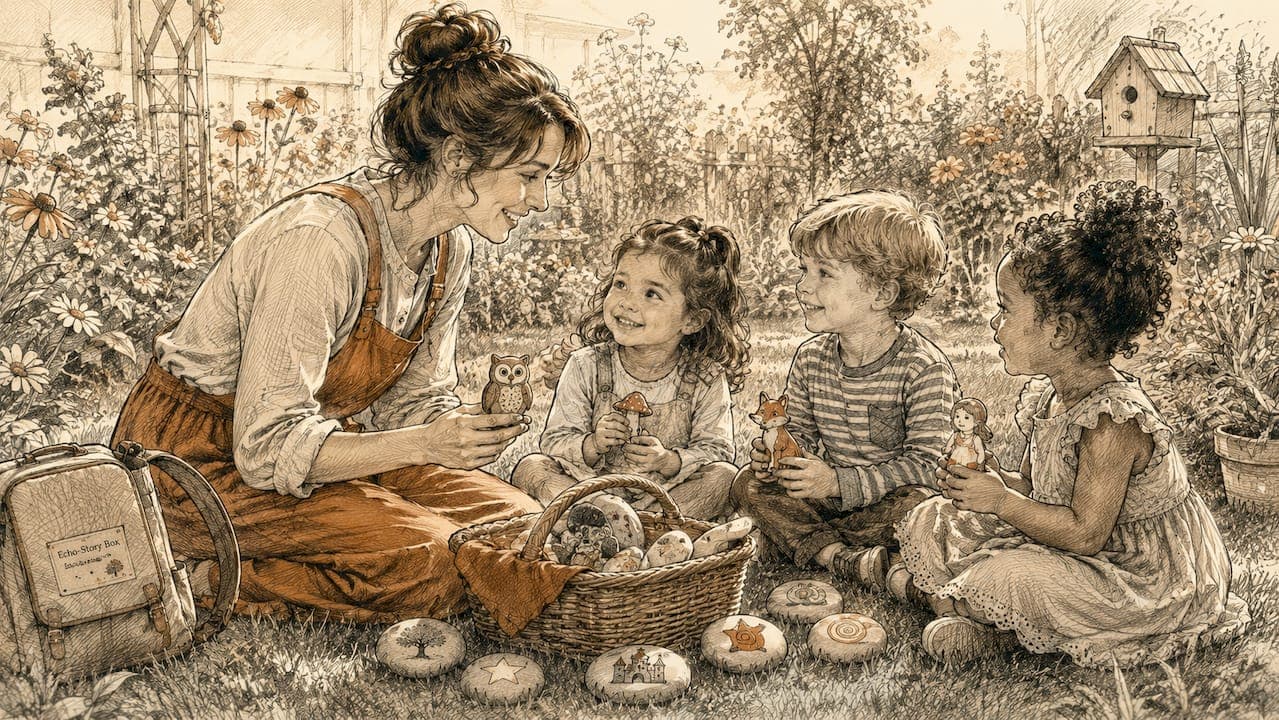
A storytelling curriculum for early learners is a structured, play-based approach to developing narrative skills, comprehension, and emotional connection through oral and hands-on story experiences. The most effective versions are screen-free, grounded in story grammar, and built around children's real lives. Oral storytelling builds the cognitive base children need for inferencing and comprehension long before they can write a single word. When you build storytelling curriculum for early learners with these principles in mind, you give children a foundation that carries them through every stage of literacy.
What does a storytelling curriculum for early learners need?
Every strong storytelling curriculum starts with the right materials, environment, and mindset. You do not need expensive kits or digital tools. You need simple, tactile objects that invite children to create.
Screen-free materials that work
The most effective storytelling materials for young children are physical and open-ended. Three categories stand out:
- Story baskets: Fill a basket with random household objects, small toys, or nature items. Story baskets support oral language, vocabulary, narrative skills, and print awareness by making storytelling feel like play rather than a formal task.
- Story stones: Smooth rocks painted with simple images, characters, or settings. Children arrange them to build a sequence, which naturally introduces the concepts of beginning, middle, and end.
- Family photos: Printed photos of familiar people and places give children an immediate emotional connection to the story they are building. This is especially powerful for children from low-literacy backgrounds.
The four narrative components to teach first
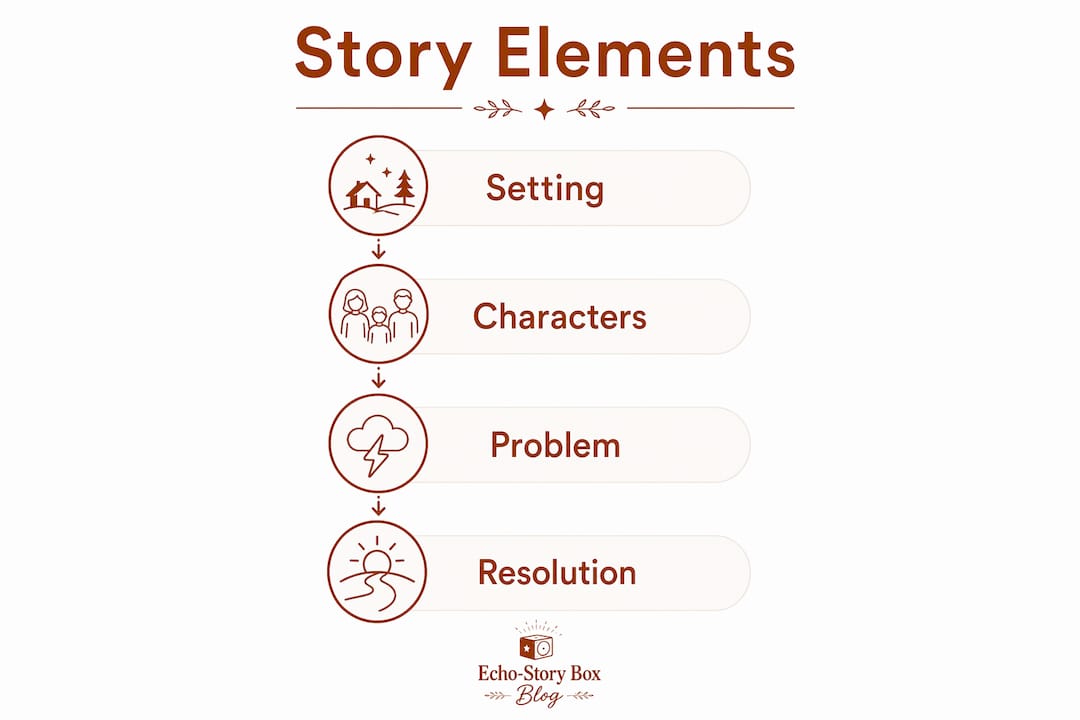
Before any activity begins, educators and parents should understand the four building blocks of story grammar: setting, characters, problem, and resolution. These are the terms used in early literacy research, and they give you a shared language with children. You do not need to use academic words with a four-year-old. You can simply ask, "Where does our story happen? Who is in it? What goes wrong? How does it get better?"
| Narrative component | Child-friendly prompt |
|---|---|
| Setting | "Where does our story happen?" |
| Characters | "Who is in our story?" |
| Problem | "What goes wrong?" |
| Resolution | "How does it get better?" |
Pro Tip: Keep a small story basket near your reading corner and let children pull objects out at random before group time. The surprise element sparks immediate creative engagement.
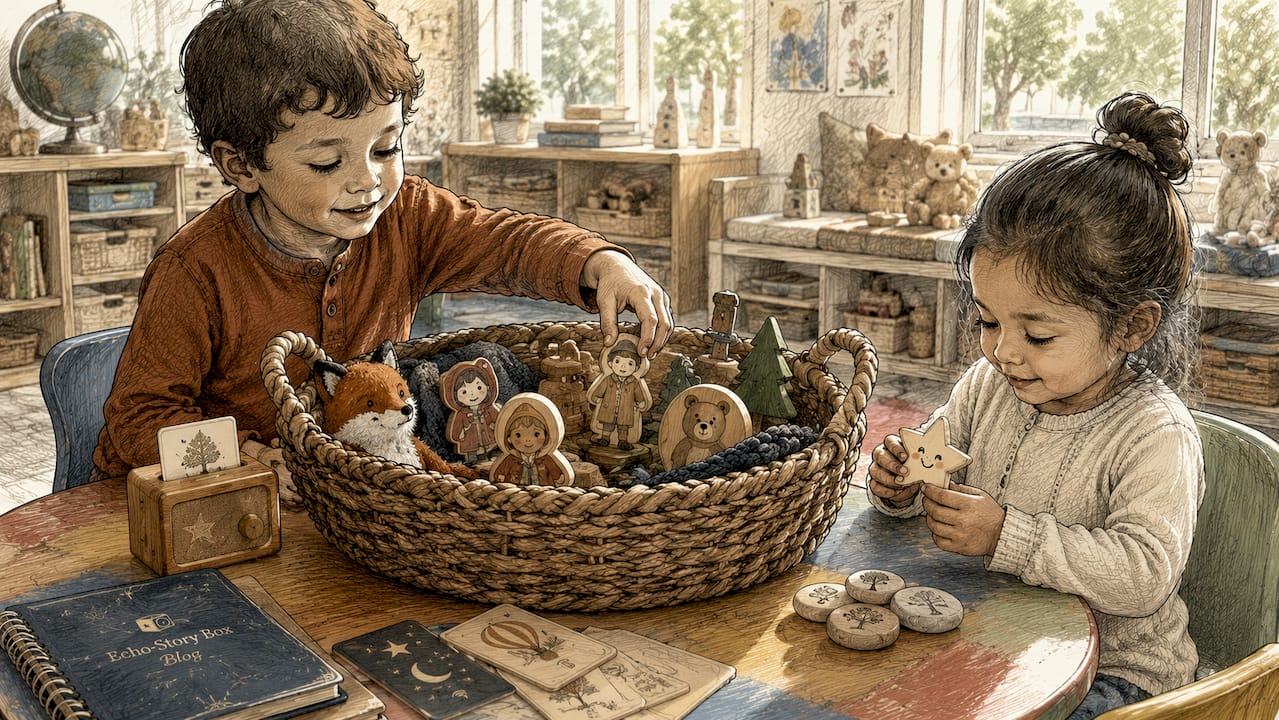
Community and family stories belong in the curriculum too. A grandmother's memory of a childhood trip or a parent's story about their first day of school carries the same narrative structure as any picture book. Inviting those voices into the classroom or home session gives children models they trust.
How to run storytelling activities that build narrative skills
The most reliable method for developing narrative skills in preschoolers is the "Tell It, Act It, Draw It" routine. A child tells a short story aloud, acts it out with props or their body, and then draws one scene from it. Each step reinforces the same story in a different mode. That repetition builds comprehension without feeling repetitive to the child.
Step-by-step storytelling session
- Gather the group. Sit in a circle with three to five children. Smaller groups give every child a turn and reduce anxiety.
- Model first. Tell a short, simple story using the four narrative components. Keep it under two minutes. Use a story basket object as your starting point.
- Run a cooperative round. Use the one sentence at a time method. Each child adds one sentence to build a shared story. This routine works well for children aged 2–4 and takes 10–15 turns to complete.
- Introduce a personal narrative. Show a family photo and ask the child to tell you what happened that day. Teacher modeling here is critical. Narrate alongside the child: "I see your dog. Let's say: One day, Max the dog ran into the yard..."
- Act it out. Let children use their bodies or simple props to perform the story. Movement locks the narrative structure into memory.
- Draw one moment. Ask each child to draw the problem or the ending. Encourage invented spelling for labels. The goal is not accuracy. The goal is connecting oral story to written symbol.
- Celebrate every attempt. Read the story back to the group using the children's exact words. Hearing their own language in a "published" story is deeply motivating.
Pro Tip: Adapt the length of each step to your group's attention span. Toddlers may only manage steps 1 through 3. That is a complete and successful session.
Combining picture books with story grammar instruction significantly improves preschoolers' narrative abilities, including their grasp of setting, problem, sequence, and consequences. Use a picture book as your anchor text two or three times a week, then let children retell or remix the story using their own objects.
How do you support diverse learners in storytelling activities?
Scaffolding is the practice of giving children just enough support to succeed without doing the work for them. In storytelling, scaffolding looks different for every child.
For shy or low-literacy children, the most effective scaffold is the family photo. Using family photos with teacher modeling helps children from low-literacy backgrounds narrate complete personal stories with clear structural elements. The photo removes the blank-page problem. The child already knows the story. They just need permission and a prompt to tell it.
For multilingual learners, repetitive story structures are your best tool. Stories with predictable patterns, like "First... then... finally..." give children a scaffold they can hang new vocabulary on. You can also invite children to tell part of a story in their home language and translate together as a group.
"Imperfect storytelling is not a mistake. It is a developmental milestone. When a child says 'and then, and then, and then,' they are practicing sequencing. That is exactly where they should be."
Key scaffolding approaches that work across diverse groups:
- Echo the child's words back. If a child says "the dog runned away," repeat it naturally in your response: "The dog ran away. Then what happened?" You model correct grammar without correcting the child directly.
- Use familiar story structures. Repetitive refrains and predictable patterns reduce cognitive load and let children focus on content rather than form.
- Celebrate the "messy middle." Effective storytelling curricula treat imperfect contributions as valid learning moments, not errors to fix.
- Prompt with objects, not questions alone. Handing a child a story stone or a photo gives them something to react to, which is far easier than answering an open-ended question cold.
- Balance adult guidance with child creativity. Your job is to hold the structure. The child fills it with their own imagination.
Low-tech scaffolding tools like story maps, family photos, and teacher modeling help children internalize narrative logic without pressure.
What are the common challenges in sustaining storytelling engagement?
The biggest mistake educators and parents make is over-correcting children's stories. Over-correcting early shuts down creativity and teaches children that storytelling is a performance with right and wrong answers. It is not. It is a practice.
Here are the most common challenges and how to handle them:
- Silly or unexpected contributions: A child who turns a wooden spoon into a superhero is not derailing the story. Imaginative substitutions like this represent developmental milestones and should be welcomed, not redirected.
- Short attention spans: Keep sessions to 10–15 minutes for toddlers and up to 20 minutes for preschoolers. End before children disengage, not after.
- Uneven participation: Use a talking object, like a small stone or stuffed animal, to signal whose turn it is. This reduces interruptions and gives quieter children a clear moment to speak.
- Story maps that feel too formal: Draw your story map loosely, with imperfect lines and simple stick figures. Modeling a "sloppy" story map signals to children that they do not need to be perfect, which increases participation.
- Keeping it playful: Story stones and similar objects encourage vocabulary development and sequencing without the stress of formal correctness. If it feels like a worksheet, redesign it.
Pro Tip: Schedule storytelling at the same time each day. Routine reduces resistance. Children who know "story time is after snack" arrive already primed to participate.
Balancing repetition with creativity is a real tension. Children need to hear the same story structures repeatedly to internalize them. But they also need space to invent. The solution is a fixed structure with a variable filling. Keep the four narrative components constant. Let everything inside them change every session.
Key takeaways
A storytelling curriculum for early learners works best when it is screen-free, play-based, and built around story grammar, family connection, and consistent low-tech scaffolding.
| Point | Details |
|---|---|
| Start with story grammar | Teach setting, characters, problem, and resolution as the core framework for every session. |
| Use tactile materials | Story baskets, story stones, and family photos build narrative skills without screens or worksheets. |
| Scaffold diverse learners | Echo children's language, use repetitive structures, and prompt with objects rather than open questions. |
| Embrace imperfect storytelling | Treat messy narrative attempts as milestones, not errors, to keep children engaged and creative. |
| Keep sessions short and routine | Daily 10–20 minute sessions at a consistent time build narrative skills faster than longer, irregular ones. |
Why I think we underestimate what young children can do with a story
I have watched a three-year-old hold a smooth stone painted with a moon and narrate a story about her grandmother that made every adult in the room go quiet. She did not use perfect grammar. She repeated "and then" six times. And the story was complete. It had a setting, a character, a problem, and an ending that surprised everyone, including her.
That moment changed how I think about early childhood storytelling techniques. We tend to wait until children have "enough" language before we invite them into real storytelling. That is backwards. The storytelling is what builds the language.
The other thing I have learned is that parents are often the most underused resource in a storytelling curriculum. A grandparent's voice telling a family story carries more weight than any published picture book. When families bring their own narratives into the curriculum, children understand that stories belong to them, not just to books or classrooms.
My honest advice: keep it simple, keep it physical, and keep it joyful. A basket of random objects and fifteen minutes of your full attention will do more for a child's narrative development than any app or structured program. The messier the story, the more learning is happening.
— Bob
How Echostory-box supports screen-free storytelling at home and in the classroom
Educators and parents who want to extend storytelling beyond the classroom session will find that Echostory-box aligns naturally with the principles in this curriculum.

Echostory-box is a screen-free audio player built for children ages 4–10. Children tap a story card onto the box and a story begins. No menus, no ads, no scrolling. The experience is tactile and calm, much like reaching into a story basket. Original adventures featuring characters like Theo the Rabbit introduce children to vocabulary, historical figures, and character development through audio storytelling. Families can also record their own voices, preserving grandparent stories and personal narratives as lasting audio keepsakes. For families and educators building a screen-free story experience, Echostory-box offers a gentle, purposeful next step.
FAQ
What is story grammar and why does it matter for preschoolers?
Story grammar refers to the structural components of a narrative: setting, characters, problem, and resolution. Teaching these components improves preschoolers' narrative abilities and prepares them for reading comprehension in primary school.
How long should a storytelling session be for toddlers?
Storytelling sessions for toddlers work best at 10–15 minutes. Ending before children disengage keeps the experience positive and builds a habit of willing participation.
What are the best screen-free storytelling activities for kids?
Story baskets, story stones, cooperative "one sentence at a time" storytelling, and personal narrative with family photos are the most effective screen-free storytelling activities for young children. Each one builds oral language, sequencing, and narrative structure through play.
How do you support shy children during group storytelling?
Use a talking object to give shy children a clear, low-pressure turn. Family photos also reduce anxiety by giving children a familiar subject to narrate rather than an open-ended prompt.
When should children start learning narrative skills?
Children benefit from oral storytelling experiences as early as age two. Narrative skill development begins with listening and talking about stories, well before formal writing instruction starts.