
Narrative history is the interpretive act of shaping historical evidence into coherent, human-centered stories that make the past understandable and emotionally real. This practice, recognized by the American Historical Association and scholars like Wendi Kavanaugh, goes far beyond listing dates and facts. History through narrative explained means turning archives, letters, and records into stories with characters, conflict, and meaning. For parents and families, this matters because children learn history best when it feels like a story worth caring about, not a textbook worth forgetting.
What is history through narrative explained?
Narrative history is a scholarly practice that presents the past as a coherent story rather than raw data, focusing on motives, turning points, and emotional resonance. That definition is the foundation of everything that follows. Traditional narrative history prioritizes chronological, individual-centered accounts. Modern approaches also weave in broader sociological trends, giving readers both the personal and the panoramic view.
The key word is interpretive. A historian does not simply report what happened. They select which facts matter, which voices to center, and how to sequence events so the story builds meaning. This is why two historians can examine the same archive and produce very different accounts. Neither is lying. Both are making choices about what the evidence means.
For families and educators, this distinction matters. When you teach history through stories, you are already doing what historians do. You are choosing which details to include, whose perspective to take, and how to frame the outcome. Understanding that process makes you a more thoughtful storyteller and a more critical reader of history.
How do historians turn evidence into narrative?
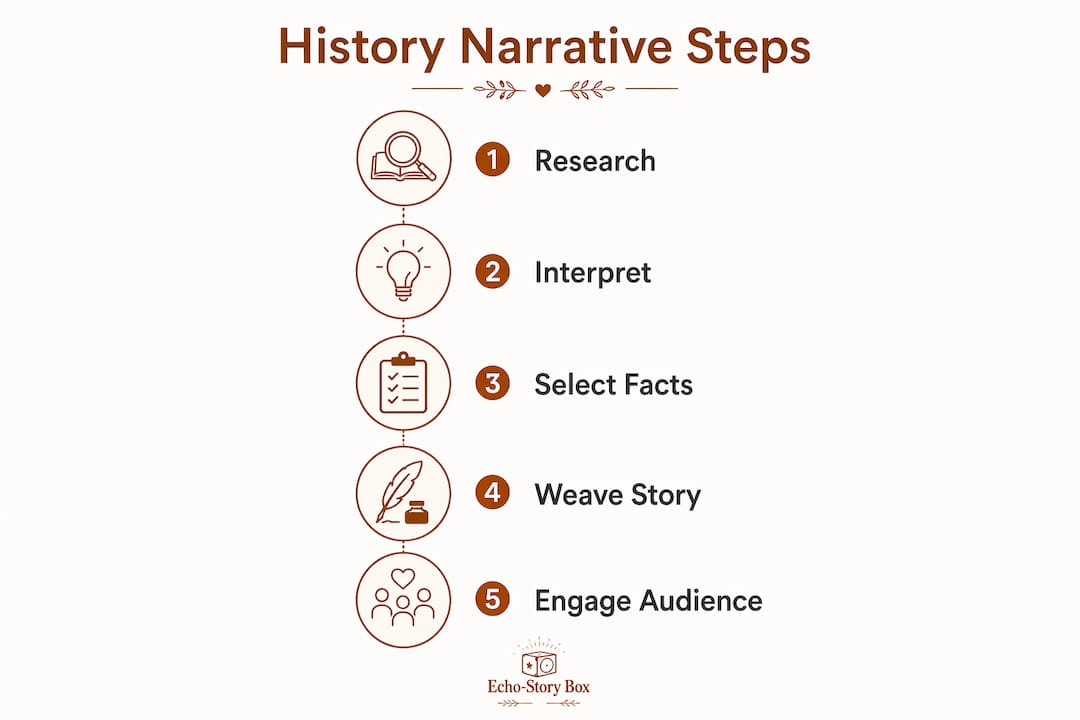
Creating a historical narrative involves three key stages: gathering primary evidence, identifying human conflict or patterns, and structuring a story with a clear beginning, middle, and end. Each stage requires both scholarly rigor and storytelling craft. The evidence must be verified. The structure must serve the truth.
Here is how the process works in practice:
- Gather primary sources. Letters, diaries, government records, photographs, and oral histories form the raw material. The historian reads widely before writing a word.
- Identify the human conflict or question. Every good historical narrative has a central tension. What was at stake? Who was deciding? What could have gone differently?
- Find the unexpected pattern. Archives often contain silences, gaps, and surprises. A missing letter, a crossed-out line, or an overlooked voice can reshape the entire story.
- Structure the narrative. Arrange events so the story moves forward with purpose. Introduce context, build toward a turning point, and close with consequence.
- Verify and revise. Every claim must trace back to evidence. Unsubstantiated stories lack both scholarly and pedagogical value.
The discipline here is real. Narrative history is not creative fiction. It is creative nonfiction, where imagination serves the facts rather than replacing them.
Pro Tip: When telling a historical story to your child, keep a mental list of the sources behind it. If your child asks "How do you know that?", you want a real answer. That habit models good thinking.
Why does narrative make history stick for children?
Narrative transforms political documents into relatable human dilemmas and portrays historical figures as active decision-makers rather than names on a page. That shift from memorization to perspective-taking is what makes stories so effective for young learners. Children do not remember dates. They remember people, choices, and consequences.
Storytelling also supports brain development in ways that lectures simply cannot match. When a child hears a story, they activate emotional memory, not just factual recall. That emotional connection is what makes the learning last.
| Teaching approach | Typical outcome |
|---|---|
| Traditional fact-based instruction | Short-term memorization, low emotional engagement |
| Narrative-driven history | Higher retention, stronger empathy, deeper critical thinking |
| Story plus discussion | Best results: retention, perspective-taking, and questioning skills |
Effective storytelling strategies for children and families include:
- Start in media res. Drop the child into a vivid moment before explaining context. "It was the middle of the night, and the soldiers could hear the river" works better than "In 1776, George Washington crossed the Delaware."
- Focus on one person's experience. A child understands one person's fear or courage far better than a nation's policy.
- Use sensory details. Cold, hunger, noise, and color make history feel real.
- Pause and ask questions. "What would you have done?" builds critical thinking naturally.
- Connect to the child's own life. A story about a child their age facing a hard choice lands differently than a story about generals.
Pro Tip: Avoid telling children what a historical figure "should have" done. Frame decisions as uncertain at the time. This avoids hindsight bias and teaches children that history was never inevitable.
What are the challenges of narrative history interpretation?
Narrative history is an interpretive, creative act. That is its strength and its risk. The trouble with narrative history is that it can oversimplify complex events, exclude marginalized voices, and harden into national myths that resist questioning. Every narrative reflects the choices of its author, including whose story gets told and whose gets left out.
| Strength | Limitation |
|---|---|
| Makes history engaging and memorable | Can oversimplify complex causes |
| Centers human experience and emotion | May exclude minority or marginalized voices |
| Builds empathy through perspective-taking | Risks reinforcing national myths |
| Provides clear structure and meaning | Subjective framing can distort emphasis |
The concept of epistemic accountability addresses this directly. Responsible narrative creation requires that storytellers ground every claim in verified evidence, even when the story is emotionally compelling. Narrative structures evidence. It does not create knowledge on its own.
Teaching children to read historical narratives critically is one of the most valuable skills a parent or educator can build. Ask: Who wrote this? Whose experience is centered? Who is missing from this story? These questions do not undermine the story. They deepen it. A child who learns to ask those questions becomes a reader who can think critically about every story they encounter, historical or otherwise.
How can families use narrative techniques at home?
Starting historical narratives in media res with sensory-rich moments hooks a child's curiosity before any analysis begins. This technique works because it respects how children actually process information: emotion first, context second. You do not need a classroom or a curriculum to use it. You need a story and a willing listener.
Balancing macro and micro perspectives is equally powerful. The "big story" gives children the stakes. The "little story" gives them someone to care about. A story about World War II means more when it includes one child's experience of rationing food than when it only describes troop movements.
Practical tips for families:
- Match the story's complexity to the child's age. Ages 4–6 need simple cause and effect. Ages 8–10 can handle moral ambiguity and multiple perspectives.
- Use audio storytelling. Listening without a screen encourages imagination and focused attention in ways that video rarely does.
- Revisit the same story at different ages. A story about the Underground Railroad lands differently at age 6 than at age 10. Both versions are valuable.
- Let children retell the story. Retelling builds comprehension and reveals what they actually understood.
- Explore educational storytelling formats together. Audio stories, picture books, oral family history, and dramatic play all serve different learning styles.
The American Historical Association notes that the best storytellers find large historical themes inside small, human-centered stories. You do not need to teach the entire Civil War. You need one person's letter home. That letter carries the whole war inside it.
Pro Tip: Make stories interactive by pausing at a key decision point and asking your child what they think will happen next. This builds suspense, engagement, and the habit of thinking historically rather than just listening passively.
Key takeaways
Narrative history is the most effective tool for teaching children history because it connects facts to human experience, emotion, and consequence.
| Point | Details |
|---|---|
| Narrative history defined | It is the interpretive act of shaping verified evidence into coherent, human-centered stories. |
| Historian's process | Gather sources, find the human conflict, structure the story, and verify every claim. |
| Why stories work for children | Narrative builds emotional memory and perspective-taking, not just factual recall. |
| Critical reading matters | Teach children to ask whose voice is centered and whose is missing in any historical story. |
| Practical family techniques | Start in media res, balance big and little stories, and make storytelling interactive. |
Why narrative history is both a gift and a responsibility
I have watched children sit completely still for a story about a ten-year-old girl hiding her family's food during a famine. Not a documentary. Not a textbook chapter. A story told out loud, with pauses and detail and one central question: what would she do next? That stillness tells you everything about why narrative works.
What I have learned over years of watching families engage with history this way is that the craft matters as much as the content. A poorly told true story loses children faster than a well-told fictional one. The emotional hook has to come first. The analysis can follow. If you reverse that order, you lose the room.
The responsibility side of this is real, though. I have seen well-meaning parents tell historical stories that quietly centered one group's heroism while erasing another group's suffering. They were not being dishonest. They were repeating the narratives they had inherited. That is exactly why teaching children to ask critical questions about stories is not optional. It is the whole point. A child who loves history through stories and knows how to question those stories is better prepared for the world than one who simply memorizes approved facts.
The hidden stories are often the most powerful ones. The voices that were left out of the official record, the decisions made by ordinary people under impossible pressure, the small acts of courage that never made it into any textbook. Those are the stories worth finding. And they are always there, waiting in the archive.
— Bob
Bring history to life with screen-free storytelling
Echostory-box was built for exactly this kind of learning. It gives families a calm, screen-free way to share stories that matter, including history adventures featuring characters like Theo the Rabbit, Eileen, and Eisley, who introduce children to real moments from the past through audio storytelling.

Children tap a story card, and the story begins. No menus, no ads, no distractions. Just a voice and an imagination. For parents who want to bring narrative history into their home in a simple, gentle way, Echostory-box offers screen-free storytelling tools that make it easy to start. Whether you are a homeschool family, a grandparent with stories to share, or a parent looking for something calmer than a screen, Echostory-box gives history a voice your child will want to hear again.
FAQ
What is narrative history?
Narrative history is the practice of presenting historical events as a coherent story, focusing on human motives, conflict, and turning points rather than raw data. It makes the past emotionally engaging and easier to understand.
Why is storytelling effective for teaching history to children?
Storytelling moves children from memorization to perspective-taking by turning historical figures into active decision-makers facing real dilemmas. This emotional connection improves both retention and empathy.
How do I avoid hindsight bias when telling history to my child?
Frame historical decisions as uncertain at the time they were made, not as obvious in retrospect. This approach, supported by social studies research, encourages critical thinking and genuine engagement with historical complexity.
What is epistemic accountability in narrative history?
Epistemic accountability means grounding every narrative claim in verified evidence, even when the story is emotionally compelling. Narrative structures evidence but does not create knowledge on its own.
How can I make historical stories more engaging for young children?
Start in the middle of a vivid moment before explaining context, focus on one person's experience, and use sensory details. Pausing to ask "What would you do?" turns listening into active thinking.