

Biographical storytelling is defined as a factual narrative form that transforms a person's life events into a meaningful, structured story shaped by motivations, themes, and emotional resonance. Unlike a simple timeline or résumé, what is biographical storytelling explained most clearly is this: it is a non-fiction literary genre that uses narrative structure, character development, and thematic coherence to bring a real life to the page. Educators use it to spark student engagement. Writers use it to honor remarkable people. Families use it to preserve voices and memories before they fade. Whether you are writing about a historical figure, a grandparent, or yourself, understanding narrative storytelling at this level changes how you approach every sentence.
What is biographical storytelling explained as a craft?
Biographical storytelling is not journalism, and it is not memoir. It sits in its own space: a factual account of someone else's life, told with the care and craft of a novelist. The writer gathers real evidence, then shapes it into a story with a beginning, a turning point, and a resolution. The goal is not to list everything that happened. The goal is to reveal who the person truly was.
The craft of biography lies in selective storytelling that reveals the subject's essence rather than a full life registry. That selectivity is what separates a gripping biography from a dry Wikipedia entry. Robert Caro's multi-volume work on Lyndon B. Johnson, for example, is not exhaustive because it covers every day of Johnson's life. It is powerful because Caro chose which moments revealed the man's hunger for power and his complicated relationship with justice.

Biographical storytelling also differs from autobiography. The writer is always an outside observer, which means every claim must be grounded in verifiable sources. Letters, photographs, interviews, and documented accounts are the raw material. The writer's job is to arrange that material so it breathes.
What are the essential components of effective biographical storytelling?
Effective biographical storytelling involves five components that transform a flat list of facts into a story readers actually finish. Each one serves a specific purpose.
- Clear narrative arc. Every biography needs a beginning, a middle, and an end. The arc shows how the subject changed over time or how the world changed around them. Without it, the reader has no reason to keep turning pages.
- Character development. The subject must feel like a person, not a statue. Show their doubts, their failures, and their growth. Readers connect with people who struggle, not with perfect icons.
- Emotional resonance. A biography that only reports facts leaves readers cold. Emotional resonance comes from placing the reader inside a pivotal moment: the morning a decision was made, the letter that changed everything, the silence after a loss.
- Vivid descriptive imagery. Concrete sensory details make scenes real. The smell of a workshop, the sound of a crowded market, the weight of a tool in someone's hands. These details are not decoration. They are the difference between reading about history and feeling it.
- Identifiable themes. The best biographies carry a central message: perseverance, sacrifice, reinvention. Themes give the story meaning beyond one person's life and make it relevant to every reader.
Pro Tip: Before you write a single sentence, identify the one theme that defines your subject's life. Every scene you choose should connect back to that theme. If a fact does not serve the theme, cut it.
A biography that lacks even one of these components feels flat. Think of a school report that lists dates and achievements but never explains why the person made the choices they did. That is a timeline, not a story.
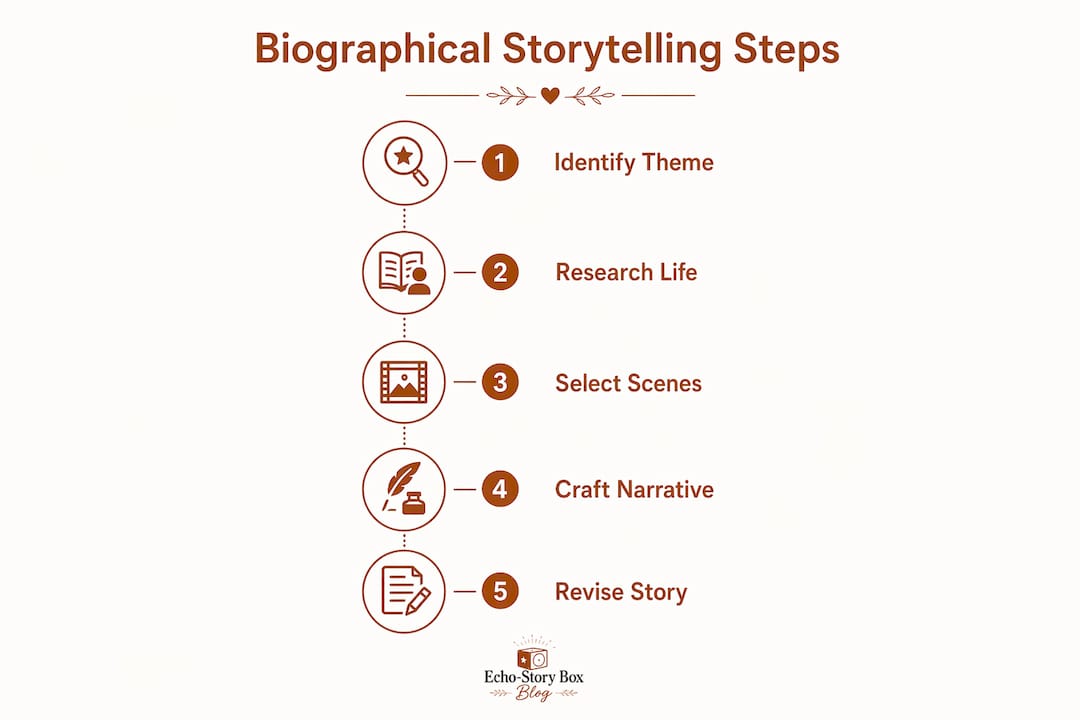
How does the process of writing a biographical story unfold?
The 8-step writing process moves from research through final revision and balances factual accuracy with narrative creativity. Following these steps keeps you from the most common trap: dumping every fact you found onto the page.
- Define your project scope. Decide whose life you are telling, what period you will cover, and who your audience is. A biography written for a grandchild sounds different from one written for an academic journal.
- Build a timeline. Gather dates, places, and key events in chronological order. This is your raw material, not your final structure.
- Gather primary evidence. Letters, diaries, photographs, interviews, and official records are your foundation. Primary evidence must anchor all biographical storytelling scenes to maintain factual accuracy.
- Identify your through-line. This is the central question or driving theme that holds the story together. Most successful biography writers start with a central through-line before drafting, which helps avoid information dumping and delivers a more engaging emotional core.
- Structure your narrative. Decide whether you will tell the story chronologically, thematically, or through a series of scenes. This choice shapes everything that follows.
- Draft the story. Write with the reader in mind. Use scenes, dialogue grounded in documented sources, and descriptive detail. Do not write a report. Write a story.
- Fact-check every claim. Every name, date, and quoted statement must be verified against your primary sources. Inventing dialogue or internal thoughts is inappropriate for narrative nonfiction biographies.
- Revise for flow and impact. Read the draft aloud. Cut sections that slow the pace. Strengthen transitions. Make sure every paragraph earns its place.
Pro Tip: Keep a running "cut file" as you revise. Paste removed paragraphs there instead of deleting them. You will feel freer to cut, and occasionally you will find a gem that belongs somewhere else.
The most common mistake at this stage is treating step two as the final product. A timeline is research, not writing. The story begins when you start making choices about what matters and why.
What narrative structures and storytelling techniques enrich biographical storytelling?
Biography storytelling techniques fall into three main structural approaches. Each one serves a different purpose, and the best writers choose based on the subject's life, not personal habit.
| Structure | How It Works | Best Used When |
|---|---|---|
| Linear chronology | Tells the life from birth to death or a defined endpoint in order | The subject's life has a clear arc of growth or transformation |
| Thematic | Organizes chapters around ideas rather than time periods | The subject's life resists simple chronology or spans many decades |
| Flashback or in medias res | Opens at a dramatic moment, then moves backward and forward | The most compelling moment is not the beginning of the life |
Narrative biographies typically sacrifice strict chronological details to emphasize thematic clarity and emotional resonance. This is not cheating. It is craft. A biography of Marie Curie, for instance, might open with the moment she became the first woman to win a Nobel Prize, then move backward to her childhood in Warsaw. That choice creates immediate tension and gives the reader a reason to care about the early years.
Writers often struggle with structure because they try to force strict chronology. Successful stories use structure to achieve emotional or educational goals, not to satisfy a calendar. The question to ask is not "What happened first?" but "What does the reader need to feel first?"
Narrative nonfiction techniques, including scene-setting, pacing, and point of view, are all available to the biographical writer. The only firm rule is that biographical storytelling builds human connection by combining historical truth with novelistic techniques. You can write with the pace of a thriller. You cannot invent the facts.
How can educators, writers, and families apply biographical storytelling?
The importance of biographical storytelling shows up differently depending on who is using it and why. Here are the most practical applications across three groups.
For educators:
- Assign students to write short biographical sketches of historical figures using primary sources. This teaches research skills alongside narrative writing.
- Use the five-component framework (arc, character, emotion, imagery, theme) as a grading rubric. Students learn to evaluate their own work against clear criteria.
- Pair biographical storytelling with oral history projects. Students interview family members or community elders, then shape those interviews into written narratives. This connects life stories as teachable moments to real classroom learning.
- Introduce picture book biographies as mentor texts. Books about figures like Ruby Bridges or Harriet Tubman show young writers how professional authors handle complex lives in short formats.
For writers:
- Choose subjects whose lives raise questions you genuinely want to answer. Curiosity sustains a long project better than admiration alone.
- Build your research archive before you write. A well-organized collection of primary sources makes the drafting stage far less painful.
- Read widely in the genre. Works by authors like David McCullough, Walter Isaacson, and Doris Kearns Goodwin demonstrate how biography storytelling techniques operate at a high level.
For families:
- Record grandparent interviews using a simple audio device. Ask open questions: "What was the hardest year of your life?" "What do you want your grandchildren to know about you?"
- Organize family photographs chronologically, then write captions that tell a story rather than just label a face. This is biographical storytelling in its simplest form.
- Create a legacy audio recording that a child can return to for years. Explore personalized story experiences as a way to make those recordings feel like gifts rather than archives.
- Use the through-line concept at home. Ask: "What is the one thing we want future generations to know about this person?" Let that answer guide every story you preserve.
Why the through-line is the heart of every biography
After years of working with biographical storytelling projects, I keep coming back to the same truth: most struggling writers have too many facts and no through-line. They know everything about their subject. They just do not know what the story is about.
The through-line is not a summary. It is a question the story answers. "How did a girl born into poverty become the most influential scientist of her generation?" That question pulls every scene forward. Every fact you include either answers that question or it does not belong.
I have seen families spend months recording interviews and organizing photographs, only to end up with a beautiful archive that no one ever reads twice. The archive becomes a story the moment someone asks: "What did this person believe that shaped everything they did?" That single question changes the project from a collection into a narrative.
The emotional challenge is real too. Writing about someone you love means choosing what to leave out. That feels like a betrayal at first. Over time, you realize that leaving out the noise is how you honor the signal. The best biographical stories are not the longest ones. They are the ones where every sentence earns its place.
Biographical storytelling fosters empathy by grounding narratives in truth while using storytelling techniques that make readers feel something real. That combination of honesty and craft is what makes a biography last.
— Bob
Preserve your family's story with Echostory-box
Understanding biographical storytelling is the first step. The second step is actually capturing the voices and memories before they are gone.
Echostory-box is built for exactly this. It is a screen-free audio storytelling tool that lets families record grandparent messages, life lessons, and personal narratives onto simple NFC story cards. A child taps a card and hears a grandparent's voice telling a real story from their life. No scrolling, no ads, no complicated setup. Just a voice and a story. If you are ready to turn your family's history into something your grandchildren can hold and hear, explore Echostory-box and see how simple legacy storytelling can be.
FAQ
What is the biographical storytelling meaning in simple terms?
Biographical storytelling is the practice of turning a real person's life events into a structured, meaningful narrative using techniques like character development, emotional scenes, and a central theme. It is a non-fiction form that reads like a story rather than a report.
How does narrative biography differ from a standard biography?
A narrative biography uses novelistic techniques such as scene-setting, pacing, and vivid imagery to bring the subject's life to life, while a standard biography may present facts in a more straightforward, encyclopedic format. Both are factual, but narrative biography prioritizes emotional engagement alongside accuracy.
What is the most important step in how to tell a biography?
Identifying a central through-line or driving question before drafting is the most critical step. This focus prevents information dumping and gives every scene a clear purpose within the larger story.
Can families use biographical storytelling without writing experience?
Yes. Families can start with recorded audio interviews, organized photographs, and simple written captions. The five-component framework (arc, character, emotion, imagery, theme) works as a guide even for first-time storytellers with no formal writing background.
What narrative structures work best for biographical storytelling examples?
Linear chronology works well when a subject's life shows clear growth over time. Thematic structures suit complex lives that resist simple timelines. Flashback openings work best when the most compelling moment is not the beginning of the subject's life.
Key takeaways
Biographical storytelling is most effective when a strong through-line, factual grounding, and narrative structure work together to reveal a person's essence rather than just their timeline.
| Point | Details |
|---|---|
| Define the through-line first | Identify the central question your biography answers before writing a single scene. |
| Use the five-component framework | Narrative arc, character development, emotional resonance, imagery, and theme are the building blocks of every strong biography. |
| Ground every scene in primary evidence | Letters, interviews, and documented accounts must anchor all reconstructed moments to maintain factual accuracy. |
| Choose structure by emotional goal | Select chronological, thematic, or flashback structures based on what the reader needs to feel, not what happened first. |
| Apply it at home | Families can use biographical storytelling frameworks to preserve grandparent voices and create lasting legacy recordings for future generations. |