
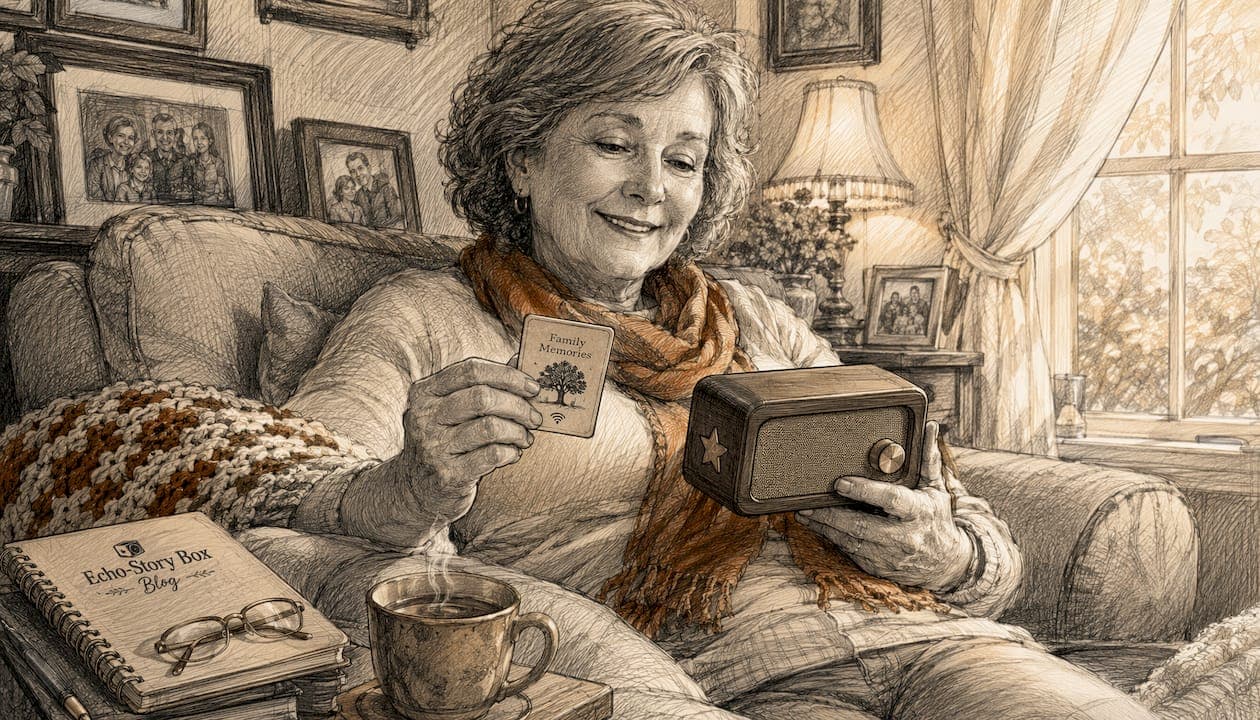
The best types of legacy gifts for grandchildren aged 3–10 are screen-free, audio-first keepsakes that pair a grandparent's recorded voice with something a child can hold. Many family stories are lost within a few generations, which means the time to record is now, while the storyteller is present and well. The Library of Congress recommends lossless audio formats for long-term preservation, and Echostory-box makes the whole experience tactile and simple for young children.
Here are the five strongest options to consider:
- Family voice recordings — a grandparent's voice reading a bedtime story or sharing a memory
- Tactile audio players with NFC story cards — children tap a card and the story plays instantly
- Personalized story subscriptions — monthly story cards mailed to the child
- Heirloom object paired with a recorded explanation — a ring, quilt, or keepsake with its story attached
- Experience and tradition gifts recorded afterward — a baking session or holiday ritual captured in audio
Table of Contents
- What types of legacy gifts work best for grandchildren?
- Why does screen-free audio storytelling matter for ages 3–10?
- How do you create a meaningful audio gift step by step?
- What do sample gift packages look like, and what do they cost?
- How do you preserve recordings so future generations can find them?
- Key Takeaways
- Why audio-first gifts are worth more than they look
- Echostory-box brings all of this together in one place
What types of legacy gifts work best for grandchildren?
Experts recommend story-led memories over factual summaries when engaging younger grandchildren. A recording that says "Let me tell you about the summer I turned eight" lands far better with a five-year-old than a family history document. Each gift category below serves a different budget, comfort level, and family situation.
- Family voice recordings — the simplest and most personal option; a grandparent records a short story or message using a phone or tablet. Low cost, high emotional impact, and easy to duplicate.
- Tactile audio players with NFC story cards — a physical box that plays audio when a child taps a card. No screen, no menus. Perfect for ages 3–7 who love hands-on play.
- Personalized story subscriptions — monthly mailed cards with new stories featuring the child's name, pets, or favorite places. Builds anticipation and a growing library over time.
- NFC story cards or audio story cards — standalone cards that store or trigger audio. Affordable to produce and easy to slip inside a birthday card or memory box.
- Heirloom object + recorded story — a grandmother's brooch or a grandfather's pocket watch, paired with a short recording explaining its meaning. The object becomes a doorway into the story.
- Experience and tradition gifts — a shared cooking session, a fishing trip, or a holiday ritual. Record a short audio recap afterward so the memory lives beyond the moment.
| Gift category | Best age range | Effort level | Rough cost | Emotional durability |
|---|---|---|---|---|
| Family voice recording | 3–10 | Low | — | Very high |
| Tactile audio player + NFC cards | 3–7 | Medium | $50–$80 | Very high |
| Personalized story subscription | 4–10 | Low (ongoing) | $10/month | High |
| Heirloom + recorded explanation | 5–10 | Medium | — | Very high |
| Experience gift + audio recap | 3–10 | Medium | Varies | High |
Why does screen-free audio storytelling matter for ages 3–10?
Audio preserves what photos and text simply cannot: the warmth in a voice, the pause before a punchline, the way a grandparent laughs. A child who hears their grandmother's voice telling a story about her childhood neighborhood gets something no photograph can deliver.
Children in the 3–10 age range are in a prime window for imaginative listening, making activities like reading comprehension practice especially effective at fostering their narrative skills. They have not yet developed the passive consumption habits that screens can create, and their brains actively build mental images from spoken words. Short, vivid stories hold their attention far better than long chronologies. Pairing stories with photos or simple visual prompts makes recordings even more engaging for this age group.
The urgency is real: 90% of family stories are lost within three generations. A five-minute recording made this week could be the story a grandchild shares with their own children decades from now.
The social benefits are just as meaningful. A child who has a nightly ritual of tapping a story card and hearing Grandpa's voice builds a sense of connection that spans distance and time. That ritual, repeated across years, becomes part of why recorded stories become treasures for families long after the storyteller is gone.
How do you create a meaningful audio gift step by step?
The simplest approach: plan 3–5 short recording sessions, each producing one themed, bite-sized story of 5–12 minutes. That length is long enough to feel complete and short enough to hold a young child's attention. Short personal messages of 5–15 minutes are more replayed and emotionally durable than longer recordings, and updating them every 2–3 years keeps the legacy current.
Step-by-step recording checklist:
- Choose 3–5 story themes (childhood memory, family recipe, a funny moment, a life lesson, a holiday tradition).
- Schedule sessions of 15–20 minutes maximum to avoid fatigue, especially for older storytellers.
- Use a simple prompt card to start each session (see prompts below).
- Record using a smartphone voice memo app, a USB microphone, or a dedicated recorder. Save files as WAV or high-quality MP3 (320 kbps).
- Add metadata immediately: speaker's full name, date, location, and relationship to the child.
- Create two backups before the session ends: one on a local drive, one in cloud storage.
Recording prompts for ages 3–10:
- "Tell me about the silliest thing that ever happened to you as a kid."
- "What did your house smell like when you were little?"
- "What's the story behind [heirloom object]?"
- "What's one thing you hope I always remember?"
- "Teach me how to make your favorite recipe, step by step."
Focusing prompts on early childhood experiences tends to trigger the most vivid, sensory-rich stories. Researchers call this the reminiscence bump: memories from roughly ages 10–30 are recalled with the most detail and warmth, making them ideal material for legacy recordings.
Pro Tip: Anchor each recording to a physical object. Hold the heirloom, open the recipe card, or look at a photo while recording. Children who can hold the same object while listening form a much stronger emotional connection to the story.
For practical guidance on recording sessions with elderly parents, including setup tips and pacing, Echostory-box has a dedicated resource worth bookmarking.
What do sample gift packages look like, and what do they cost?
| Gift package | What's included | Budget range | Prep time | Who leads |
|---|---|---|---|---|
| Quick DIY audio letter | Recorded voice message on a USB drive or shared link | — | 1–2 hours | Grandparent |
| Printed storybook + audio card | Custom hardcover book ($50–$80) + NFC card with matching audio | $50–$80 | 1–2 weeks | Parent + grandparent |
| Tactile audio player + 6-card starter pack | Echo-Story Box + 6 preloaded NFC story cards | $50–$80 | 1–3 days | Parent |
| Monthly story card subscription | New story cards mailed each month | $10/month | Minimal (ongoing) | Parent |
| Heirloom + recorded explanation package | Physical keepsake + USB or NFC card with story | — | 2–4 hours | Grandparent |
A few practical notes on each:
The Quick DIY audio letter costs almost nothing and can be ready in an afternoon. It works beautifully as a birthday surprise tucked inside a card.
Printed storybooks are powerful keepsakes. Hardcovers in the $50–$80 range hold up to years of handling far better than paperback options, which matters when a child wants to read the same book every night for three years.
The tactile audio player option is where Echostory-box shines. Children tap a card and the story plays. No passwords, no menus, no screen. For ages 3–7 especially, that simplicity is the gift.
Subscription boxes build a living library over time. A child who receives a new story card each month develops a ritual around it, which is exactly the kind of repeated, relationship-building experience that legacy planning works best as when it is proactive and shared during life.
Plan to refresh voice recordings every 2–3 years so the content stays connected to where the child is developmentally.
How do you preserve recordings so future generations can find them?
Start with this principle: use multiple backups and clear metadata so a family member 30 years from now can find the file, understand who is speaking, and play it without special software.
Preservation checklist:
- Save audio in WAV (lossless) for archival copies and high-quality MP3 (320 kbps) for everyday playback.
- Name every file clearly:
LastName_FirstName_Topic_YYYY-MM-DD.wav(e.g.,Miller_Ruth_ChicagoChildhood_2026-03-15.wav). - Record metadata in a simple text document stored alongside the files: speaker name, date, location, relationship to child, and a one-sentence summary.
- Anchor audio to a physical prompt such as a printed story card, recipe card, or NFC card stored with the heirloom.
Backup steps (numbered for clarity):
- Save one copy on a local external hard drive stored at home.
- Save a second copy in cloud storage (Google Drive, iCloud, or a family-shared folder).
- Keep a printed index of all recordings with file names and short descriptions, stored in a physical memory box or with important family documents.
- Consider a third copy on a USB drive kept with a trusted family member in a different location.
On rights: the person who makes a recording owns it. If you plan to share recordings beyond immediate family, get simple written permission from anyone else whose voice appears. For preserving family voice recordings in a format children can access as they grow, Echostory-box offers step-by-step guidance tailored to non-technical families.
Key Takeaways
Screen-free, audio-first legacy gifts that pair a grandparent's recorded voice with a tactile keepsake are the most emotionally durable and accessible types of legacy gifts for grandchildren aged 3–10.
| Point | Details |
|---|---|
| Start recording now | 90% of family stories are lost within three generations; one 5–10 minute session this week is enough to begin. |
| Keep sessions short | Limit recording sessions to 15–20 minutes; 3–5 short sessions produce richer material than one long marathon. |
| Anchor audio to an object | Pair every recording with a physical prompt (story card, heirloom, recipe card) so children can access it independently. |
| Use two geographically separate backups | Save one copy locally and one in cloud storage; add a printed index stored with family documents. |
| Echostory-box as a ready-made option | Echostory-box combines a tactile NFC audio player, family voice recording support, and monthly story subscriptions in one screen-free gift. |
Why audio-first gifts are worth more than they look
There is a tendency to underestimate a simple voice recording. It does not come in a box. It does not light up. A child cannot show it off at school. But ask any adult what they would most want from a grandparent who has passed, and almost no one says "a photo album." They say: "I wish I could hear their voice one more time."
The families I have seen benefit most from audio-first legacy gifts are not the ones who built elaborate archives. They are the ones who recorded one short, honest story and gave it a home the child could find on their own. A tactile audio player on a bookshelf. A story card in a memory box. Something simple that a six-year-old can operate without help.
The gift is not the technology. The technology just makes the voice accessible. Start with one recording, keep it short, and give it somewhere to live.
Echostory-box brings all of this together in one place
If you want a ready-made solution that handles the tactile player, the NFC story cards, the family voice recording support, and the monthly subscription in one package, Echostory-box is built for exactly that.
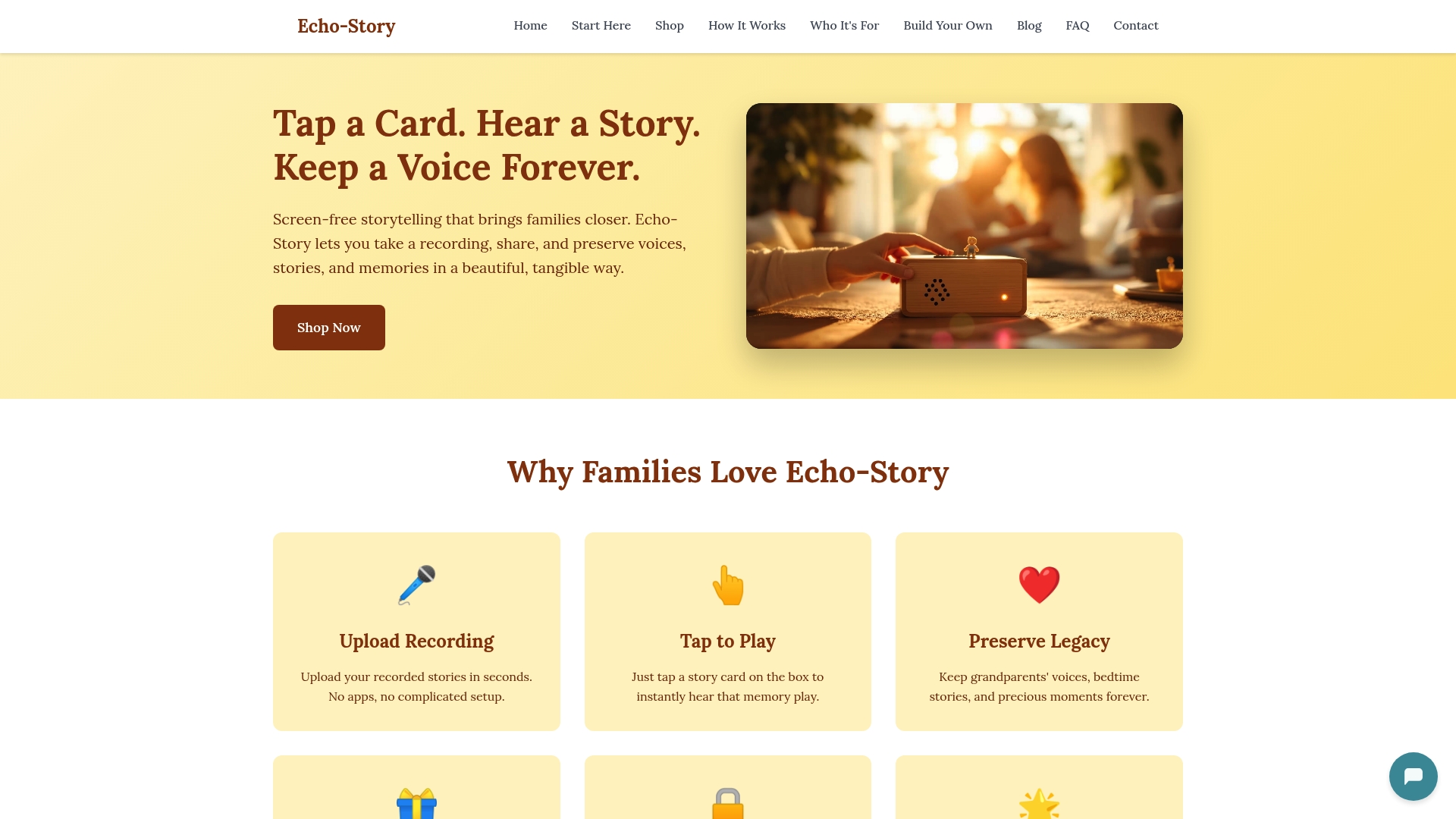
Children tap a story card and the audio plays instantly. No screen, no ads, no complicated setup. Grandparents can record their own voice messages and load them onto a card. Parents can add a monthly story subscription so new cards arrive by mail. The whole experience is designed to feel like opening a storybook, not operating a device. It fits every gift category covered in this article: tactile audio player, personalized stories, family voice recordings, and legacy preservation in one calm, screen-free package.
Visit Echostory-box to explore starter packs, DIY build options, and legacy recording services. One small gift today can become the voice a grandchild carries for a lifetime.