

Biblical character education gives children a moral compass rooted in Scripture, builds prosocial behavior, strengthens emotional resilience, and cultivates a lasting sense of purpose. Research consistently links faith-based moral formation to lower behavioral risks, greater gratitude, and stronger social responsibility. These outcomes hold across home, school, and church settings when families and educators work together with a shared moral language.
The benefits of biblical character education for kids go well beyond good manners. When children understand why honesty, compassion, and forgiveness matter, not just that they should practice them, those values tend to stick through adolescence and into adulthood.
Here is a quick look at what the research and practice show:
- A clear moral compass grounded in Scripture rather than shifting cultural norms
- Stronger prosocial behavior, including empathy, generosity, and conflict resolution
- Lower behavioral and relational risks among children who engage regularly with the Bible
- Greater sense of purpose and gratitude linked to parental faith socialization
- Emotional resilience built through prayer, community, and story
- Long-term character formation that moves from rule-following to genuine heart-change
Table of Contents
- What is biblical character education, and how does it differ from secular programs?
- How does biblical character formation happen day-to-day?
- What does the research say about outcomes?
- What should you teach at each age and stage?
- Practical steps you can take this week
- How do you measure character growth in children?
- Common challenges and how to respond well
- Key Takeaways
- Why biblical character education matters more than most programs admit
- Echostory-box makes faith-based storytelling simple and screen-free
- Useful sources and further reading
What is biblical character education, and how does it differ from secular programs?
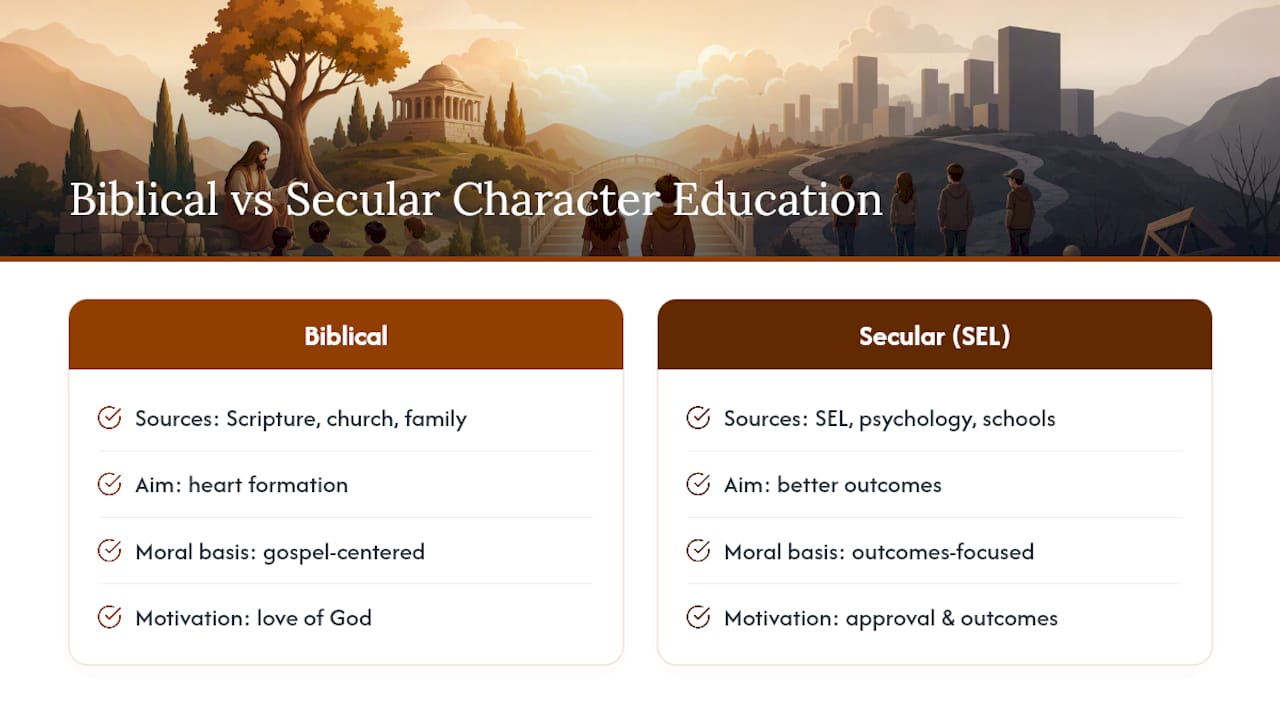
Biblical character education is the intentional process of shaping a child's values, habits, and motivations through Scripture, church tradition, and family practice. Its goal is not simply to produce well-behaved children. The aim is heart formation: helping children act rightly because they love God and neighbor, not because they fear punishment or want social approval.
That distinction separates it from most secular character curricula. Programs like social-emotional learning (SEL) teach empathy and self-regulation because those skills produce better outcomes for individuals and communities. That is a worthy goal. Biblical character training teaches the same virtues, but anchors them in a gospel-centered moral vision: children are made in God's image, they are loved unconditionally, and their choices matter because of that relationship.
Gospel-centered moral education emphasizes not just right actions but right actions empowered by love of God. Scripture and church tradition shape conscience in ways that avoid a purely culture-driven ethics. The practical difference shows up in discipline, in curriculum, and in the language adults use when a child makes a poor choice. A secular program might say, "That hurt your friend's feelings." A biblical approach adds, "And God cares about how we treat each other because He made both of you."
Curriculum integration is another key difference. In faith-based schools and homeschool settings, biblical values are woven through literature, history, and science, not confined to a weekly character lesson. That consistency is what builds lasting habits rather than surface compliance.
How does biblical character formation happen day-to-day?
Character is not taught in a single lesson. It forms through repeated, consistent experiences across the places where children spend their time.
Daily routines that shape the heart
Morning devotions, bedtime prayer, and short scripture readings create a rhythm that children internalize over years. These do not need to be long. Five minutes of a Bible story at breakfast, a short prayer before school, and a gratitude question at dinner can do more than a weekly character class. Faith-based routines in early childhood strengthen habits, social-emotional skills, and classroom culture, according to early childhood educators who have implemented them.
Modeling and shared language
Children watch adults more than they listen to them. When a parent admits a mistake and asks forgiveness, or a teacher pauses a lesson to address a conflict with grace, those moments teach more than any curriculum page. The most effective programs use a shared moral vocabulary across home, school, and church, so children hear the same words and see the same values modeled in every setting.
Curriculum integration and restorative discipline
In faith-based schools, biblical values shape character through literature discussions, history lessons framed around justice and courage, and science units that emphasize stewardship. Discipline in these settings tends to be restorative rather than purely punitive: when a child wrongs another, the process focuses on repentance, repair, and reconciliation. Practitioners report that this approach produces deeper heart-change and supports long-term relational health.
Service learning
Short service projects, even simple ones like writing cards for elderly neighbors or collecting food for a local pantry, give children a chance to practice compassion and stewardship in real situations. The experience of serving tends to make abstract values feel concrete and personal.
Pro Tip: Habit-stack character formation with an existing routine. Attach a short story or scripture reflection to something you already do every night, like a bedtime story. The habit is already there; you are simply adding meaning to it. Echostory-box's faith-based audio stories make this easy because children tap a card and listen, with no screen required.
What does the research say about outcomes?
The evidence connecting biblical and religious character education to measurable outcomes is growing, though researchers are careful to note that most studies show correlation rather than proven causation.
Key finding: A survey of U.S. children ages 8–12 found that frequent Bible engagement correlated with lower rates of lying and other relational risks, with effects persisting even after controlling for several background factors.
Family religious practice is a particularly strong predictor. Religious socialization research shows that family religious discussion and practice predict higher endorsement of binding moral foundations, including loyalty and purity, and that family discussion is a stronger predictor than attendance alone. Going to church matters, but talking about faith at home matters more.
Parental faith practices also shape character into young adulthood. A study published in the Journal of Character Education found modest but statistically significant associations between parents' faith socialization and young adults' social responsibility, purpose, and gratitude. These are not dramatic effect sizes, but they are consistent across different samples.
At the school level, a program evaluation at Benguet State University Elementary Laboratory School found that integrating Christian values across the curriculum was associated with high holistic development ratings in spiritual, social, and emotional domains.
Key outcomes the research supports:
- Higher prosocial behavior and empathy
- Lower behavioral and relational risk among frequent scripture readers
- Greater sense of purpose and gratitude linked to parental faith practices
- Stronger civic engagement and social responsibility in young adults
- Improved social-emotional skills in faith-based early childhood classrooms
A note on limits: Family environment, socioeconomic factors, and community context all influence these outcomes. Biblical character education works best as part of a broader ecosystem of loving relationships, not as a standalone program.
What should you teach at each age and stage?
Starting early matters. The years from birth through age six are when children form their foundational worldview, emotional habits, and sense of safety. Values introduced in these years through story, song, and simple prayer become the baseline assumptions children carry into school.
Ages 0–6: Habits and simple stories
At this stage, children absorb more than they analyze. Focus on simple habits: saying thank you, sharing, being gentle, and hearing Bible stories that feature clear, loving characters. The Good Samaritan, Noah's faithfulness, and the story of Ruth are all accessible at this age. Repetition is the method. Children need to hear the same stories many times before the values settle in.
Ages 6–10: Empathy, responsibility, and reasoning
Early elementary children can begin to reason about fairness and consequences. This is the right time to introduce responsibility through chores and classroom roles, and to discuss empathy explicitly: "How do you think she felt when that happened?" Scripture memory works well here, and character education through storytelling gives homeschool families a structured way to build these conversations into the school day.
Practical steps you can take this week
You do not need a formal curriculum to start. These seven daily actions work for both home and classroom settings.
- Sunday — Connect it to story. Read or listen to a Bible story or values-driven children's story that reinforces the week's theme. Let the story do the teaching.
Pro Tip: The most common mistake in character education is moralizing after every choice. Instead, connect values to love: "We share because God is generous with us." One sentence, said warmly and consistently, does more than a five-minute lecture. Children internalize the motivation, not just the rule.
How do you measure character growth in children?
Measuring character is genuinely hard, and any honest approach acknowledges that. The goal is not a grade; it is a pattern of growth over time. Simple, consistent observation is more useful than a formal test.
A practical observation rubric
| Character Trait | Beginning | Developing | Consistent |
|---|---|---|---|
| Honesty | Avoids truth when uncomfortable | Sometimes tells the truth unprompted | Tells the truth even when it costs something |
| Empathy | Rarely notices others' distress | Notices but needs prompting to respond | Responds to others' needs without prompting |
| Responsibility | Avoids owning mistakes | Acknowledges mistakes when confronted | Takes ownership and seeks to make things right |
| Service | Participates only when required | Volunteers occasionally | Initiates acts of service independently |
Simple data collection ideas
Teacher and parent observation logs, kept weekly, do not need to be elaborate. A short note like "Offered to help without being asked" or "Told the truth about breaking the rule" gives you a pattern over a semester. Student self-reflection prompts, such as "One way I showed kindness this week was ___," add the child's own perspective. Short behavior tallies for specific target behaviors (unprompted sharing, honest reporting) can track progress in a classroom setting.
The key is consistency. Reviewing observations monthly with a co-teacher or spouse reveals trends that a single snapshot misses. Christian curriculum programs that emphasize responsibility and trustworthiness often include built-in reflection tools that make this process easier for homeschool families.
Common challenges and how to respond well
Navigating diverse classrooms
Faith-based schools and homeschool co-ops are not always homogeneous. Children come from families with different levels of faith commitment. The most effective response is to teach values with warmth and clarity rather than pressure. When a child from a less religious home hears "We share because God loves us and made everyone valuable," that framing is gentle enough to be received without alienation, and specific enough to be meaningful.
When children ask hard questions
"Why did God let that happen?" or "Do I have to believe this?" are signs of healthy moral development, not rebellion. A short, honest response works better than a long defense: "That's a really good question. I don't have a complete answer, but here's what I believe and why." Modeling intellectual humility is itself a character lesson.
Avoiding checkbox morality
The biggest risk in any character program is reducing virtue to a checklist. Children who learn to perform kindness for a sticker or a grade have learned compliance, not character. The heart-change approach keeps motivation central: the goal is children who want to be honest, not children who know they should be. Practical response: when praising a child's behavior, name the motivation, not just the action. "You helped her because you care about her" lands differently than "Good job helping."
Pluralism in public and mixed settings
Parents who want to reinforce biblical values at home while their children attend public school face a real tension. The most practical response is to make home the primary formation environment: consistent routines, shared language, and story-based conversations at home can reinforce values that school does not explicitly teach. Narrative gospel teaching gives parents a structured framework for doing this through story rather than lecture.
Key Takeaways
Biblical character education works best when it moves children from rule-following to genuine love of God and neighbor, reinforced consistently across home, school, and church.
| Point | Details |
|---|---|
| Start early and stay consistent | The years from birth to age six are foundational; habits and stories introduced then become lasting moral anchors. |
| Family practice outweighs attendance | Research shows family religious discussion predicts moral formation more strongly than church attendance alone. |
| Bible engagement reduces risk | Frequent scripture reading among children ages 8–12 correlates with lower rates of lying and relational risk. |
| Measure growth, not performance | Use observation rubrics and self-reflection prompts to track patterns over time, not single-moment grades. |
| Echostory-box supports story-based formation | Screen-free, faith-based audio stories make it simple to build daily character routines without a screen in the room. |
Why biblical character education matters more than most programs admit
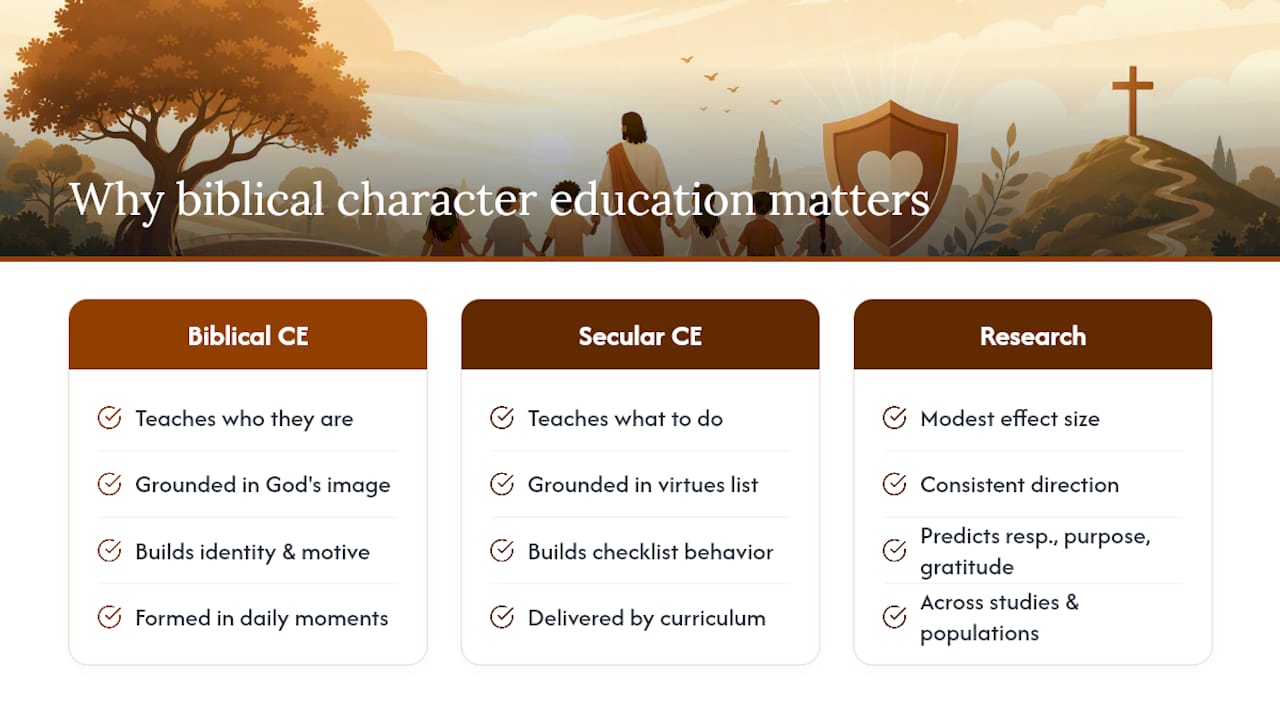
Here is what most articles on this topic miss: the research on biblical character education is modest in effect size but remarkably consistent in direction. Parental faith socialization shows up again and again as a predictor of social responsibility, purpose, and gratitude in young adults. That consistency across different studies and populations is more meaningful than any single dramatic finding.
What I find most compelling is the motivation question. Secular character programs teach children what to do. Biblical character education, at its best, teaches children who they are and whose they are. A child who understands that she is made in God's image and loved unconditionally has a different foundation for moral decision-making than a child who has simply memorized a list of virtues. The former has an identity; the latter has a checklist.
The practical implication for parents and educators is this: do not outsource character formation to a curriculum. The most powerful formation happens in small, repeated moments, a story at bedtime, a conversation after a conflict, a parent who admits they were wrong. Those moments, accumulated over years, are what actually shape a child's heart.
Echostory-box makes faith-based storytelling simple and screen-free
If you are looking for a gentle, practical way to bring biblical values into your child's daily routine, Echostory-box was built for exactly this. It is a screen-free audio player that children operate by tapping an NFC story card. No menus, no ads, no scrolling. Just a story that begins the moment the card touches the box.

For faith-based families, Echostory-box supports original character-building adventures, Bible story audio, family voice recordings, and personalized story experiences where your child's name and family become part of the story. Grandparents can record faith testimonies and encouragement messages that children can revisit for years. Churches and homeschool families use it for devotion routines, small-group story time, and values-based learning that feels like play, not school.
The simplicity is the point. When a child taps a card and hears a story about courage or kindness, the lesson arrives through imagination, not instruction. That is how character formation actually works at this age.
Visit Echostory-box to see story card packs, starter kits, and faith-based content options for children ages 3–10.
Useful sources and further reading
These resources represent the strongest available research and practical guidance on biblical character education for children.
- Investigating the associations between parents’ faith socialization practices and young adults’ character formation
- Building the Foundation: The Benefits of Integrating Faith-Based Routines in Early Childhood Education
- How Biblical Values Shape Character Development in Students — Haywood Christian Academy
- Why Does Character Matter for Children?