
Blue-enriched evening light suppresses children's melatonin and shifts their circadian clock, making it harder for them to fall asleep and stay asleep. The single most helpful thing you can do tonight is start a 1–2 hour screen-free window before your child's bedtime.
Here is what that means in practice:
- Turn off phones, tablets, and TVs at least 60–120 minutes before lights-out.
- Dim overhead lighting in the rooms your child uses in the evening.
- Replace screen time with calm, low-light activities: drawing, puzzles, or listening to an audio story.
- Remove light-emitting devices from the bedroom entirely, including tablets used as white-noise players.
The science behind these steps is clear, and it is especially important for children because their eyes and brains respond to evening light more strongly than adults' do. The sections below explain why, and what you can do about it at every age.
Table of Contents
- What blue light actually is and why it matters for sleep
- How evening light suppresses melatonin and shifts your child's clock
- Where evening blue light comes from and why timing matters
- Practical steps you can take tonight to protect your child's sleep
- Age-specific guidance for preschoolers, school-age kids, and teens
- What night mode, blue-blocking glasses, and filters actually do
- When to talk to your pediatrician about your child's sleep
- Why audio stories support melatonin-friendly bedtime routines
- Key Takeaways
- The case for small, consistent changes over perfect solutions
- Useful sources and further reading
What blue light actually is and why it matters for sleep
Visible light spans a spectrum from roughly 380 nm to 700 nm. The short end of that range, approximately 450–490 nm, is what we call blue light. NASA's documentation of the visible electromagnetic spectrum confirms that peak sensitivity for the eye's non-visual system sits near 480–490 nm, right in the middle of that blue band.
Why the non-visual system? Your child's eyes contain two types of light-sensing cells. The familiar rods and cones handle vision. A third type, called intrinsically photosensitive retinal ganglion cells (ipRGCs), does something different: it reads ambient light levels and sends timing signals to the brain's master clock. These cells contain a pigment called melanopsin, and melanopsin responds most strongly to light near 480 nm.
Think of it this way: the visible spectrum is like a piano keyboard. Blue light sits at the far left end, the high-sensitivity keys that trigger your child's internal clock. Red and amber light sit at the far right, where the clock barely notices.
Common sources of blue-enriched light in a typical home evening:
- Smartphone and tablet screens
- LED televisions
- Compact fluorescent and LED overhead bulbs (especially those labeled "daylight" or "cool white")
- Some LED night lights
- Bright desk lamps near a child's homework area
Pro Tip: Check the color temperature on your light bulbs. Bulbs rated 5000 K or higher are blue-enriched. Swapping to bulbs rated 2700–3000 K in your child's bedroom and living areas costs a few dollars and reduces evening blue-light exposure without any change in routine.
How evening light suppresses melatonin and shifts your child's clock
The pathway from a glowing screen to a wide-awake child at 10 PM follows a short, well-documented chain.
- ipRGCs detect blue-enriched light in the evening environment.
- They signal the suprachiasmatic nucleus (SCN), a small cluster of neurons in the hypothalamus that acts as the body's master clock.
- The SCN tells the pineal gland to hold off on melatonin production.
- Melatonin stays low, so the brain does not receive its normal "time to sleep" cue.
- Sleep onset is delayed, sometimes by an hour or more.
Melatonin is not a sedative. It does not knock children out. It is a timing signal, a gentle biological announcement that darkness has arrived and sleep should follow. When evening light suppresses it, the clock shifts later, and your child's body simply does not feel ready for sleep at the usual time.
Research from Harvard Health shows that blue wavelengths suppress melatonin for roughly twice as long as green light does in controlled exposure experiments, and produce larger circadian shifts. That is not a small difference. A child who watches a tablet for an hour before bed is not just delaying sleep by a few minutes.
What this looks like at home: A child with a natural 8:00 PM melatonin rise who spends the hour before bed on a tablet may not feel sleepy until 9:00 PM or later. Bedtime resistance, requests for water, and "I'm not tired" are often the behavioral face of a suppressed melatonin signal.
Where evening blue light comes from and why timing matters
The hour before bedtime is the highest-risk window. That is when melatonin would naturally begin to rise, and when the circadian clock is most sensitive to light-driven delays.
Common evening sources in most American homes:
- Smartphones held close to the face (high lux at short distance)
- Tablets used for videos or games in bed
- LED televisions, especially large screens in bright rooms
- "Daylight" or "cool white" overhead LED bulbs
- Some LED night lights (check for warm amber or red options instead)
- Bright kitchen or bathroom lighting during the pre-bed routine
Why lux level matters more than most parents realize. Lux measures light intensity at the eye. A typical table lamp produces roughly 50–150 lux at reading distance. A bright overhead room light can reach 300–500 lux. A tablet screen held close to a child's face can deliver 50–200 lux directly to the retina. As the preschool research above shows, even 5–40 lux is enough to suppress melatonin by 70–99% in young children. Dimming a screen does not make it safe; it just moves it slightly down a suppression curve that is already near its ceiling.
Warm-colored night lights (amber or red, rated below 10 lux and placed low near the floor) are a practical exception. Red wavelengths sit far from the 480 nm melanopsin peak and produce far less circadian disruption than blue-enriched sources, which is why pediatric sleep guidance from Children's Health specifically recommends dim, low-placed night lights for children who need some light to feel comfortable.
Practical steps you can take tonight to protect your child's sleep
Start with the changes that have the biggest impact, then layer in the smaller ones.
Age-specific notes
- Preschoolers (ages 2–5): Bedtimes of 7:00–8:00 PM work well for most. Start the screen-free window right after dinner. Use a dim red night light if needed. The bedtime routine matters more than the exact clock time.
Age-specific guidance for preschoolers, school-age kids, and teens
Each age group has different biological needs and different practical challenges.
Preschoolers (ages 2–5)
- Target bedtime: 7:00–8:00 PM.
- Screen-free window: Start no later than 5:30–6:00 PM for a 7:00 PM bedtime.
- Night light: Dim amber or red, placed at floor level, below 10 lux.
- Routine anchor: Predictable sequence (bath, story, song, lights out) matters more than any single element.
- Watch for: Preschoolers are among the most photosensitive age group. Even brief tablet use after dinner can delay sleep by close to an hour.
School-age children (ages 6–12)
- Target bedtime: 8:30–9:30 PM depending on school start time.
- Screen-free window: Screens off 1–2 hours before target bedtime.
- Routine anchor: Consistent bedtime routines reduce sleep-onset time and improve overall sleep quality at this age.
- Practical tip: If homework requires a screen in the evening, finish it as early as possible and follow it with at least 60 minutes of non-screen activity before bed.
Teens (ages 13–17)
- Target bedtime: 10:00–11:00 PM (acknowledging biological delay).
- Screen-free window: Aim for screens off by 9:00–9:30 PM.
- Daytime anchor: Encourage 20–30 minutes of outdoor bright light in the morning. This is one of the most effective ways to counteract a delayed circadian rhythm.
- Negotiation tip: Teens respond better to agreed-upon curfews than imposed ones. Frame it as a sleep performance strategy, not a punishment.
Individual children vary considerably in photosensitivity, as research on individual differences in light sensitivity confirms. If your child seems especially resistant to sleep even with good light hygiene, that variability is real and worth noting for a pediatric visit.
What night mode, blue-blocking glasses, and filters actually do
Parents often ask whether night mode or blue-blocking glasses are enough. The honest answer is: they help a little, but they are not a substitute for the bigger changes.
| Intervention | Spectrum reduction | Intensity (lux) reduction | Practicality for kids | Expected effectiveness |
|---|---|---|---|---|
| Night mode / warm display | Moderate | Minimal | Easy to enable | Low to moderate |
| Blue-blocking glasses | Moderate to high | None | Difficult for young children | Moderate if worn consistently |
| Dimming screen brightness | Low | Moderate | Easy | Moderate |
| Warm-white bulbs (2700–3000 K) | Moderate | None | Easy, one-time change | Moderate |
| Screen curfew (1–2 hours) | Complete | Complete | Requires habit change | High |
| Red/amber night light only | High | High (already low) | Easy | High for bedroom |
The key insight from the research is that melatonin suppression responds to both spectrum and intensity. Night mode shifts the color of the light but often leaves brightness unchanged. A child using a tablet on night mode in a bright room is still receiving significant lux at the retina. Dimming the screen helps more than changing its color. Turning it off entirely helps most.
Blue-blocking glasses with orange-tinted lenses do filter a meaningful portion of short-wavelength light, but getting a preschooler or school-age child to wear them consistently in the evening is a practical challenge most families find difficult to sustain.
The clearest recommendation: use warm bulbs and dimmer settings as a baseline, and treat screen curfews as the primary tool. Filters are a useful supplement, not a replacement.
When to talk to your pediatrician about your child's sleep
Home changes help most children. But some sleep problems need professional evaluation.
Talk to your pediatrician if you notice:
- Sleep onset consistently takes longer than 60 minutes despite good light hygiene and a consistent routine.
- Your child is excessively sleepy during the day, falling asleep in the car, at school, or during quiet activities.
- Behavior changes: irritability, difficulty concentrating, or mood swings that seem tied to poor sleep.
- Snoring, mouth breathing, gasping, or pauses in breathing during sleep.
- A sudden change in sleep pattern with no obvious cause (new stress, illness, or schedule change).
- Persistent bedtime anxiety or fear that goes beyond typical developmental stages.
A simple log to bring to the appointment:
- Bedtime and wake time for 7–10 days
- Screen use timing and duration each evening
- Night wakings and their duration
- Daytime symptoms (mood, energy, focus)
A pediatric sleep specialist can evaluate whether behavioral strategies, a sleep study, or other medical assessment is needed. If your child's school is also noticing attention or behavior concerns, a parent's guide to sleep disorder accommodation testing may help you understand what accommodations are available.
Why audio stories support melatonin-friendly bedtime routines
The mechanism is straightforward. Audio removes the visual stimulation and the light source simultaneously. When a child listens to a story instead of watching one, the ipRGCs in their eyes receive no blue-enriched signal, melatonin can rise naturally, and the circadian clock stays on schedule.
Studies showing robust melatonin suppression from evening light, including the preschool research from PMC, reinforce why removing the light source entirely is more effective than filtering it. Audio-first routines do exactly that.
An implementation checklist for audio-first bedtime:
- Choose a dedicated audio device that has no screen (or place a phone face-down with the display off and brightness at zero).
- Set volume to a calm, conversational level, roughly 50–60 dB, similar to a quiet conversation.
- Begin audio 15–20 minutes before target sleep time, after lights are already dimmed.
- Select calm, narrative content: a parent reading aloud, a recorded grandparent story, a gentle audiobook, or a narrated adventure.
- Keep the device outside arm's reach so it does not become a tactile distraction.
- Use the same content type each night to build a conditioned sleep association.
What works well in practice:
- A parent's recorded voice reading a familiar story
- A grandparent's voice message or bedtime story
- A calm narrated adventure with gentle pacing
- Classic audiobooks at an age-appropriate level
- Soft instrumental music followed by a short narrated story
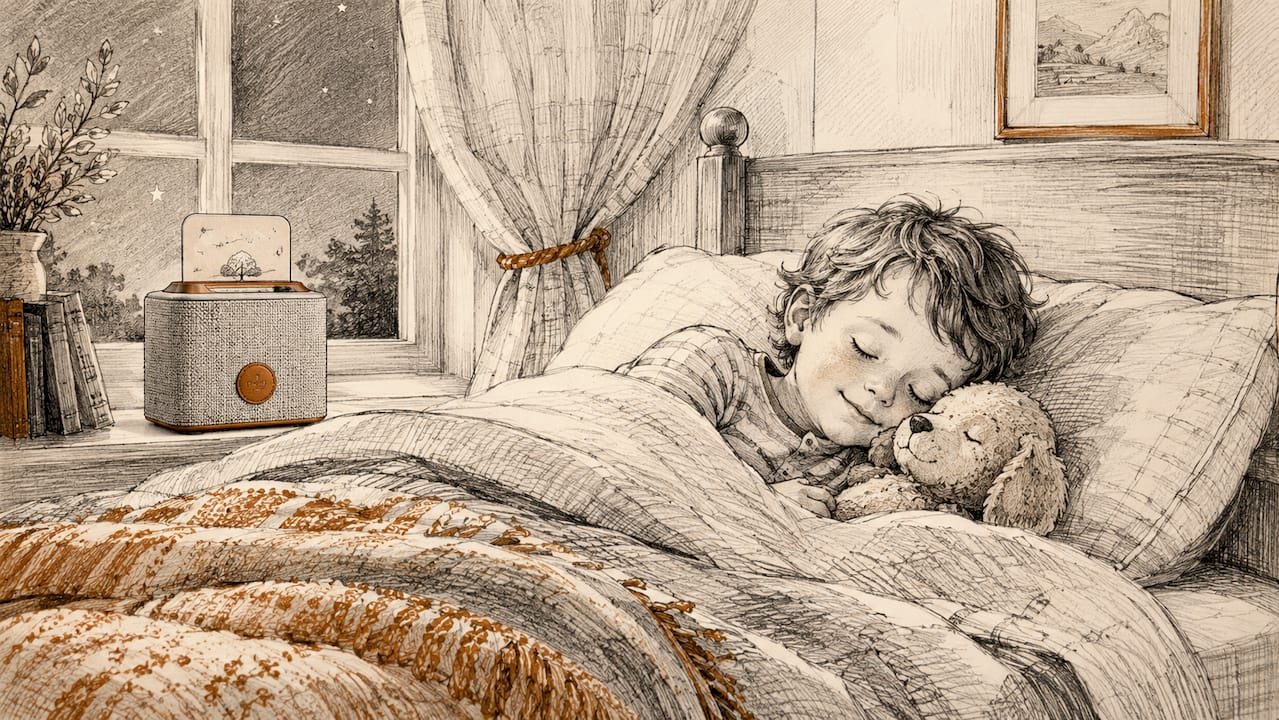
Screen-free audio players, like the Echostory-box, fit naturally into this kind of routine. Children tap a story card and listen, with no screen, no ads, and no notifications to pull their attention back toward stimulation. You can read more about how audio stories help children fall asleep and the benefits of audio stories at bedtime for a deeper look at the evidence behind this approach.
Key Takeaways
Children's eyes and developing circadian systems are significantly more sensitive to evening blue light than adults', and even dim light in the hour before bed can suppress melatonin by 70–99%, making a consistent screen-free window the single most effective step parents can take.
| Point | Details |
|---|---|
| Screen-free window | A 1–2 hour screen-free window before bed is the highest-impact change, supported by Sleep Foundation guidance and peer-reviewed research. |
| Children's sensitivity | School-age children show approximately 1.9× greater melatonin suppression than adults under the same light exposure. |
| Low lux still matters | Even 5–40 lux suppresses melatonin by 70–99% in young children, so dim screens and night lights are not automatically safe. |
| Night mode is not enough | Filters reduce spectrum but rarely lower brightness enough to prevent suppression; dimming and curfews are more effective. |
| Echostory-box as a practical step | Replacing evening screen time with a screen-free audio player like Echostory-box removes the light source entirely, supporting natural melatonin rise. |
The case for small, consistent changes over perfect solutions
The science here is genuinely reassuring once you understand it. You do not need a perfect home or a rigid schedule. You need a consistent window of low light before bed, a calm activity to fill it, and the patience to let the routine take hold over a week or two.
What often gets lost in conversations about blue light is how much of the solution is already within reach. Warm bulbs, a screen curfew, a dim night light near the floor, and a good story playing quietly in the dark. None of that requires expensive equipment or a complete lifestyle overhaul.
The children who struggle most with sleep resistance are often the ones whose evenings are still bright and stimulating right up to the moment a parent says "lights out." The biology is not mysterious. The clock needs darkness to start the melatonin signal. Give it that, and most children settle more easily than their parents expect.
If you try these steps consistently for two weeks and sleep is still a real struggle, bring your notes to your pediatrician. You will have useful data, and they will have more to work with.
Useful sources and further reading
The following peer-reviewed studies and trusted health resources were used in this article. Parents who want the full technical detail are encouraged to read them and bring questions to their child's pediatrician.
- High Sensitivity of Melatonin Suppression Response to Evening Light in Preschool-Aged Children - PMC
- High sensitivity of melatonin suppression response to evening light in preschool-aged children - PMC
- Review on age-related differences in non-visual effects of light: melatonin suppression, circadian phase shift and pupillary light reflex in children to older adults - PMC
- How Blue Light Affects Kids' Sleep - Sleep Foundation
- Blue light has a dark side - Harvard Health
- Light‐induced melatonin suppression in children compared with adults under different LED color temperatures - PMC
- Individual differences in light sensitivity affect sleep and circadian rhythms - PMC
- Visible light (electromagnetic spectrum) - NASA Science
- A parent's guide to better sleep – Children's Health
This article is for general informational purposes only and is not a substitute for professional medical advice. If you have concerns about your child's sleep, consult your pediatrician or a qualified pediatric sleep specialist.