

A consistent bedtime routine helps children fall asleep faster, wake less often, regulate their emotions more calmly, and build the behavioral skills that carry into school and beyond. The research is clear: routines practiced regularly most nights per week predict earlier bedtimes, shorter sleep onset, and fewer caregiver-reported sleep problems. Tonight, you can start with just three steps: a warm bath or wash-up, a short story or calming audio, and lights out at the same time as last night.
Here is what that simple sequence actually does for your child, and how to build on it.
- Consistent timing (within about 20 minutes each night) reinforces your child's internal sleep signals.
- Repeated calming cues, like a bath or a story, teach the nervous system that sleep is coming.
- Predictability reduces bedtime resistance because children know what to expect.
Table of Contents
- What counts as a bedtime routine, exactly?
- Why consistent bedtime routines help children sleep better
- The benefits go well beyond a good night's sleep
- How strong is the evidence, really?
- What to actually do each night: a simple, screen-free routine
- Sample routines by age: what works at each stage
- Troubleshooting common bedtime routine problems
- When should you talk to a pediatrician about sleep?
- Bedtime routines as a window for language, literacy, and attachment
- Key Takeaways
- Why screen-free storytelling belongs at the heart of bedtime
- How Echostory-box fits into your family's bedtime routine
What counts as a bedtime routine, exactly?
A bedtime routine, as researchers define it, is a set of caregiver-led, repeated activities completed in the hour before lights-out. The key word is repeated. A one-off bath and story does not produce the same effect as the same sequence done night after night. Research operationalizes consistency as five or more nights per week, and that threshold shows up across multiple studies as the point where measurable benefits appear.
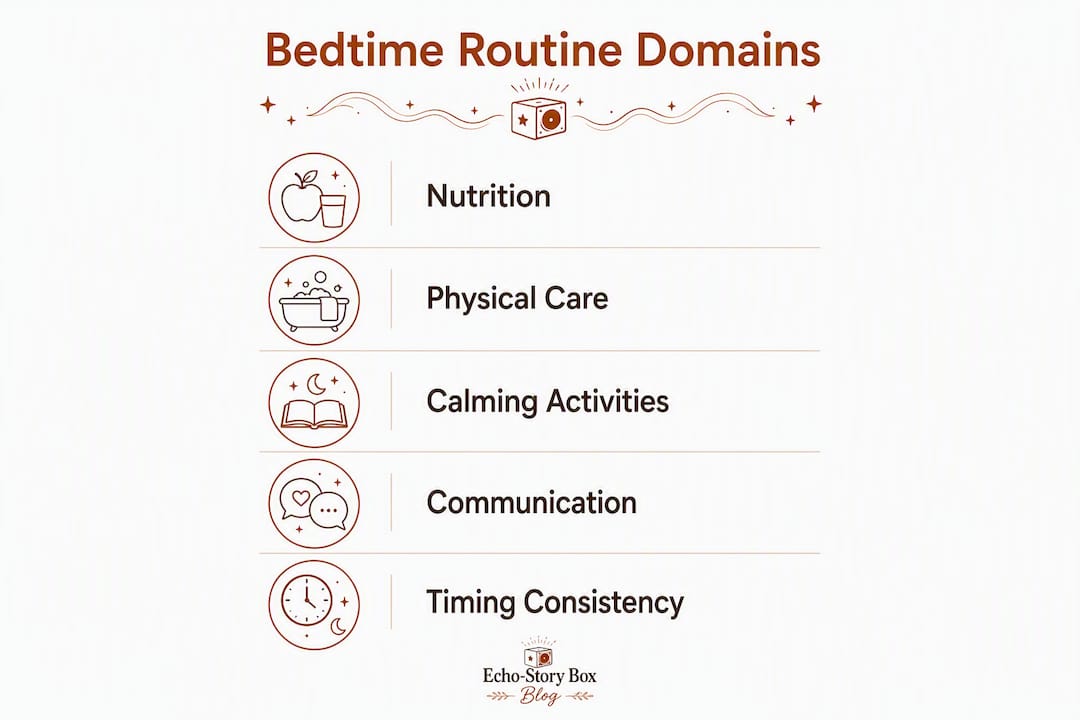
The activities themselves fall into four well-documented domains. Most effective routines touch at least three of them.
| Domain | Examples | Why it helps |
|---|---|---|
| Nutrition | Light snack, no sugary foods, water | Prevents hunger disruptions; tooth brushing after snack reduces caries risk |
| Hygiene | Bath or wash-up, tooth brushing, pajamas | Warm water lowers core body temperature, cueing sleepiness |
| Communication | Reading aloud, storytelling, calming audio | Builds language, literacy, and emotional closeness |
| Physical contact | Cuddle, gentle massage, rocking (infants) | Activates the parasympathetic nervous system; supports attachment |
Timing flexibility matters too. A small shift of roughly 20 minutes from night to night is manageable and does not appear to undermine the benefits. Greater nightly variability—such as around two hours across a week—is associated with higher impulsivity and poorer emotion regulation, whereas small variability of about 20 minutes is linked to better behavioral outcomes.
Why consistent bedtime routines help children sleep better
The benefits of bedtime routines are not just behavioral. They reach into your child's biology.
Circadian entrainment. Your child's brain has an internal clock that responds to repeated cues. When the same sequence of activities happens at the same time each evening, the brain learns to anticipate sleep. Melatonin release, body temperature drop, and other sleep-onset signals begin to fire earlier and more reliably. Consistent timing reinforces those signals; irregular timing confuses them.
Behavioral conditioning. A bath followed by a story followed by lights-out becomes a chain of cues. Over time, each step in the chain signals the next, and the last step signals sleep. This is why children who have a routine tend to fall asleep faster: the routine itself does part of the work before they even close their eyes.
Co-regulation. Young children cannot fully regulate their own nervous systems. A calm, present caregiver during the routine helps the child's arousal level come down. Warm physical contact, a quiet voice, and predictable interaction all send safety signals that ease the transition from the stimulation of the day to the stillness of sleep.
The research finding: Greater nightly bedtime variability correlates with higher impulsivity and lower emotion regulation compared to small variability of around 20 minutes, according to Penn State researchers studying the INSIGHT cohort.
- Consistent routines shorten sleep onset latency (the time it takes to fall asleep).
- Fewer night wakings are reported by caregivers when routines are practiced regularly.
- Screen exposure near bedtime delays sleep onset because screens are stimulating and slow the nervous system's wind-down.
The benefits go well beyond a good night's sleep
Sleep is the most obvious payoff, but the positive effects of routines extend into your child's daytime life in ways that are just as meaningful.

Emotional regulation and behavior. A longitudinal study found that early consistent bedtime routines predicted better emotion regulation in toddlerhood, which in turn linked to fewer behavioral problems later in childhood. The routine itself did not just improve sleep. It shaped how children learned to manage their feelings, and those gains compounded over years.
Bedtime variability over an hour is associated with a higher risk for behavioral difficulties in school-aged children, including problems that can look like attention or impulse-control issues. Routines are not just for children who already struggle with sleep. They are proactive tools that protect against those patterns before they develop.
Executive function and school readiness. When routines include language-based activities like reading aloud or storytelling, the benefits extend to working memory, attention, vocabulary growth, and early literacy. Shared reading at bedtime is one of the most accessible and well-supported ways to build the skills children need when they start school.
"Bedtime is one of the few moments in a busy day when a parent is physically present, calm, and focused on the child. That consistency of attention is itself a developmental gift." — BMC Public Health research on family routines and parent–child attachment
Family wellbeing. Caregivers who maintain consistent bedtime routines report lower anxiety, fatigue, and anger. The routine calms the adult as much as the child. That calmer caregiver state feeds back into the quality of the interaction, creating a positive cycle that benefits everyone in the household.
- Consistent routines support stronger parent–child attachment through warm, responsive evening interactions.
- Language gains from shared reading at bedtime are well-documented across multiple age groups.
- Calmer caregivers tend to use more positive parenting practices, which reinforces the routine's effectiveness.
How strong is the evidence, really?
The research base on sleep habits for children is one of the more consistent bodies of work in developmental science. Here is an honest summary of what it shows and where gaps remain.
What is well-supported:
- Systematic reviews and longitudinal cohort studies (including the INSIGHT cohort at Penn State) consistently link routine consistency to earlier bedtimes, shorter sleep onset, and fewer night wakings.
- Emotional and behavioral outcomes are supported by both cross-sectional and longitudinal data, including studies that tracked children from infancy into elementary school.
- Language and literacy benefits from bedtime reading are replicated across many studies and age groups.
- Routine consistency may be especially protective in lower-socioeconomic contexts, where consistent routines appear to buffer against worse socio-emotional outcomes linked to caregiver stress and resource constraints.
Where the evidence is thinner:
- Most studies focus on children under age six. Evidence for older children and adolescents is less robust.
- Long-term causal pathways are harder to establish. Most studies show associations, not proof that the routine alone caused the outcome.
- Fewer randomized controlled trials exist compared to other behavioral interventions.
What parents can reasonably expect: A consistent routine practiced five or more nights per week will likely help your child fall asleep faster and wake less often. Emotional and behavioral improvements are real but take weeks to months to become noticeable. Language benefits from shared reading accumulate gradually over time.
- Start with consistency of timing before worrying about the perfect activity sequence.
- Small, sustainable routines outperform elaborate ones that are hard to maintain every night.
- The evidence is strong enough to act on confidently, even where causal proof is incomplete.
What to actually do each night: a simple, screen-free routine
The goal is a predictable sequence your child can anticipate. Longer is not always better. A short, calm routine done every night beats a long one done three times a week.
A 6–8 minute micro-routine (great for busy nights)
- Wash up and brush teeth (2 minutes).
- Put on pajamas and get into bed (1 minute).
- One short story, a calming audio track, or two minutes of quiet conversation (3–4 minutes).
- Lights out at the same time as the night before.
A fuller 20–40 minute routine (for most evenings)
- Light snack if needed, then brush teeth (5 minutes).
- Warm bath or wash-up (5–10 minutes).
- Pajamas, dim the lights, and move to the bedroom (2 minutes).
- One or two books read aloud, or a story from an audio player (10–15 minutes).
- Brief cuddle, quiet conversation, or a simple breathing exercise (3–5 minutes).
- Lights out at a consistent time.
Timing guidance. Begin the wind-down 30–60 minutes before the target lights-out time. Aim to keep lights-out within about 20 minutes of the same time each night. Weekends are the hardest: a late Saturday night followed by an early Monday morning creates the kind of variability that undermines the whole week.
| Activity domain | Screen-free options | Notes |
|---|---|---|
| Nutrition | Water, small whole-food snack | Avoid sugar; brush teeth after |
| Hygiene | Bath, wash-up, tooth brushing | Warm water helps lower body temperature |
| Communication | Read-aloud, audio story, calming conversation | Shared reading builds language and literacy |
| Physical contact | Cuddle, gentle back rub, rocking (infants) | Activates calming nervous system responses |
Pro Tip: If your child resists the transition to bed, try a simple verbal script: "First we brush teeth, then we read one story, then it's sleep time." Saying it the same way each night helps the sequence feel safe and predictable rather than negotiable.
Sample routines by age: what works at each stage
Children's needs shift as they grow, and so should the routine. Here is a practical starting point for each age group.
| Age group | Suggested bedtime | Routine length | Key activities |
|---|---|---|---|
| Infants | 6:30–8:00 PM | 10–20 minutes | Feed, gentle bath, swaddle or hold, soft lullaby or white noise |
| Toddlers (1–3 years) | 7:00–8:00 PM | 15–20 minutes | Snack, bath, pajamas, 1–2 short books, cuddle |
| Preschool (3–5 years) | 7:00–8:30 PM | 20–30 minutes | Snack, bath, teeth, longer story or audio, brief chat, lights out |
| School-age (6–10 years) | 8:00–9:00 PM | 25–40 minutes | Snack, hygiene, reading or audio story, quiet conversation, lights out |
| Tweens (10–12 years) | 9:00–9:30 PM | 20–30 minutes | Hygiene, collaborative choice of calming activity, screen curfew 60 min before bed |
A few age-specific notes worth keeping in mind:
- Infants benefit most from sensory-focused wind-downs: warm water, skin contact, and a consistent caregiver voice. The routine does not need to be long, just consistent.
- Toddlers are in the stage where emotion regulation is developing most rapidly. A predictable sequence practiced five or more nights per week has a measurable effect on their ability to manage big feelings the next day.
- Preschoolers respond well to slightly longer stories and a predictable hygiene sequence. Giving them one small choice ("Do you want the rabbit story or the adventure story tonight?") supports the executive function skills they are actively building.
- School-age children and tweens do better when they have some say in the calming activity. A screen curfew of at least 60 minutes before lights-out is worth holding firmly. You can find examples of slow, calming routines that work well for this age group.
Troubleshooting common bedtime routine problems
Most routine breakdowns come down to one of a few predictable causes. Here are the most common ones and what actually helps.
Bedtime resistance and refusal. This usually means the wind-down started too late, the child is overtired, or the routine feels unpredictable. Move the start time 15 minutes earlier and add one more predictable step. Avoid negotiating the sequence once it has begun.
Wide weekly variability. Weekend late nights are the most common culprit. Try to keep the weekend bedtime within 30–45 minutes of the weekday time. A slightly later Friday is fine; a two-hour shift Saturday and Sunday is not.
Night wakings. If a child wakes repeatedly despite a consistent routine, check whether the sleep environment changed (light, noise, temperature) or whether the child is falling asleep with a caregiver present and then waking to find them gone. A consistent, independent sleep onset at the start of the night tends to reduce mid-night wakings.
Travel and illness. These are the hardest disruptions. Keep the sequence of the routine even when the timing shifts. The same story, the same physical contact, the same verbal script in a hotel room signals safety even in an unfamiliar place. Resume the normal timing as soon as you are home.
Shift-working parents. When one caregiver works evenings, the other can maintain the routine solo. What matters is that the sequence is the same regardless of who is doing it. A recorded story or a grandparent's voice on an audio player can fill the gap on nights when a parent is absent.
- Do not use screens as the wind-down activity, even on hard nights. The short-term ease is not worth the sleep-onset delay.
- Do keep the timing predictable even when the activities need to flex.
- Review common bedtime routine mistakes if resistance has become a nightly battle.
Pro Tip: If you are struggling to stay consistent yourself, remember that caregivers who maintain routines report lower anxiety and fatigue. The routine helps you wind down too. Treat it as your signal to slow down, not just your child's.
When should you talk to a pediatrician about sleep?
Most children respond well to a consistent routine within a few weeks. Some situations, though, call for a professional conversation rather than another tweak to the schedule.
Talk to your child's pediatrician if you notice any of the following:
- Persistent severe night wakings that do not improve after four to six weeks of a consistent routine.
- Total sleep duration that remains very short despite consistent timing (well below the American Academy of Pediatrics guidelines of 9–12 hours for school-age children and 10–13 hours for preschoolers).
- Loud snoring, gasping, or pauses in breathing during sleep, which may suggest sleep-disordered breathing.
- Extreme daytime impairment: a child who cannot function at school, is falling asleep during the day, or shows significant mood or behavioral changes that are not improving.
- Bedtime anxiety that is severe, persistent, and distressing to the child beyond typical adjustment.
When you go to the appointment, bring a simple sleep diary covering one to two weeks: bedtime, wake time, number of night wakings, and any symptoms you noticed. That information helps the pediatrician distinguish a behavioral sleep issue from a medical one quickly.
Most sleep difficulties in children do respond to consistent behavioral changes. Some signs, however, warrant evaluation for conditions like obstructive sleep apnea or restless legs syndrome, which a routine alone cannot address.
Bedtime routines as a window for language, literacy, and attachment
The routine is not just a path to sleep. It is one of the most reliable daily opportunities you have to build your child's language, deepen your connection, and create memories that last.
Research consistently links language-based bedtime activities, particularly shared reading and storytelling, to improved vocabulary, stronger early literacy skills, and better school readiness. The effect is not just about the words on the page. It is about the back-and-forth conversation, the questions, the voices, and the warmth of being close to someone who loves you while a story unfolds.
Bedtime routines are windows for parent–child attachment because bedtime is one of the few moments in a child's day when a caregiver is fully present and responsive. That warm, consistent interaction supports healthy brain development in ways that extend well beyond sleep quality. Choosing read-aloud books that help children name and process emotions adds another layer: children who can label feelings handle them better.
A screen-free audio story player fits naturally into this part of the routine. A child taps a story card, the story begins, and the caregiver sits close and listens alongside them. The tactile act of choosing a card gives the child a sense of ownership. The audio format keeps the room dim and calm. And when a grandparent's recorded voice tells the story, the attachment benefit extends across distance.
- Shared reading and storytelling at bedtime are among the most accessible ways to build vocabulary and early literacy.
- Warm, responsive caregiver interaction during the routine supports secure attachment and healthy emotional development.
- A screen-free audio format keeps the environment calm while still delivering the language and connection benefits of storytelling.
Pro Tip: Personalize the story. When a child hears their own name, their pet's name, or a place they love woven into the story, engagement deepens noticeably. Echostory-box supports personalized story cards that include the child's name and family details, making the bedtime story feel like it was made just for them.
Key Takeaways
Consistent bedtime routines practiced regularly most nights per week improve children's sleep, emotional regulation, and long-term behavioral outcomes, with the greatest gains coming from routines that include screen-free language activities like reading or storytelling.
| Point | Details |
|---|---|
| Consistency threshold | Routines practiced five or more nights per week produce measurable sleep and behavioral benefits. |
| Timing variability | Keep lights-out within about 20 minutes of the same time each night; greater nightly variability—such as around two hours across a week—is associated with higher impulsivity and poorer emotion regulation. |
| Beyond sleep | Early consistent routines predict better emotion regulation in toddlerhood and fewer behavioral problems later in childhood. |
| Screen-free wind-down | Screens near bedtime delay sleep onset; replace them with reading, storytelling, or calming audio. |
| Echostory-box | A tactile, screen-free audio story player that fits the communication and attachment domains of a research-aligned bedtime routine. |
Why screen-free storytelling belongs at the heart of bedtime
The evidence in this article points to one consistent theme: the most effective bedtime routines are calm, predictable, and built around human connection. Not screens. Not passive entertainment. Real interaction, warm voices, and stories that a child can hold onto.
That is what makes the storytelling piece so worth protecting. When a parent reads aloud or a grandparent's recorded voice fills the room, something happens that no algorithm can replicate. The child feels seen, safe, and loved. Those feelings are not incidental to sleep. They are the mechanism. A calm, connected child falls asleep more easily, wakes less often, and carries that regulated nervous system into the next day.
What I find most overlooked in conversations about bedtime routines is the attachment dimension. Parents often focus on the sleep outcome, which is understandable. But the routine is also one of the few daily rituals where a caregiver's full attention belongs entirely to the child. That is rare. Protecting it from screens, from distraction, and from the pressure to rush through it is one of the most meaningful things a family can do.
The science supports starting small. A consistent three-step routine tonight is worth more than a perfect forty-minute routine you cannot sustain. Start with the same time, one calming activity, and a moment of physical closeness. Build from there.
How Echostory-box fits into your family's bedtime routine
The research is clear: a screen-free, language-rich, predictable bedtime routine is one of the best investments you can make in your child's sleep, emotional health, and development. Echostory-box was built to make that easier.

With Echostory-box, your child taps a story card and a story begins. No scrolling, no ads, no bright screens. Just a calm voice, a good story, and a child settling into sleep. You can load it with original adventures featuring characters like Theo the Rabbit, personalized stories that include your child's name, or recordings of a grandparent's voice telling a family story. The tactile card system gives children a sense of ownership over their routine without handing them a device that fights for their attention.
It fits directly into the communication and physical contact domains that research identifies as most beneficial. Sit close, listen together, and let the story do the calming work. That is the routine the evidence points to, and it is exactly what Echostory-box is designed to support.
Ready to make storytelling the best part of your child's night? Visit Echostory-box to explore story packs, personalized options, and everything you need to build a screen-free bedtime routine your child will actually look forward to.