
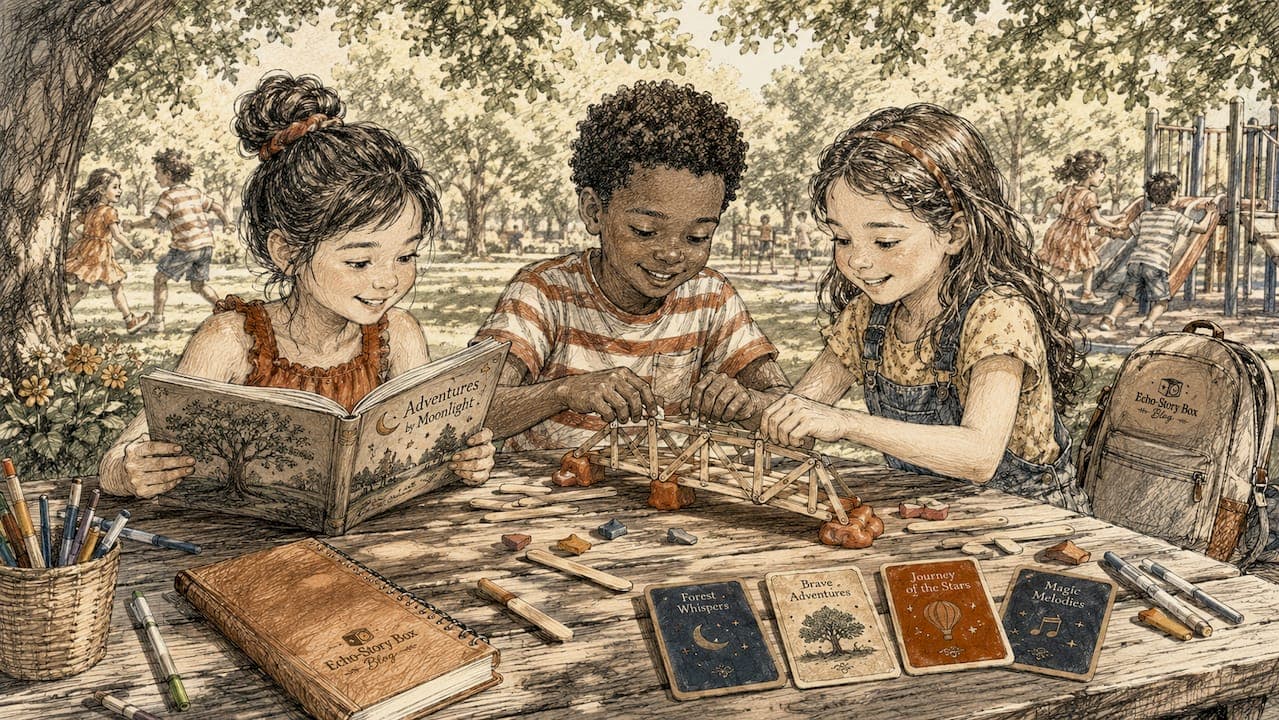
A story-based STEM activity is an interdisciplinary learning approach where children read or hear a story, identify a character's engineering problem, and then design and build a solution through hands-on prototyping and testing. This method, often called Novel Engineering in educational circles, merges literacy and STEM skills into a single, purposeful experience. Instead of treating science or engineering as abstract exercises, it gives children a character to care about and a real problem to solve. The result is deeper engagement, stronger vocabulary, and genuine creative thinking. For parents and educators looking for screen-free activities that hold a child's attention, story-based STEM is one of the most effective tools available.
What is a story based STEM activity and how does it work?
A story-based STEM activity follows a 4–6 step design process that moves from reading to building to reflection. Each step is guided by the story's narrative, so children always have a clear reason for what they are doing.
Here is how a typical session runs:
- Read or listen to the story. Choose a book or audio story with a clear character problem. The Three Billy Goats Gruff need to cross a river. The Gingerbread Man needs a boat. The problem must demand an engineering solution, not just a conversation.
- Identify the challenge. Ask children: "What does this character need?" This step builds comprehension and critical thinking at the same time.
- Ask questions and plan. Children sketch their design ideas and list the materials they will use. Story maps work well here to connect the narrative to the physical build.
- Build and test. Children construct their solution using available materials. Cardboard, tape, craft sticks, and simple circuits are common choices.
- Iterate. If the bridge collapses or the boat sinks, children revise their design. This is where persistence and problem-solving grow.
- Present and reflect. Children explain their solution. Keeping presentations to two minutes maintains focus on the engineering challenge rather than retelling the whole story.
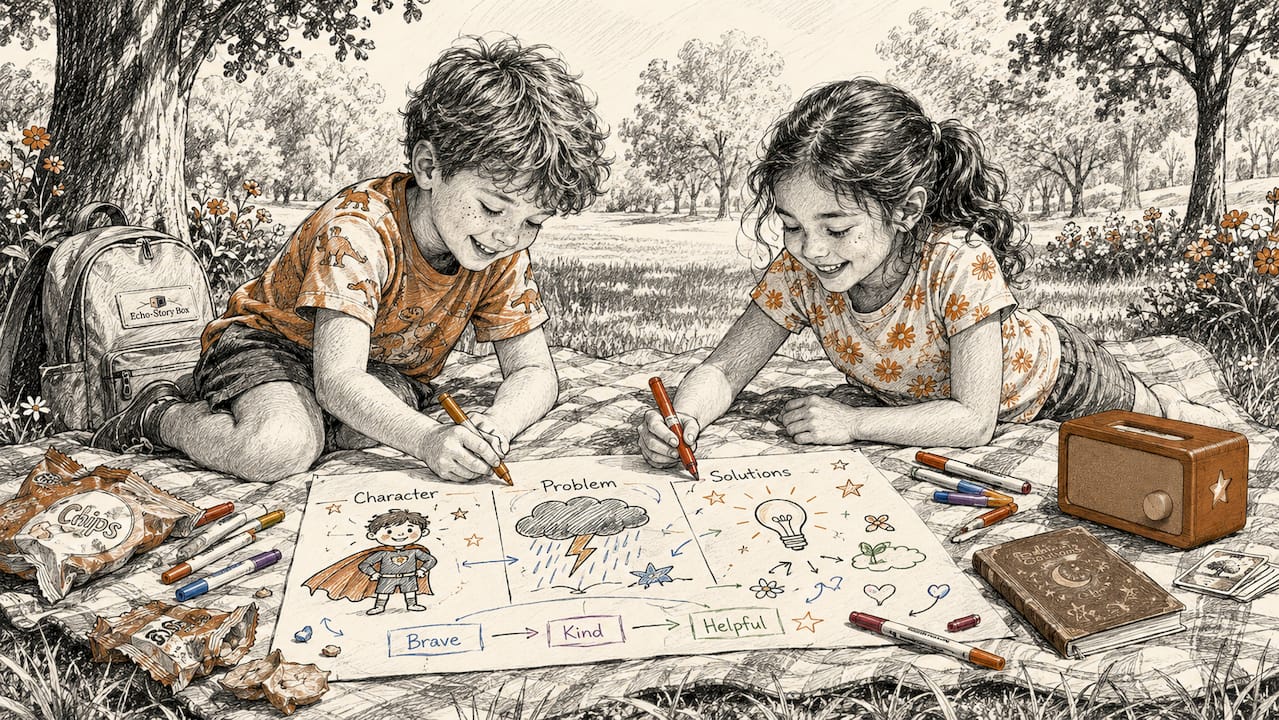
Pro Tip: Use a simple story map before the build phase. Ask children to draw the character, the problem, and their proposed solution in three boxes. This prevents the activity from drifting into arts and crafts.
The key to making this work is choosing a story with a conflict strong enough to demand a physical solution. If the story problem is too simple, the STEM task feels optional rather than necessary, and children lose motivation quickly.
What are the benefits of story based STEM for children?
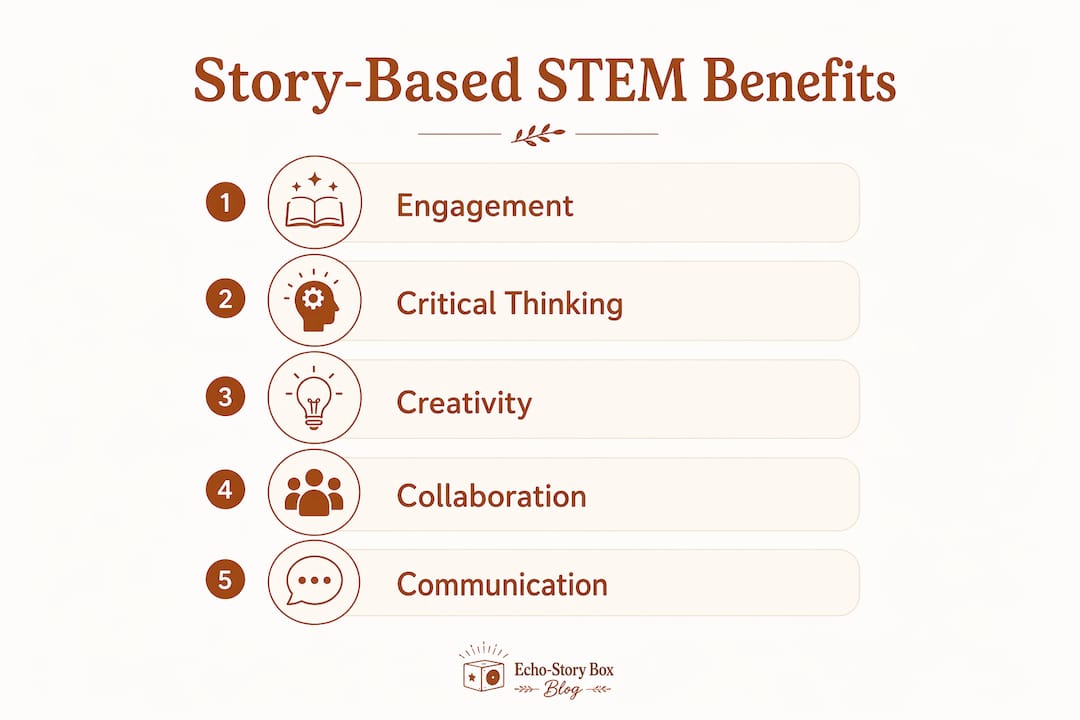
Story-based learning in STEM builds skills across multiple developmental areas at once. That is what separates it from standard STEM projects or standard reading time.
The core benefits include:
- Vocabulary growth. Embedding scientific and technical language into a narrative context improves retention and conceptual understanding far better than vocabulary lists alone. Children learn words like "buoyancy" or "load-bearing" because they need them to solve a problem they care about.
- Empathy and perspective-taking. When children design a solution for a story character, they practice seeing the world through someone else's eyes. This builds social-emotional skills alongside STEM identity development.
- Persistence. Children who engage with integrated storytelling show improved persistence in STEM tasks. The narrative gives them a reason to keep trying when their first design fails.
- Collaboration. Group builds around a shared story create natural opportunities for teamwork, negotiation, and communication.
- Creativity. Contextualized storytelling connects academic content to children's lived experiences, which strengthens memory and critical thinking in ways that abstract problems cannot.
"Story narratives act as scaffolds for cognitive and emotional engagement, framing STEM tasks as meaningful missions rather than isolated challenges." — Research on narratives in STEM
The role of storytelling in brain development is well established. When you add a hands-on STEM challenge to that foundation, you get an experience that builds the whole child, not just one skill set.
How can parents and educators create story based STEM activities?
Creating these activities at home or in the classroom is simpler than most parents and educators expect. The materials are inexpensive, and the structure is flexible enough to work for ages 4–14.
Start with these steps:
- Choose a story with a clear problem. Picture books like The Three Billy Goats Gruff, The Gingerbread Man, or Rosie Revere, Engineer work well. The character must face a challenge that requires building or designing something physical.
- Match complexity to age. For children ages 4–7, keep the build simple: a bridge from craft sticks, a raft from foam pieces. For ages 8–14, introduce simple circuits or basic coding to add a technology layer. A three-act story structure with an LED circuit element keeps older children focused and engaged.
- Gather low-cost materials. Story-based STEM projects often cost very little, using cardboard, tape, craft sticks, aluminum foil, and simple battery-powered circuits. Most families already have what they need.
- Balance story and engineering. Spend roughly one-third of the session on the story and two-thirds on the build. If the story discussion runs too long, children lose build time and momentum.
- Let children modify the story. Allowing children to invent plot twists or change the character's challenge increases engagement and leads to deeper STEM thinking. Unpredictable outcomes, especially with robotics or coding, can become exciting new story developments.
- Use the two-minute presentation rule. When children share their finished solution, cap it at two minutes. This keeps the focus on the engineering work, not the retelling.
Pro Tip: For older children, add a small LED circuit to highlight a key moment in the story. A lighthouse that lights up for a lost sailor, or a lantern that glows when a character finds safety, makes the technology feel purposeful rather than tacked on.
Exploring educational storytelling formats can also help you find the right structure for your child's age and learning style.
What are examples of popular story driven STEM projects?
Concrete examples make it easier to picture what these activities look like in practice. The table below shows four common project types, the materials they use, the age range they suit best, and the skills they build.
| Project type | Story example | Materials | Age range | Skills targeted |
|---|---|---|---|---|
| Bridge or path build | The Three Billy Goats Gruff | Craft sticks, tape, cardboard | Ages 4–8 | Structural engineering, load testing |
| Boat or raft build | The Gingerbread Man | Foam, foil, clay, straws | Ages 5–9 | Buoyancy, material selection |
| Circuit storytelling | Lights, Camera... Action! lesson | LED lights, batteries, wire | Ages 8–14 | Basic circuits, narrative design |
| Novel Engineering project | Any picture book with a character problem | Recycled materials, tape | Ages 6–12 | Design thinking, literacy, iteration |
Novel Engineering projects are particularly flexible. Children read a picture book, identify the character's core problem, and then brainstorm and prototype solutions using whatever materials are available. The story does the motivational work. The engineering does the learning work.
Circuit-based storytelling adds a technology layer that older children find genuinely exciting. In the Lights, Camera... Action! lesson format, children build a simple LED circuit that activates at a key moment in their story. The final presentation is capped at two minutes, which keeps the engineering solution at the center of the experience.
Collaborative story builds, where small groups each solve a different part of the same story problem, teach negotiation and communication alongside STEM skills. Small group storytelling naturally builds the kind of teamwork that solo projects cannot replicate.
The best story-based STEM projects share one quality: the story problem has multiple possible solutions. Best practices require selecting stories with engineering challenges that invite more than one answer. When every child can solve the problem differently, creativity flourishes and comparison pressure drops.
Key Takeaways
Story-based STEM activities work because narrative gives children a reason to care about the engineering challenge, which drives persistence, creativity, and deeper learning.
| Point | Details |
|---|---|
| Definition is clear | A story-based STEM activity pairs a character's problem with a hands-on design and build challenge. |
| Process has structure | A 4–6 step design process moves from story reading to building, testing, and presenting. |
| Benefits are broad | Children gain vocabulary, empathy, persistence, and STEM identity through a single activity. |
| Cost is low | Most projects use cardboard, tape, and simple circuits, making them accessible at home or school. |
| Story choice matters | Pick stories with strong conflicts that demand physical solutions and allow multiple design answers. |
Why story-based STEM changed how I think about learning
I used to believe that STEM and storytelling were separate lanes. STEM was logical and structured. Stories were emotional and open-ended. Keeping them apart felt tidy.
What I have seen since then is that the separation actually hurts both. STEM without narrative feels pointless to many children, especially younger ones. They build the bridge, but they do not care if it holds. Storytelling without a challenge to solve can stay passive. The child listens but never acts.
When you put a character in trouble and hand a child the materials to help, something shifts. The child stops being a student and starts being an inventor. That identity shift is not a small thing. Children who articulate their design choices develop engineering thinking that carries forward into harder problems.
The pitfall I see most often is over-structuring the story side. Parents and educators sometimes spend so long on comprehension questions that the build time shrinks to almost nothing. The story is the launch pad, not the destination. Keep it short, keep the problem clear, and then get out of the way and let children build.
The other thing worth saying: do not worry if the first attempt is messy. A collapsing bridge is not a failure. It is data. The best story-based STEM sessions I have witnessed looked chaotic from the outside and produced remarkable thinking on the inside.
— Bob
Echostory-box: screen-free stories that spark STEM thinking
Story-based STEM activities need great stories at their core. Echostory-box is built exactly for that.
Echostory-box is a screen-free audio player for children ages 4–10. Children tap a story card onto the box and a story begins. No scrolling, no ads, no complicated menus. The stories feature characters like Theo the Rabbit, Eileen, and Eisley, who face real challenges that spark curiosity and imagination. Many of the adventures are designed to pair naturally with hands-on activities, making them a calm and focused starting point for story-driven STEM projects at home or in the classroom. You can learn more about how it works or browse the full story kit collection to find the right fit for your family.
FAQ
What is a story based STEM activity in simple terms?
A story-based STEM activity is a hands-on project where children use a story's character problem as the starting point for designing and building a solution. It combines literacy and engineering into one connected experience.
What age group benefits most from story based STEM?
Children ages 4–12 benefit most, though the complexity of the build scales with age. Younger children work with simple materials like craft sticks and tape, while older children can incorporate circuits or basic coding.
Do you need special materials for story based STEM projects?
Most projects use common household materials like cardboard, tape, aluminum foil, and craft sticks. Simple LED circuits can be added for older children, but they are not required for a successful activity.
How is Novel Engineering different from regular STEM?
Novel Engineering specifically uses literature as the design brief. Students read a book, identify the character's problem, and prototype a solution. It is a structured approach developed to blend engineering design with reading comprehension.
How long should a story based STEM session take?
A typical session runs 45–90 minutes. Spend roughly one-third of the time on the story and two-thirds on building, testing, and presenting. Keeping final presentations to two minutes helps children stay focused on the engineering solution.