
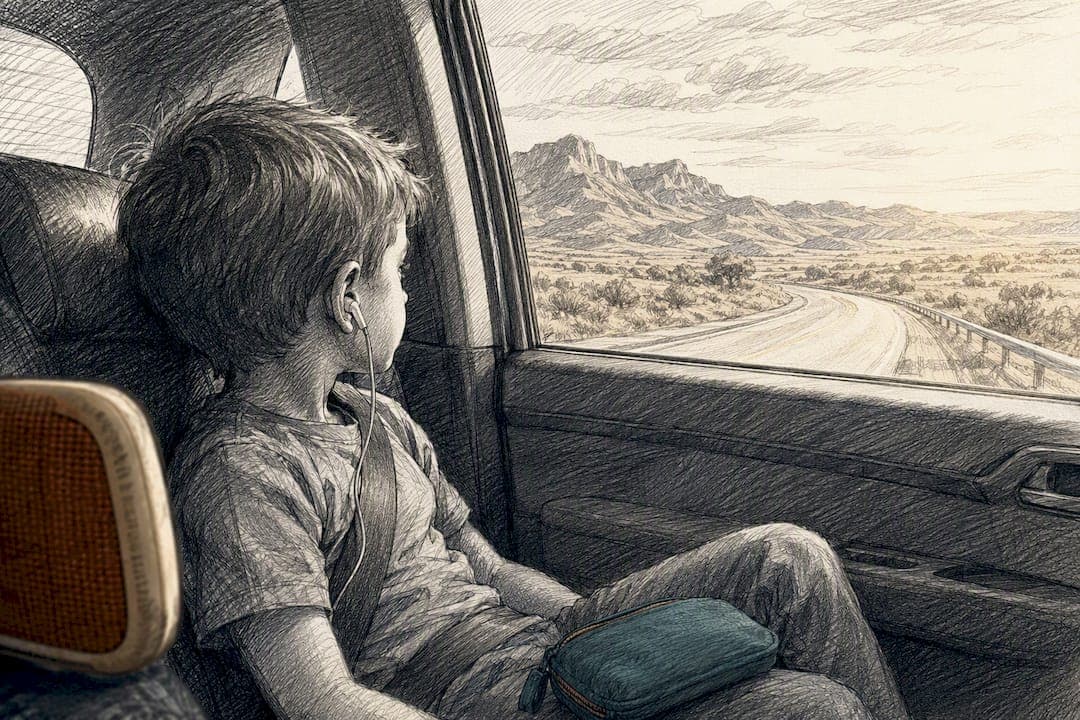
Yes, a screen-free road trip is practical with the right planning. Three tactics do most of the work: rotate activities every a rotation every half an hour to three-quarters of an hour, lean on audio-first options like audiobooks and story players, and build in movement or snack stops before boredom turns into a meltdown. One quick safety note: keep seating and activities positioned to avoid motion sickness, especially for toddlers.
TL;DR:
- Audiobooks and tactile audio players are essential for preventing motion sickness and building listening skills during long trips.
- Age-specific kits, including sensory bags for toddlers, sticker books for preschoolers, and card or logic games for early elementary children, improve engagement.
- Using audio devices with NFC story cards simplifies operation for young children and allows shared listening experiences without screens.
- Proper seating, fresh air, and timed stops help reduce motion sickness risks for kids prone to nausea during car journeys.
Table of Contents
- The 6 Screen-Free Categories Worth Packing First
- What to Pack by Age: Toddlers, Preschoolers, and Early Elementary
- Why Audio-First Options Work Better Than You'd Expect
- How to Pack and Rotate Activities Without a Meltdown
- Motion Sickness: Prevention and What to Do If It Happens
- A Sample 6-to-8-Hour Screen-Free Road Trip Timeline
- What I've Learned Watching Families Try to Ditch the Screen
- A Screen-Free Listening Option Worth Packing
- Sources
The 6 Screen-Free Categories Worth Packing First
You don't need a minivan full of gear. You need the right categories, chosen with your child's age in mind, packed where little hands can reach them.
Here's what earns a spot in the bag before you even think about specific toys:
- Audiobooks and tactile audio players — story-first listening that keeps eyes off close objects and ears tuned to a narrative, which matters more than most parents realize once you understand the motion-sickness link (more on that below).
- Portable, low-mess crafts — reusable sticker pads, dry-erase boards, and wipe-clean activity books that don't leave crumbs of paper and marker caps rolling under the seat.
- Magnetic travel games and compact puzzles — magnetic Bingo boards and travel-sized checkers that hold up well across multiple sittings survive sudden stops and small laps without scattering pieces.
- Verbal car games — twenty questions, license plate alphabet, "I spy," none of which require a single item in your trunk.
- Snack-based transitions and surprise books — a wrapped new book unveiled at hour two resets attention almost as well as a nap.
- Movement and stop planning — a playground break scouted in advance turns a gas station stop into an actual reset.
Pro Tip: Pack each child's items in a separate, clearly labeled bag. Toddlers get frustrated fast when they have to dig through a sibling's crayons to find their own busy book.
Keep this shortlist taped inside your glovebox. It's the fast version of everything the rest of this guide unpacks in detail.
What to Pack by Age: Toddlers, Preschoolers, and Early Elementary
Attention span, not stubbornness, drives most in-car boredom. A three-year-old and an eight-year-old need entirely different toolkits, and packing the wrong one for the age is the single most common mistake parents make before a long drive.
Toddlers (roughly ages 1 to 3)
Toddlers do best with sensory input they can manage independently, since their attention window runs short, often just 15 to 30 minutes per activity.
- Sensory busy bags — fabric scraps, textured balls, or a zippered pouch filled with objects to touch and sort.
- Wipe-clean books — thick board books or silicone books that survive drool and the occasional airborne toss.
- Simple finger puppets — a parent or older sibling can narrate a two-minute story with them, turning a five-second toy into ten minutes of shared play.
- Snack puzzles — a divided snack cup with different textures (crackers, puffs, small fruit) doubles as fine-motor practice and a distraction tool.
Toddlers also respond well to shared play more than solo play. A parent narrating what's outside the window, even for two minutes, resets a fussy toddler faster than any toy.
Preschoolers (roughly ages 3 to 5)
Preschoolers can sustain focus a little longer, usually 20 to 40 minutes, and they're ready for activities with light structure.
- Reusable sticker books — the kind with a static-cling or peel-and-stick backing that doesn't lose adhesive after one use.
- Travel coloring boards with attached markers — nothing rolls onto the floor, and nothing needs replacing mid-trip.
- Magnetic travel Bingo or matching games — these hold up across multiple sittings without losing pieces, a real advantage over loose card games at this age.
- Lap trays — a flat surface transforms a wiggly kid's lap into a usable workspace for coloring or snack puzzles.
Preschoolers swing between wanting company and wanting independence within the same hour. Pack at least one solo activity and one you can do together, and let your child signal which mode they're in.
Early elementary (roughly ages 5 to 9)
Kids in this range can typically stay engaged for 30 to 60 minutes, especially with activities that involve a little challenge.
- Travel journals — a blank notebook with a few prompts ("Draw the weirdest thing you saw today") turns idle time into a keepsake.
- Card games — Uno, Go Fish, or Spot It travel well and scale easily from two players to four.
- Wordplay games — Mad Libs, rhyming games, or simple word-search books stretch vocabulary without feeling like schoolwork.
- Logic puzzles — travel-sized magnetic logic games (the kind with sliding pegs or tile puzzles) genuinely absorb this age group for long stretches.
Kids this age also start caring about ownership. Let them help pick or pack their own activity bag before the trip. Buy-in on the front end reduces resistance on the back end.
Where to find this stuff without spending much
Libraries are the most underused resource for screen-free travel. Most branches lend audiobooks, activity kits, and even travel games, often for free with a library card. Dollar stores are reliable for reusable stickers, small puzzles, and notebooks. Printable activity kits, the kind you find through parenting blogs or homeschool resource sites, cost nothing but a sheet of paper and a few minutes at the printer.
Why Audio-First Options Work Better Than You'd Expect
The medical logic here is simple: fixating on close objects inside a moving vehicle, whether a book, a tablet, or a phone screen, is one of the main triggers for motion sickness. The Mayo Clinic's guidance on motion sickness points to horizon focus and seat placement as key mitigations, and audio removes the close-focus problem entirely. A child listening to a story can look out the window the whole time.
There's a developmental upside too. Audio storytelling builds listening skills and imagination in ways visual media simply doesn't, since kids have to construct the pictures themselves instead of having them handed over. Short chapters and character-driven stories tend to hold car attention spans better than long, plot-heavy audiobooks.
Packing audio well takes a little planning:
- Bring headphones sized for your child's age, and set volume caps before you hand over the device.
- Carry a battery backup or a car charger; a dead player at hour three defeats the whole point.
- Pre-load short chapters or tracks rather than one long file, so kids get a natural sense of progress.
- If more than one child is listening, consider a splitter so nobody's stuck sharing one earbud.
This is where a device like the Echo-Story Box earns its place in the bag. It runs on tactile NFC cards instead of menus, so a child taps a card and the story starts, no scrolling, no ads, no accidental video autoplay. That simplicity matters on a long drive when you don't want to be the tech support in the front seat. Families can also rotate in personal audio recordings, like a grandparent's voice reading a bedtime story, which gives solo listening time an emotional weight that a generic app never will.
How to Pack and Rotate Activities Without a Meltdown
Packing well is half the battle; timing the rotation is the other half. The goal is to swap activities before a child gets bored of one, not after.
Packing checklist per child:
- One audio option with headphones and a charger
- Two to three quiet solo activities (stickers, puzzles, a busy bag)
- One shared or verbal game the whole car can play
- A labeled snack pouch, refilled at each stop
Rotation cadence: alternate between social activities (car games, shared stories) and independent ones (stickers, audio) roughly every half an hour to three-quarters of an hour(https://theslowchildhood.com/blog/screen-free-road-trip-activities). Toddlers may need shorter windows, closer to 15 to 20 minutes, while early elementary kids can often stretch to an hour with the right puzzle or book.
Use snacks and stops as natural transition points rather than random interruptions. Plan a movement break every so often, ideally every couple of hours or when needed for toddlers, a little longer for older kids, so legs get stretched before restlessness turns into tears.
A few car-organization tricks make the whole system work: seat-back organizers keep activity bags within reach, a magnetic mat on a lap tray stops small pieces from disappearing into seat cracks, and a secured snack basket placed in the center of the back seat gives every child equal access without anyone leaning across a sibling.
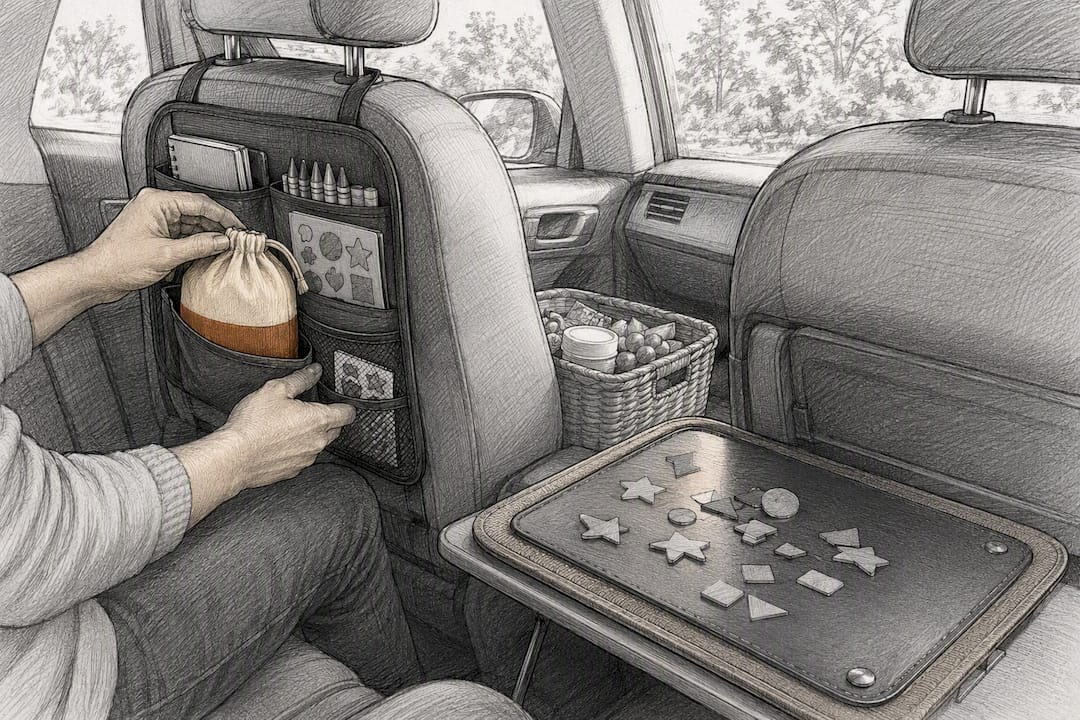
Pro Tip: End an activity while your child still likes it, not after they've grown tired of it. Rotating proactively keeps anticipation high for the next thing and heads off meltdowns before they start.
Motion Sickness: Prevention and What to Do If It Happens
Close-focus activities, screens and traditional books included, are common motion-sickness triggers because the eyes track something still while the inner ear senses movement. That mismatch is what makes kids feel queasy. Looking toward the horizon, choosing seating that allows a good view outside, and ensuring fresh air circulation help reduce motion sickness triggers.
A few preventative habits go a long way:
- Schedule a light meal before departure rather than a heavy one right before driving.
- Try acupressure wristbands for kids prone to nausea; many families find them a low-risk option worth testing.
- Build stops into the route in advance so a queasy child never has to wait long for fresh air.
- Keep an audio backup ready for kids who get sick easily, since it sidesteps the close-focus trigger entirely.
Most car sickness in children resolves within a few hours once the vehicle stops moving. If nausea is frequent or severe, talk with your pediatrician before your trip. Over-the-counter motion sickness medication exists for kids, but dosing and age recommendations vary, so get pediatric guidance rather than guessing.
A Sample 6-to-8-Hour Screen-Free Road Trip Timeline
Here's how the rotation strategy looks in practice, adapted from the age guidance above.
- 0:00, departure ritual — hand over a wrapped surprise book or a fresh sticker pack. The novelty buys a solid 30 minutes of quiet.
- 0:30 to 1:15, shared verbal game — license plate alphabet or twenty questions gets everyone talking and shakes off the "just got in the car" restlessness.
- 1:15 to 2:00, audio time — headphones on, a short-chapter audiobook or story card queued up, ideally timed to end near the next stop.
- 2:00, movement and meal break — a playground stop if one's on the route, otherwise a short walk around the rest area before lunch.
- 2:30 to 3:15, independent crafts — coloring board or magnetic puzzle, solo play while everyone digests.
- 3:15 to 4:00, snack transition into a card game — the snack basket comes out, and a round of Go Fish carries the group through.
- 4:00 onward, repeat the cycle, swapping in new audio tracks or a second surprise item to keep novelty alive through the back half of the drive.
If a child rejects an activity mid-rotation, don't force it. Swap in the next item early and circle back to the rejected one later. Kids often warm up to something the second time, once the initial resistance has passed.
What I've Learned Watching Families Try to Ditch the Screen
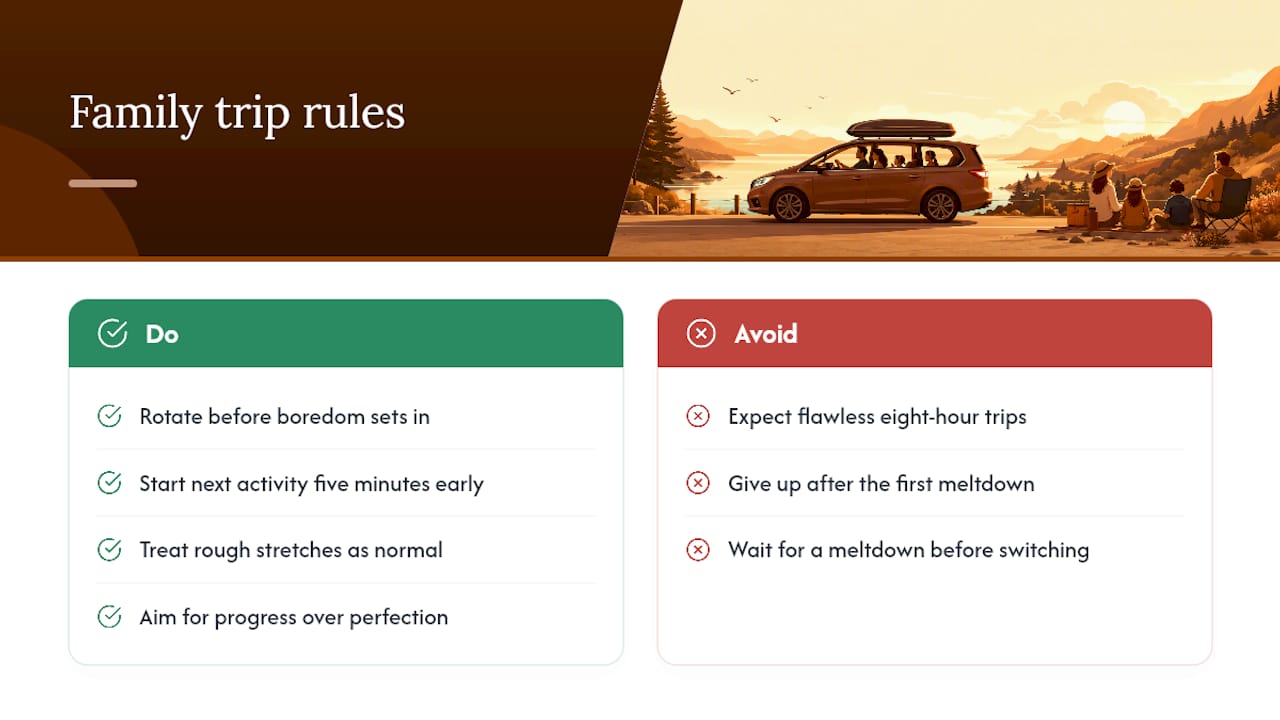
Working alongside families building their own Echo-Story Box setups has taught me that the biggest obstacle isn't the kids, it's parental expectations. Parents often picture a flawless, tantrum-free eight hours and give up at the first meltdown. The families who actually stick with screen-free travel treat a rough stretch as normal, not as proof the plan failed.
The single lesson worth carrying into your next trip: rotate before boredom sets in, not after. A five-minute head start on the next activity prevents most meltdowns entirely. Aim for progress over perfection, and a screen-free drive gets easier every time you do it.
— Bob
A Screen-Free Listening Option Worth Packing
If you want one item that covers most of the audio-first advice in this guide, there are simple audio players that run on tactile NFC story cards, no screen, no ads, no menus to fumble through from the front seat. A child taps a card and the story starts, which makes it one of the few gadgets a toddler can operate without help.

In the car, it works two ways: as a solo listening tool during independent-rotation windows, or as a shared experience when the whole family listens to one story together on a long stretch of highway. Some families load it with recorded messages from grandparents or original bedtime stories, turning drive time into something closer to a keepsake than a distraction. If you're ready to build your own kit, browse the Echo-Story Box lineup and pick a starter pack sized for your child's age before your next trip.
Sources
Guidance on screen time and travel comes from the American Academy of Pediatrics. Motion-sickness prevention draws on Mayo Clinic's car sickness FAQ. Activity ideas were informed by The Slow Childhood's age-based activity guide and Everyday Reading's screen-free games list.
- Mayo Clinic content on motion sickness (summary)
- Mayo Clinic — Car sickness in children FAQ
- The Slow Childhood — 35 Screen-Free Road-Trip Activities for Kids (By Age Group)