

How white noise differs from story audio for sleep and relaxation
White noise and story audio are both popular sleep aids, but they work in completely different ways. White noise is a continuous sound that contains all audible frequencies at equal amplitude, functioning as a neutral acoustic masker. Story audio, by contrast, is structured narrative content designed to engage your brain's language and executive centers, gently redirecting attention away from anxious or racing thoughts.
The practical difference comes down to where your sleep problem lives. White noise addresses the outside world. Story audio addresses the inside one.
Here is a clear side-by-side breakdown:
- White noise masks environmental sounds like traffic, neighbors, or a snoring partner by flooding the auditory field with broadband sound.
- Story audio occupies the verbal processing centers of your brain, giving your internal monologue somewhere calm to go instead of spiraling.
- White noise does not engage higher cognitive areas and leaves rumination untouched.
- Story audio provides cognitive diversion, reducing the mental activity that keeps many people awake.
- White noise works best when external noise is the primary sleep disruptor.
- Story audio tends to help more when racing thoughts or anxiety are the core problem.
37 % of adults report that racing thoughts keep them awake even when using white noise, highlighting a core limitation of white noise as a universal sleep solution.
Table of Contents
- What the acoustic properties of each sound actually look like
- How each type of audio engages your brain differently at bedtime
- Benefits and limitations of white noise for sleep
- Benefits and limitations of story audio for sleep
- How to choose between white noise and story audio for your needs
- Echostory-box brings calm, screen-free story audio to your family's bedtime
- Key Takeaways
What the acoustic properties of each sound actually look like
The physical structure of white noise and story audio could not be more different. White noise spans all audible frequencies at equal intensity, producing a flat, unvarying spectral profile. Think of television static, a fan humming, or steam from a radiator. There is no rhythm, no pitch change, and no information embedded in the sound.
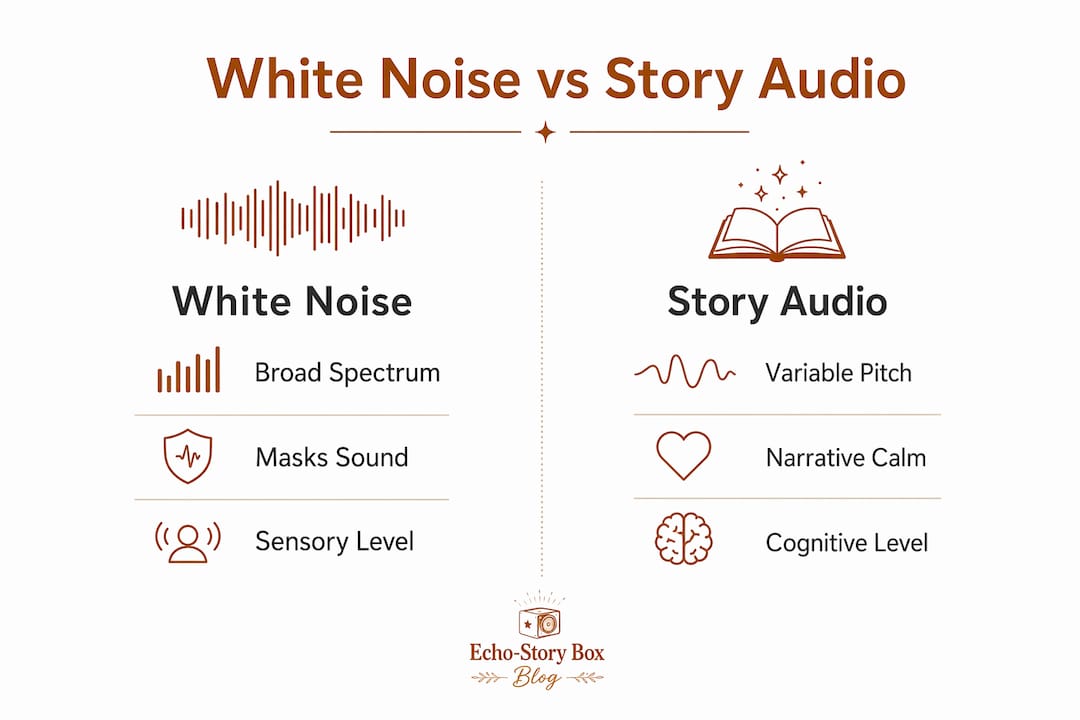
Story audio is the opposite. It carries variable frequencies shaped by a human voice, with natural shifts in pitch, pacing, tone, and emotional coloring. A narrator's voice rises slightly at a question, slows during a calm description, and carries subtle warmth or gravity depending on the content. These are not random variations. They are the acoustic signatures of language itself.
| Feature | White noise | Story audio |
|---|---|---|
| Frequency range | All audible frequencies equally | Variable, shaped by speech and voice |
| Amplitude variation | Flat, constant | Dynamic, follows speech rhythm |
| Temporal pattern | Continuous, unchanging | Structured, paced narrative |
| Linguistic content | None | Full: words, sentences, meaning |
| Emotional modulation | Absent | Present through vocal tone and pacing |
| Primary function | Acoustic masking | Cognitive engagement and diversion |
The spectral difference matters because your brain processes these two sounds at entirely different levels. White noise stays at the sensory layer. Story audio travels all the way up to the cortex, where language comprehension, memory, and imagination live.
Pro Tip: If you find white noise irritating rather than calming, you may be more sensitive to broadband sound. Pink noise, which reduces intensity at higher frequencies to mimic natural sounds like rain or ocean waves, is often a gentler alternative for the same masking purpose.
How each type of audio engages your brain differently at bedtime
White noise and story audio do not just sound different. They recruit different parts of your brain entirely. White noise operates at the sensory level of the auditory cortex, providing a steady background that your brain quickly habituates to. It does not demand attention, interpretation, or memory. That is precisely its value for masking external sounds, and precisely its limitation for quieting an overactive mind.
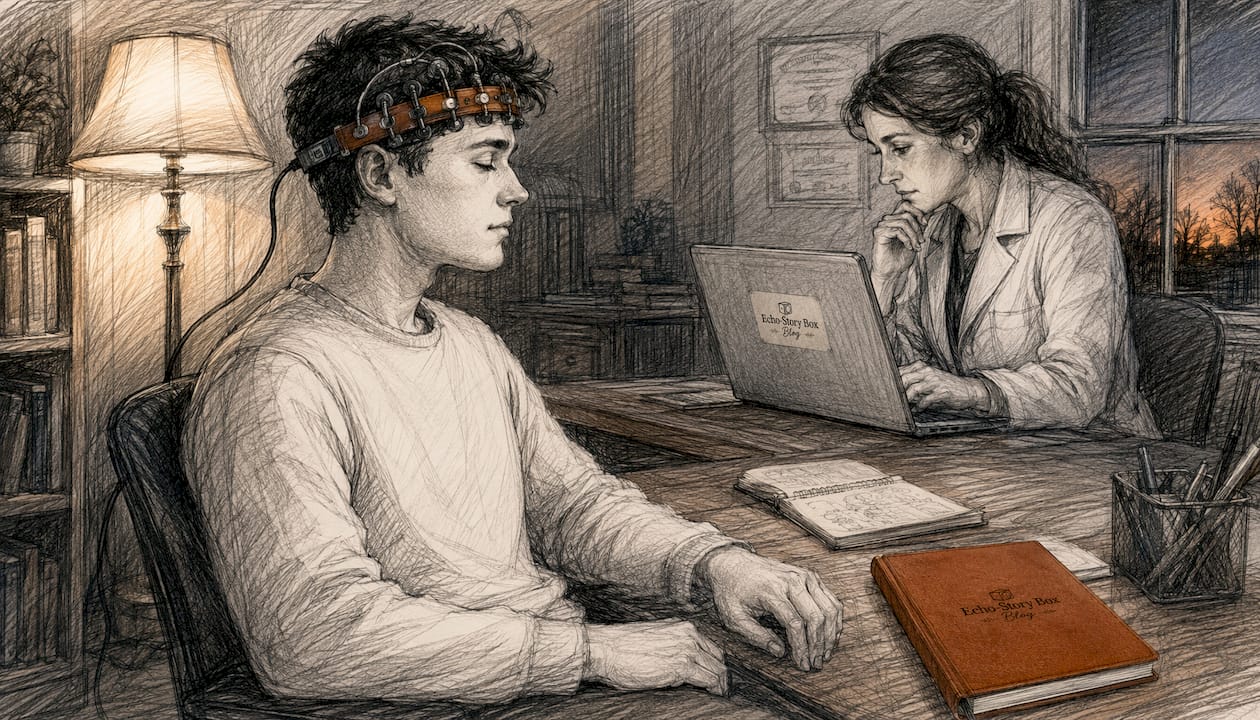
Story audio works higher up. Research using functional near-infrared spectroscopy (fNIRS) shows that narrated speech activates regions involved in language processing, including the right middle temporal gyrus and angular gyrus, as well as sensorimotor areas tied to speech comprehension. When you listen to a story, your brain is gently occupied with following a thread, building a mental image, and processing meaning. That gentle occupation is exactly what interrupts the internal monologue that fuels insomnia.
The distinction between white noise and story audio maps onto two different types of sleep problems. If your bedroom is noisy, white noise can help by raising the ambient sound floor and reducing the contrast between silence and sudden sounds. But if your mind is the problem, a story gives it somewhere quiet and safe to rest.
Listeners using structured narrative relaxation report faster sleep onset compared to no audio use at all. Research published in PMC also found that adults with sleep disturbances tend to experience greater benefits from sonic sleep aids, including narrated stories, than those without baseline sleep complaints.
Pro Tip: Choose story audio with a narrator whose voice you find naturally calming. Pitch, tone, and pacing all affect whether a story soothes or stimulates. A voice that feels warm and unhurried tends to work better than one that is bright or energetic.
Benefits and limitations of white noise for sleep
White noise has real, well-documented strengths as a sleep aid, particularly in noisy environments. Experts note that white noise helps stifle ambient noise and reduces startle responses, making it especially useful for light sleepers in urban settings or shared living spaces. Hospitals have used it for years to mask the unpredictable sounds of a clinical environment.
Benefits of white noise:
- Masks external environmental sounds like traffic, voices, or household noise
- Reduces startle responses caused by sudden sound contrasts
- Requires no cognitive engagement, making it passive and low-effort
- Works continuously through the night without changing content
- Widely available through physical machines, apps, and simple fans
Limitations of white noise:
- Does not address internal rumination or racing thoughts
- Evidence of effectiveness remains inconsistent across systematic reviews, with no consistent improvement in sleep outcomes confirmed
- Home-based studies show particularly variable results, especially for people with self-reported sleep complaints
- Prolonged or high-volume exposure carries potential risks. Animal research from HHMI found that continuous white noise can delay auditory development and affect brain plasticity, a concern worth noting for young children especially
- Some people find the sound irritating rather than soothing, making it counterproductive
The honest picture is that white noise works well for a specific problem: external noise disruption. For people whose sleep difficulty is cognitive rather than environmental, it often falls short.
Benefits and limitations of story audio for sleep
Story audio fills the gap that white noise leaves open. When your mind is busy replaying the day or rehearsing tomorrow's worries, a gentle narrative gives those verbal brain centers something else to do. Sleep stories are crafted with steady pacing, sensory descriptions, and low arousal to guide the mind toward rest without tipping it into full alertness.
Here is what makes story audio work, and where it can go wrong:
- Cognitive diversion. A well-paced story occupies the verbal centers of the brain, reducing the active rumination that drives anxiety-related insomnia.
- Low-arousal imagery. Good sleep stories use calm, sensory-rich descriptions of peaceful environments rather than plot twists or tension.
- Narrator voice quality. A slow, warm, unhurried voice is part of the design. Narrator pitch and tone critically affect whether the audio soothes or disrupts sleep.
- Personalized content. Research suggests personal preference plays a meaningful role in how effective story audio feels, which is why variety and choice matter.
- Differentiated from audiobooks. Standard audiobooks are not designed for sleep. They often lack the pacing, tone, and low-arousal structure that purpose-built sleep stories use. Using a thriller or a fast-paced nonfiction book as a sleep aid rarely works.
The limitations are real too. Abrupt changes or unexpected sounds in audio tracks can cause micro-awakenings, disrupting sleep architecture even when the listener does not fully wake. A story that is too engaging, too suspenseful, or narrated in a voice that feels stimulating can keep the brain alert rather than easing it toward sleep. The benefits of audio stories at bedtime depend heavily on choosing the right kind of content.
Pro Tip: Avoid stories with surprise elements, cliffhangers, or emotionally intense scenes at bedtime. The goal is gentle mental occupation, not entertainment. A story about a slow walk through a meadow will outperform a mystery novel every time.
How to choose between white noise and story audio for your needs
The right choice depends on what is actually keeping you awake. Neither option is universally better. They solve different problems, and understanding which one fits your situation makes all the difference.
Choose white noise if:
- Your main sleep disruptor is external noise (traffic, neighbors, a partner's movement)
- You prefer a completely passive background sound that requires no attention
- You find narrative content too engaging or distracting at bedtime
- You wake easily from sudden sounds and need a consistent ambient level
- You share a room and want a neutral sound that works for multiple people
Choose story audio if:
- Racing thoughts or anxiety are what keep you awake, not external noise
- You find silence uncomfortable or mentally loud
- You want something that gently occupies your mind without screens
- White noise has not helped your sleep despite consistent use
- You or your child responds well to calm, familiar voices at bedtime
A few practical tips for getting started:
- Keep volume low for both options. Loud audio, whether noise or narrative, can interfere with sleep quality regardless of content type.
- Try story audio for at least a week before deciding it does not work. It takes a few nights to find the right voice, pacing, and content type.
- Combine approaches if needed. Some people find white noise in the background with a quiet story layered over it works better than either alone.
- Pay attention to bedtime listening habits that build consistency, since routine matters as much as the audio itself.
- For children, story audio tends to outperform white noise because it supports imagination and calm simultaneously, especially when the content is warm, familiar, and gently paced.
Echostory-box brings calm, screen-free story audio to your family's bedtime
If story audio sounds like the right fit for your family, the challenge is finding content that is actually designed for calm listening rather than entertainment or engagement. Most streaming platforms are built to keep you watching, not to help you wind down.
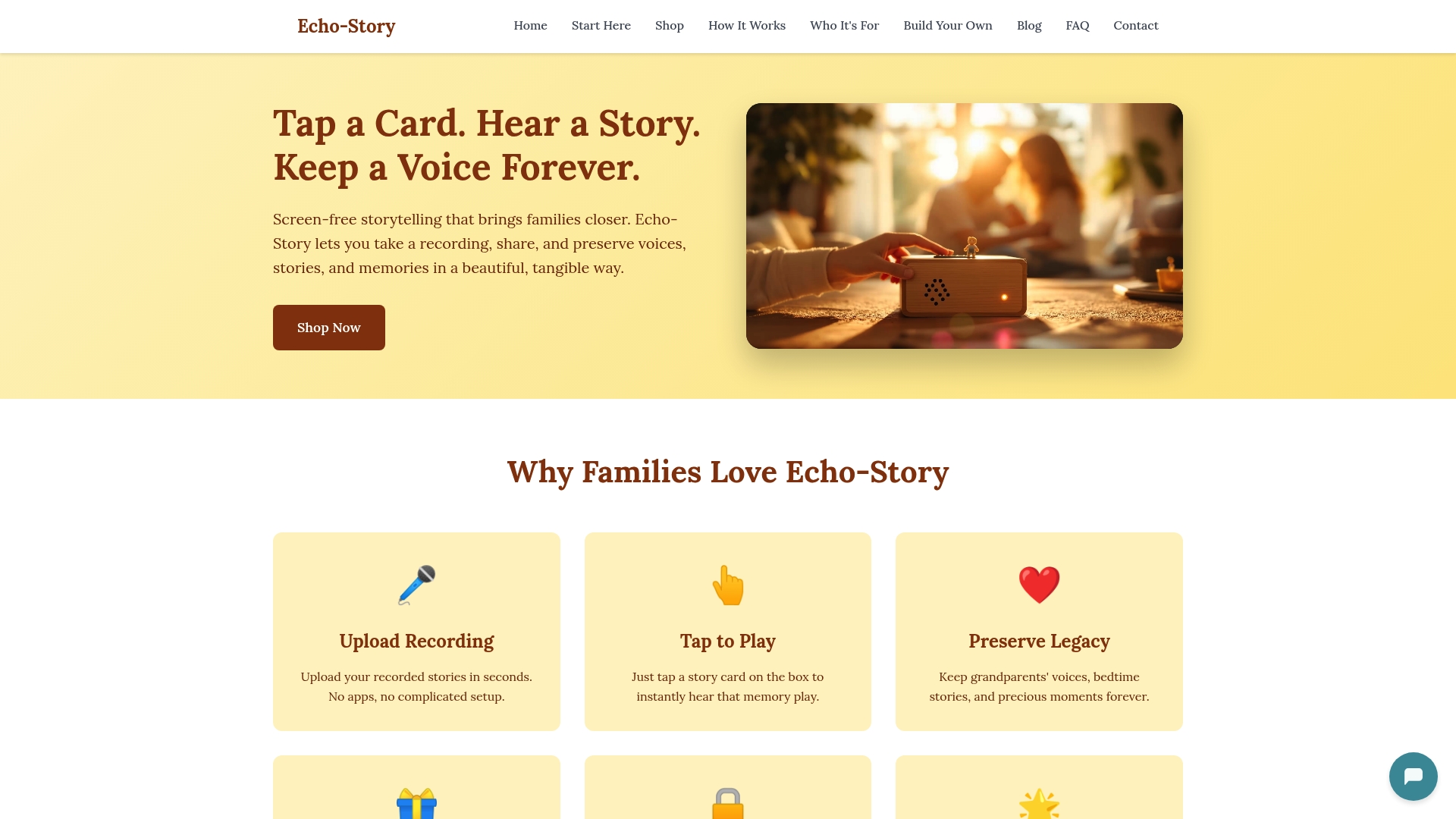
Echostory-box is built around the opposite idea. It is a screen-free audio player that lets children tap a story card and simply listen, with no ads, no recommendations, no notifications, and no complicated menus. The stories are warm, gently paced, and crafted for the kind of low-arousal listening that supports sleep and imagination. Parents and grandparents can even record their own voices, turning bedtime into something personal and lasting. For families who want the cognitive calming benefits of story audio without the overstimulation of a screen, Echostory-box offers a simple, tangible way to make that happen every night. Visit Echostory-box to explore story card options and find the right fit for your child.
Key Takeaways
White noise masks external sound at the sensory level, while story audio works at a higher cognitive level to quiet racing thoughts, making each tool most effective for a different root cause of sleeplessness.
| Point | Details |
|---|---|
| White noise works acoustically | It contains all audible frequencies at equal amplitude, masking environmental sounds without engaging cognition. |
| Story audio works cognitively | Narrated stories activate language and executive brain centers, redirecting rumination and reducing anxious thought loops. |
| 37 % of adults struggle with racing thoughts even when using white noise as a sleep aid | |
| Content quality shapes story audio outcomes | Steady pacing, low arousal, and a calm narrator voice are what make sleep stories effective rather than alerting. |
| Echostory-box for families | Echostory-box delivers screen-free, gently paced story audio through a simple tap-to-play card system designed for calm bedtime listening. |