
Bedtime with a 4 to 10 year old can feel like a negotiation. One more drink of water. One more hug. One more reason to stay awake. Faith-based bedtime stories for young children offer something different. They settle the room, speak to the heart, and give kids a gentle way to close the day with gratitude and peace. This guide covers how to choose the right stories, build a routine that sticks, use stories to process big feelings, and make prayer feel natural rather than forced.
Table of Contents
- Key takeaways
- Selecting faith-based bedtime stories for young children
- Building a calming faith-based bedtime routine
- Using faith stories to help children process emotions
- Practical tips for story discussions and short prayers
- My honest take on faith bedtime storytelling
- A screen-free tool for faith-filled evenings
- FAQ
Key takeaways
| Point | Details |
|---|---|
| Choose age-matched stories | Stories like Never Alone target ages 3–7 and directly address nighttime fears with God's presence. |
| Start the routine early | Beginning the bedtime sequence 45 minutes before lights out reduces resistance and helps children settle. |
| Keep prayer short | Prayers under two minutes work best for young children, especially when they feel participatory rather than recited. |
| Use stories for big emotions | Faith-based stories give children vocabulary to name fears and bring them to God in simple, honest ways. |
| Consistency beats perfection | Even twice weekly, a steady routine of story, song, and prayer builds lasting faith habits over time. |
Selecting faith-based bedtime stories for young children
Not every faith-based book belongs at bedtime. Some are wonderful for Sunday school but carry too much energy or complexity for a child who needs to wind down. The best faith-based bedtime stories for young children share a few key qualities.
They use simple, warm language. They keep the theological content gentle and accessible rather than heavy. And they connect faith to something a child already feels, like comfort, safety, or love.
What to look for in a good bedtime faith story:
- A reassuring central message rather than a convicting or challenging one
- Illustrations or audio pacing that feels calm and slow
- Characters a child can relate to (animals, children, or familiar family settings)
- A resolution that ends with peace, not unresolved tension
- Length appropriate for the child's age (shorter for ages 4–6, slightly longer for ages 8–10)
One strong example is Never Alone by Faith Eury Cho, which helps children ages 3–7 rest in Jesus's presence when they feel scared at night. It addresses one of the most common bedtime fears directly and does it with warmth and even humor.
For families who want to introduce prayer alongside stories, P.R.A.Y. Pals teaches children ages 3 and up to pray through Praise, Repent, Ask, and Yield. It pairs engaging illustrations with gentle invitations to pray together, making it a natural fit for the end of the day.
Translation also matters more than most parents realize. Choosing a child-friendly Bible translation like the NIrV (New International Reader's Version) significantly improves comprehension and keeps kids engaged rather than confused by language that feels foreign to them.
Pro Tip: Rotate your story selection weekly rather than reading the same book every night. Repetition has value, but fresh stories keep children genuinely curious about what happens next, which makes them easier to settle.
Balancing calming content with teachable moments is the real art here. Spiritual stories for kids work best at bedtime when they leave a child feeling held and loved, not challenged to do better.
Building a calming faith-based bedtime routine
A good bedtime routine is more than a sequence. It is a signal to your child's nervous system that the day is done and it is safe to rest. When you layer faith content into that sequence consistently, the spiritual practice becomes inseparable from the calm.
Here is a simple structure that works well for children ages 4 to 10:
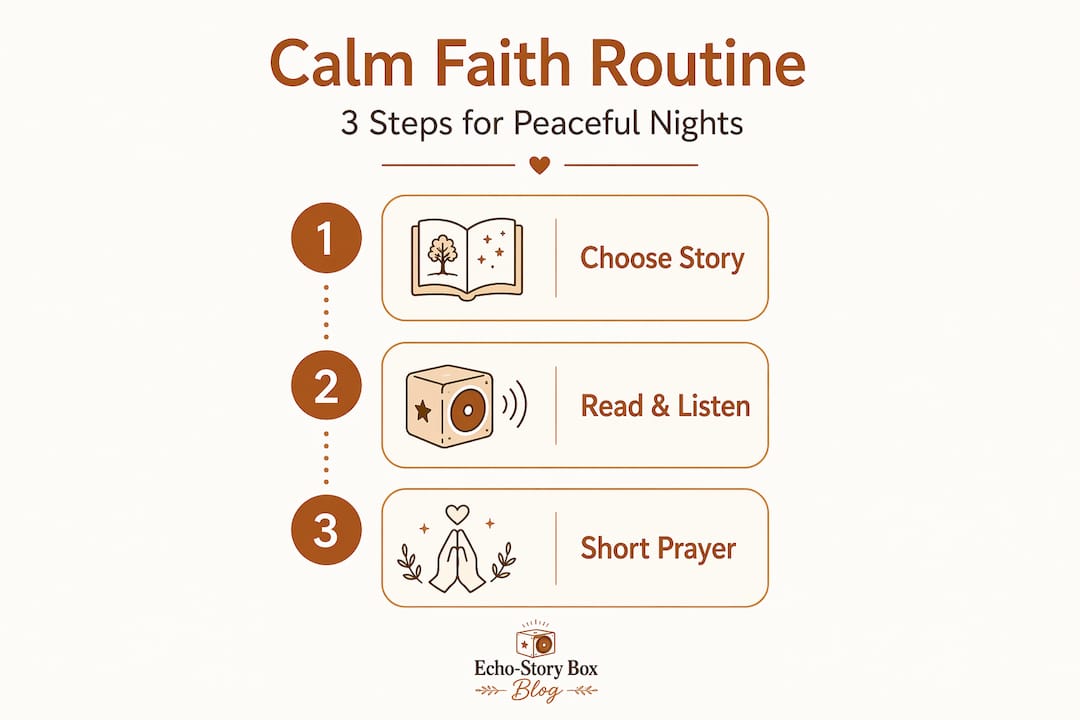
- Begin winding down 45 minutes before sleep. Dim the lights, lower your voice, and move away from active play. This shift in environment tells your child's body to start preparing for rest before the story even begins.
- Read one short faith story. Keep it to five to ten minutes for younger children and no more than fifteen to twenty for older ones. The caregiver guide behind this approach suggests offering selectable lengths so you can match the story to how settled your child already feels.
- Ask one or two gentle questions. "What was your favorite part?" or "Did anything in the story remind you of your day?" This keeps children active listeners rather than passive ones.
- Sing a short song or hum a familiar hymn. Even one verse is enough. Music shifts the mood and signals that the talking is winding down.
- Pray together for one to two minutes. Keep it short. Bedtime prayer adjusted by age and discipline level works best when it feels like a conversation rather than a performance.
- End with a physical cue. A kiss, a hand on the forehead, or a whispered blessing. This final gesture signals that the routine is complete.
The reason this sequence works is that each step acts as a cue. Your child starts to associate the story with slowing down, and the prayer with the final approach to sleep. Over time, hearing you open the book can itself trigger calm.
Pro Tip: If your child is fidgety during story time, try adding one small sensory moment. Let them hold a soft toy, trace a picture in the book with their finger, or rub a small piece of fabric while they listen. This gives their hands something to do and keeps their mind engaged with the story.

For families exploring audio-based faith stories as part of their routine, the benefits of audio stories at bedtime are worth understanding. A calm voice speaking faith-filled content in a dimly lit room works with the body's natural sleep preparation, not against it.
Using faith stories to help children process emotions
Children aged 4 to 10 carry bigger feelings than they can often name. Worry about school, fear of the dark, anxiety when a parent travels, sadness when a grandparent is sick. Faith-based stories give children a safe container for those feelings and a language to bring them to God.
Stories for kids ages 5 to 10 that address family illness, sibling strain, and fear processing help children develop vocabulary for complex emotions they would otherwise struggle to express. When a character in a story feels scared and prays, a child learns that is something they can do too.
Consider how Daniel in the Lions' Den is best told at bedtime. Rather than leaning into the drama of hungry lions, a gentle retelling with calm pacing and simple visuals teaches courage and trust in God without escalating a child's anxiety. The message lands. The fear does not.
Here are a few ways to use story time specifically for emotional support:
- Name the feeling in the story before asking about your child's day. "Daniel was really scared. Have you ever felt scared like that?" This gives children a character to hide behind while they work up the courage to share their own experience.
- Use the story's resolution as a springboard for prayer. After a story about God's comfort, a child who is anxious about a parent's illness has a natural opening to pray about it in their own words.
- Why bedtime stories reduce child anxiety is partly explained by this: stories create emotional distance that makes hard feelings approachable.
- Adjust pacing for sensitive children. Read more slowly, pause before big moments, and narrate with a steady voice. This keeps the story from feeling threatening.
"Faith stories addressing fear and separation anxiety help children feel safe and supported by God's presence at bedtime." — Research insight from Never Alone by Faith Eury Cho
The goal is not to resolve every feeling in one night. It is to give your child the habit of bringing feelings to God. That habit, built story by story, is one of the most lasting gifts a caregiver can give.
Practical tips for story discussions and short prayers
Reading the story is only half the work. What happens in the two to three minutes after the last page is often where the real connection forms.
Here is how to make that time count, even with children who are tired or reluctant:
- Start with a fill-in-the-blank question. "Tonight I'm thankful for ____" is less intimidating than "What are you grateful for?" It lowers the barrier to participation and gets younger children talking quickly.
- Use repeat-after-me prayers for children ages 4–6. P.R.A.Y. Pals breaks prayer into small, repeatable steps that reduce the cognitive load on young children, making prayer feel like a game rather than a task.
- Offer a story-action challenge. "Tomorrow, try to do what the character did. Then tell me how it went." This extends the story's impact into the next day and gives children a sense of purpose.
- Handle mixed ages with a role. Give older children in the room the job of "prayer leader" or let them choose the question. This keeps them engaged while younger siblings follow along.
- Keep your own prayer short and simple. Modeling consistency matters more than praying perfectly. A simple two-sentence prayer prayed genuinely is more powerful than a long, formal one that feels rehearsed.
Pro Tip: Write two or three short prayer templates on an index card and keep it in your story basket. On the nights when you are exhausted and cannot think of what to say, a simple prompt like "Thank you, God, for... Please help us with..." gets the prayer started and keeps the routine intact.
The role of scripture in family storytelling grows naturally when these small, consistent moments accumulate. You are not building a theology lesson. You are building a relationship, between your child and their faith, one quiet evening at a time.
My honest take on faith bedtime storytelling
I have seen families try to launch full devotional programs at bedtime and give up by week two because it was too much. I have also seen families who simply read one short story, asked one question, and prayed one sentence together every night for a year. The second group always wins.
What I have found is that the bedtime cue matters more than the content. When a child knows that the dim light plus the story basket means it is time to slow down and listen, you have already won half the battle. The story itself almost becomes secondary to that trained sense of calm.
Faith content for this age group works best when it is short, active, and physical rather than a lecture. A child who holds a toy lamb while you read about the Good Shepherd will remember that story longer than one who sat still through five pages of dense text.
My biggest caution is this: do not let perfection stop the practice. There will be nights when the prayer is two words and the story goes unfinished. That is fine. The habit is the point. Children learn faith by watching caregivers return to it, gently and without guilt, night after night.
Start with one story and one sentence of prayer. Grow from there.
— Bob
A screen-free tool for faith-filled evenings
If you are ready to bring calming, faith-based audio stories into your bedtime routine without handing your child a tablet, Echostory-box was built for exactly this.

Echostory-box is a screen-free audio player that lets children tap a story card and simply listen. No ads, no menus, no glowing screens at 8 PM. It supports faith-based storytelling for families, including wholesome bedtime tales, values-driven adventures, and the kind of calm, human voice your child needs at the end of a full day. Grandparents can even record personal messages and prayers as story cards, so your family's faith becomes part of the routine. If you want a gentle, intentional tool that supports everything in this guide, explore what Echostory-box offers.
FAQ
What makes a bedtime story faith-based?
A faith-based bedtime story weaves spiritual values, prayer, scripture, or God's presence into its central message in a way that feels natural for children. It does not need to be explicitly religious on every page. It simply needs to point young hearts toward goodness, trust, and love.
How long should a faith-based bedtime story be for a 5 year old?
For children around age 5, five to ten minutes is the right range. Caregiver guides recommend keeping the whole bedtime spiritual segment, story plus discussion plus prayer, under twenty minutes to maintain calm and engagement.
Can faith stories really help with bedtime anxiety?
Yes. Stories like Never Alone are specifically designed to address fear and separation anxiety by assuring children of God's presence, which reduces anxiety at bedtime more gently than distraction-based methods.
What Bible translation works best for young children at bedtime?
The NIrV (New International Reader's Version) is widely recommended for children because its shorter sentences and simpler vocabulary match reading levels for ages 6 and up. Choosing the right translation directly affects how much your child understands and stays engaged.
How do I teach my child to pray without it feeling awkward?
Start with structured methods like P.R.A.Y. Pals, which breaks prayer into four simple steps, Praise, Repent, Ask, and Yield. Repeat-after-me formats work well for ages 4 to 6, while fill-in-the-blank prompts open up prayer naturally for older children.