
Yes, audio-based memory work reliably builds durable recall when families keep sessions short and daily. It works best for grammar-stage children, roughly ages 4 to 11, and for kids who learn best by listening. Start small this week: pick one subject, one 15-minute daily routine, and one audio source you already have on hand.
TL;DR:
- Audio memory work is most effective for children ages 4 to 11, especially if sessions are kept short, consistent, and scheduled daily.
- Subjects with short, repeatable, and rhythmically structured content, such as history timelines, Latin declensions, and math facts, benefit most from audio memorization.
- A 15-minute daily routine, with initial active recall followed by passive listening, outperforms longer weekly practices and supports better retention.
- Using a dedicated, tactile audio device helps prevent distractions and maintains focus during review sessions, particularly for non-readers and pre-readers.
- Consistent, low-pressure practice and pairing audio with simple body movements or gestures significantly increase memorization and engagement.
Table of Contents
- What Is Audio Memory Work, and Why Does It Help Kids Remember?
- Which Subjects Work Best for Audio Memory Work?
- How Do You Fit Memory Work Into a Busy Homeschool Week?
- Should You Use Passive Listening or Active Recall?
- What Audio Resources Should You Actually Use?
- How Do You Keep Memory Work From Feeling Like a Chore?
- Where Does a Screen-Free Audio Player Fit In?
- An Honest Take on Where Audio Memory Work Actually Pays Off
- A Screen-Free Way to Build Your Family's Audio Memory Work Routine
- Sources
- FAQ
What Is Audio Memory Work, and Why Does It Help Kids Remember?
Memory work is the classical-education practice of committing key facts, dates, and definitions to memory before a child fully grasps their meaning. Audio memory work simply sets that material to sound: songs, chants, or a parent's recorded voice reciting the same phrases over and over. The child hears it, sings it, and eventually recalls it without effort.
This works because rhythm and melody act like scaffolding for the brain. A fact tucked inside a tune is easier to pull back out than the same fact spoken flatly, because the melody gives memory a shape to hang onto. Short songs and rhythmic chants encode facts more durably than plain sentences, and music lowers the mental effort required for recall, especially for kids who lean auditory.
Grammar-stage children are wired for this kind of learning. Classical Conversations notes that young children naturally memorize before they understand, building mental "file folders" they will fill in with meaning later. That's a real gift during ages 4 to 11, and audio is the easiest way to hand it to them.
Why audio specifically outperforms flashcards alone for this age group:
- It requires no reading ability, so pre-readers can fully participate.
- It fills car rides, chores, and breakfast without adding a "sit down and study" task.
- Repetition feels like singing, not drilling.
- Parents don't have to be the only source of correct pronunciation or pacing.
Which Subjects Work Best for Audio Memory Work?
Not every subject translates well to sound. The best candidates share three traits: they're short, they repeat in a fixed order, and they have a natural rhythm.
Here's what tends to work best when set to audio:
- History sentences and timeline events — ordered content that benefits from a sung sequence.
- Latin chants and declensions — the repetitive structure practically begs for melody.
- Grammar definitions — short, exact phrasing that stays consistent week to week.
- Math facts — skip-counting songs turn drill into something closer to play.
- Science definitions and classifications — brief, list-style content that chunks naturally.
- Poetry and hymns — built for recitation and cadence from the start.
Two quick examples show why this works. A timeline of historical events, recited in order to a simple melody, gives a child a mental "clothesline" they can hang new facts on for years. A set of Latin noun endings, chanted with a steady clap on each syllable, turns an abstract grammar pattern into something the body remembers along with the ear.
Subjects that resist audio tend to require reasoning over recall, like solving a multi-step word problem. Save those for a different kind of practice, and let audio carry the raw facts.
How Do You Fit Memory Work Into a Busy Homeschool Week?
The families who stick with this long term don't cram. Short daily practice of about 15 minutes beats a long weekly session for retention, and it fits far more easily into a real week with real kids in it.
Here's a copyable version of the pattern experienced homeschool families use:
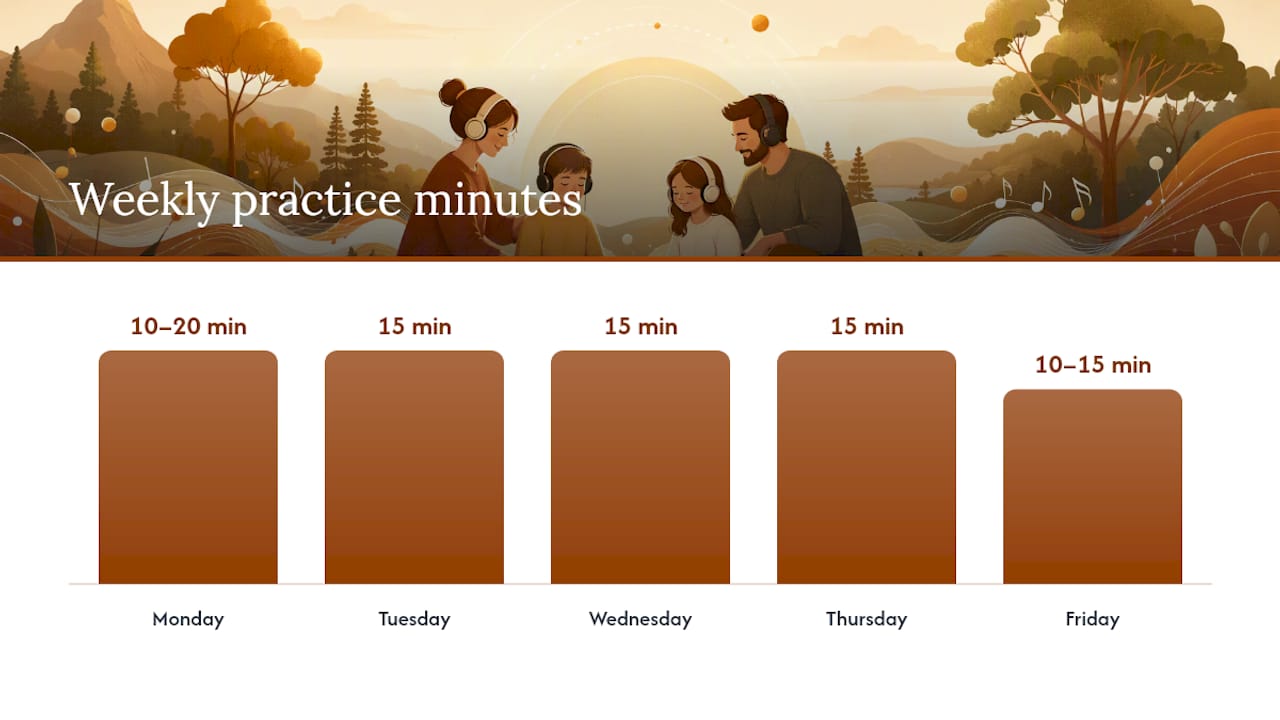
- Monday: introduce. Play the new song or chant once through, then echo it phrase by phrase for 10 to 20 minutes. This is the only day that needs extra time.
- Tuesday through Thursday: reinforce. Five minutes on the current week's material, five minutes on the ongoing timeline or sequence, five minutes cycling back through older weeks. Fifteen minutes total, and it can happen anywhere.
- Friday: cumulative review. Ten to 15 minutes running through everything learned so far, which is where spaced repetition does its real work, catching the facts that are starting to slip before they're gone for good.
You don't need a dedicated study block to make this happen. Play the audio during breakfast, on the drive to co op, during a snack, or while folding laundry. Dead time is your best friend here, not your enemy.
Pro Tip: Keep a single playlist that runs in the same order every time. Kids' brains lock onto sequence, and a shuffled playlist actually slows down recall instead of speeding it up.
Should You Use Passive Listening or Active Recall?
Both, and the order matters. Passive listening, just having the audio play in the background, builds familiarity but rarely builds recall on its own. Active recall, where the child sings or speaks along without the audio, is what actually locks the fact into memory.
A workable rhythm looks like this: introduce new material with active echoing, where the child repeats phrase by phrase right after hearing it. Once a chant feels comfortable, shift to passive listening for a few days to build fluency. Then test it cold, with no audio at all, to see what actually stuck.
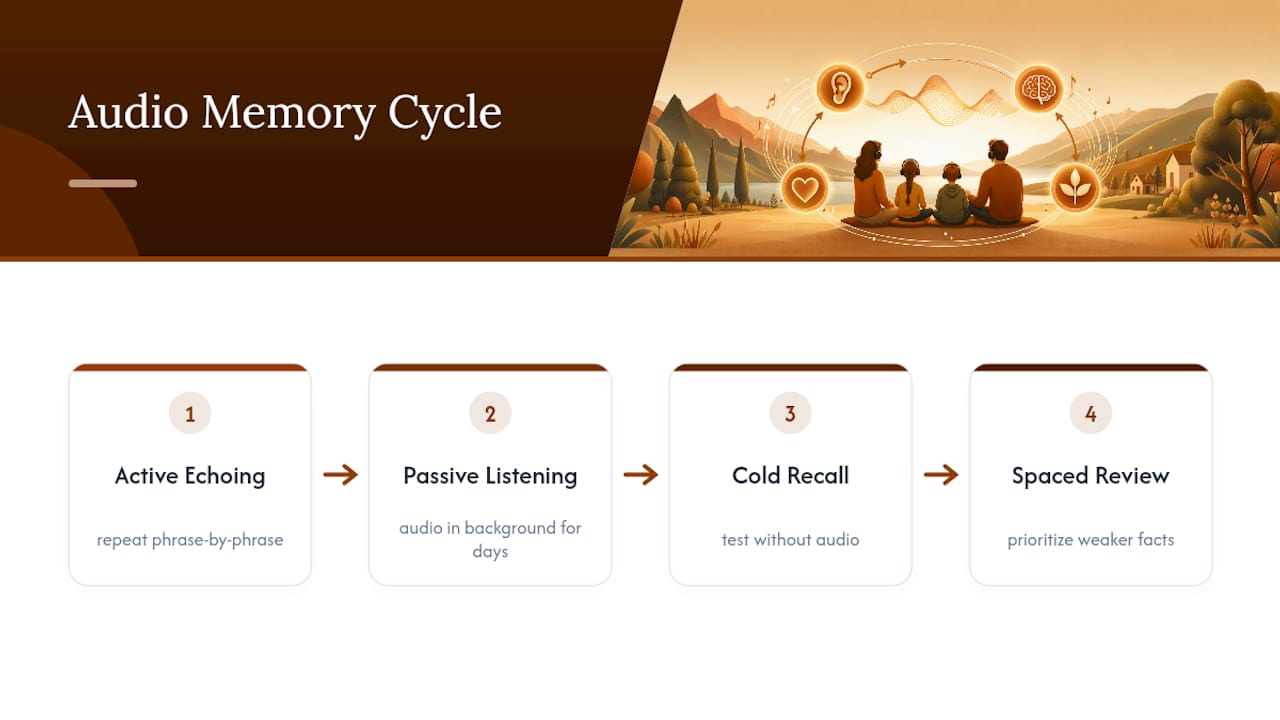
This is also where spaced repetition earns its keep. SRS style flashcard tools prioritize the facts a child is shakiest on, scheduling review at increasing intervals instead of repeating everything equally. Audio flashcard apps that read the prompt aloud work well for kids who aren't yet strong readers.
Multisensory anchors make everything stickier. Hand motions during a timeline song, finger tracing on a map while reciting geography facts, or clapping the beat during a Latin chant all recruit the body alongside the ear. None of it needs to be elaborate. A single consistent gesture per fact is often enough to turn a foggy memory into an instant one.
What Audio Resources Should You Actually Use?
Most families end up piecing together a mix rather than relying on one single resource, and that's fine. The categories worth knowing:
- Curriculum-aligned audio. Many classical programs, including Foundations Learning Center's downloadable memory work files, already have official tracks for history, Latin, and math sentences that families load straight into a playlist.
- Musical memory sets. Songs written specifically to teach facts, not just entertain, tend to have cleaner, more repeatable melodies.
- Self-made recordings. A parent's own voice reciting the week's facts, recorded on a phone, works surprisingly well and adds a personal layer kids respond to.
- Audio-enabled flashcard apps. Useful for spaced review once material has moved past the introduction stage.
- Printable guide kits. Not audio themselves, but they help you track what's been introduced and when it's due for review.
When evaluating any resource, check for short tracks (under two minutes per item), easy downloading, compatibility with whatever device you actually use, and a simple weekly layout you can glance at instead of decode. Build your own playlist once and reuse it. That single hour of setup saves you from scrambling every Monday morning.
How Do You Keep Memory Work From Feeling Like a Chore?
Low-prep games make repetition feel like play instead of drill, and pairing audio with movement or simple manipulatives measurably increases engagement.
Three that require almost no setup:
- Dice review. Roll a die, and whatever number comes up is how many memory work items your child recites before the audio confirms them.
- Tic-tac-toe recall. Each square holds a fact; get it right before placing your mark.
- Jenga week blocks. Label blocks by week number, and whichever block gets pulled is the review round for that day.
Keep the mindset simple: celebrate effort over perfection, keep sessions short and predictable, and rotate formats so nothing gets stale. If a child resists, the fix is almost always to shorten the session duration rather than pushing through it. If facts keep slipping, it usually means review has stretched too far apart, not that the child is struggling to learn.
Pro Tip: If a session ever feels like a fight, stop at five minutes instead of pushing to fifteen. A short win rebuilds momentum faster than a long struggle does.
Where Does a Screen-Free Audio Player Fit In?
A tactile, screen-free player solves a specific problem: how do you get consistent daily audio exposure without handing a child a tablet or phone? A child taps an NFC story card onto a screen-free audio box, and the track starts, no menus, no scrolling, no ads competing for attention during a review session.
For memory work specifically, families can load a weekly card with that week's history or Latin chant, so the physical act of tapping the card becomes part of the routine. A family member can also record their own voice reciting math facts or a Scripture passage, turning ordinary review into something that also carries a bit of home in it. Because it works offline and requires no login, it fits neatly into the car, the breakfast table, or a Friday cumulative review, without competing for a device someone else needs.
An Honest Take on Where Audio Memory Work Actually Pays Off
Most advice on memory work focuses on what to memorize. The bigger lever is almost always when and how often, not which fact list you chose. Families who succeed long term treat audio as background infrastructure, something that plays during breakfast or the drive to co op, rather than a separate task competing for attention on an already packed schedule.
The families who burn out usually tried to do too much too well, chasing perfect pronunciation or a flawless weekly review. Consistency beats polish here. A shaky, cheerful recitation on Tuesday beats a perfect one that only happens once a month.
If you're starting from zero, resist the urge to overhaul your whole week. Pick one subject, load one audio track, and run the 15-minute daily pattern for two weeks before adding anything else.
— Bob
A Screen-Free Way to Build Your Family's Audio Memory Work Routine
If you've been running memory work off a phone playlist, you already know the problem: one accidental tap and your child is three videos deep into something that has nothing to do with Latin declensions. This device is a tactile audio player that plays only what you load onto its NFC cards, so a review session stays a review session.
Families use it for memory work in a few concrete ways: a dedicated card for the week's history sentences or timeline song, a family-voice recording of math facts read by a parent or grandparent, and curated educational packs that rotate in new content as your child moves through a curriculum. If your family already has a working playlist on an existing device, that's a fine starting point. If you want a device that can't wander off into other apps mid-recitation, a dedicated player closes that gap for good.
Explore the Echo-Story Box and see which starter option fits your week, or browse the character-focused audio at Echostory-box's homeschool storytelling collection for read-aloud pairings that reinforce the same vocabulary your memory work is building.
Sources
For a deeper look at the classical-education philosophy behind memory work, see Classical Conversations' foundations guide. Classical Quest's routine guide covers weekly scheduling in more detail, and Musical Memory's tips page offers additional song-based games. For broader audio-learning tools, AtListen is worth a look.
- Foundations Memory Work Review: How to Master Grammar Review at Home and in CommunityClassical Conversations
- Classical Memory Work Guide - Make It Stick | Classical Quest
- Tips for Using Musical Memory in Your Homeschool - Musical Memory
FAQ
What Age Is Best for Audio Memory Work?
Grammar-stage children, roughly ages 4 to 11, get the most benefit because they naturally memorize facts before fully understanding them, building a framework for later learning.
How Long Should Daily Memory Work Sessions Last?
About 15 minutes a day works better than one long weekly session, according to practical routine guidance from experienced homeschool families.
Can Audio Memory Work Replace Flashcards Entirely?
Not entirely. Audio builds initial recall and rhythm, but pairing it with active recall or spaced-repetition flashcards helps catch the facts a child is shakiest on.
What if My Child Resists Memory Work Time?
Shorten the session first. A five-minute win rebuilds momentum faster than pushing through a full 15 minutes of frustration, and rotating in a quick game like dice review or tic-tac-toe recall often resets the mood.
Does a Dedicated Audio Player Work Better Than a Phone Playlist?
A screen-free player like the Echo-Story Box removes the risk of a child wandering into unrelated content mid-session, which a phone or tablet playlist can't fully prevent.