
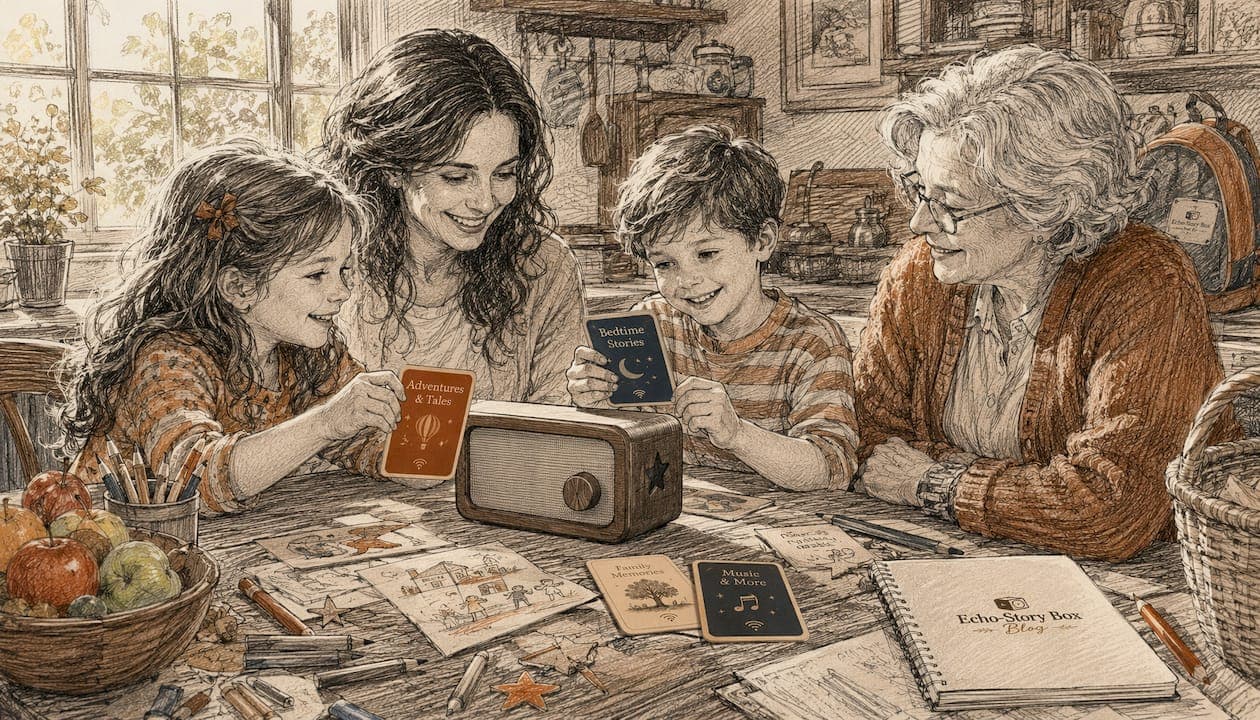
If you're searching for readtomerecordings.com alternatives, Echo-Story Box is the recommended pick for U.S. families. It offers tactile NFC story cards, genuine support for custom family recordings, and a fully ad-free experience. Here are the other strong options worth considering:
- Toniebox (Tonies): Best for toddlers ages 2–5 who love physical figurines. Place a Tonie character on top and the story plays instantly.
- Yoto Player: Best for families who want a large, organized card library of licensed stories, music, and podcasts.
- Lunii (My Fabulous Storyteller): Best for kids who enjoy choosing story elements themselves, building their own narrative each time.
- Storypod: Best for families drawn to collectible character pods and a broad content marketplace.
Table of Contents
- How do these screen-free audio players compare?
- How to choose the right screen-free audio player for your child
- A closer look at each device
- Why audio-only story players genuinely help young children
- Practical ways to use a story player every day
- Key takeaways
- Why tactile story players deserve more credit than they get
- Echostory-box is the screen-free storytelling system built for your family
- Research and further reading
How do these screen-free audio players compare?
| Device | Best for | Tactile interface | Custom recordings | Content library (US) | Device price | Subscription / card costs | Durability | Offline playback | Privacy / ads | Grandparent setup |
|---|---|---|---|---|---|---|---|---|---|---|
| Echo-Story Box | Personalization, legacy recordings, ages 3–5 | NFC story cards | ✅ Full support | Original, faith-based, educational, audiobooks | Varies by kit | Optional monthly mailed card subscription | Solid build; DIY or assembled | ✅ Yes | No ads, no tracking | Simple card-tap setup |
| Toniebox (Tonies) | Toddlers, ages 2–5 | Figurines (place on top) | Limited (Tonie Creative) | Large licensed library | — | Per-Tonie figures (varies depending on figure) | Soft, padded shell; very durable | ✅ Yes | No ads | Very easy |
| Yoto Player | Card-based organization, ages 3–5 | Physical cards (slot in) | Limited (Make Your Own cards) | Large licensed + original library | — | Per-card packs (varies depending on pack) | Solid plastic; child-friendly | ✅ Yes | No ads | Easy |
| Lunii | Interactive story creation, ages 3–5 | Dial + buttons | ❌ No | Moderate; growing US library | ~$69 | Story packs (varies depending on pack) | Compact plastic | ✅ Yes | No ads | Moderate |
| Storypod | Collectible characters, ages 2–5 | Character pods | ❌ No | Growing marketplace | ~$79 | Subscription or per-pod content | Solid build | ✅ Yes | No ads | Moderate |
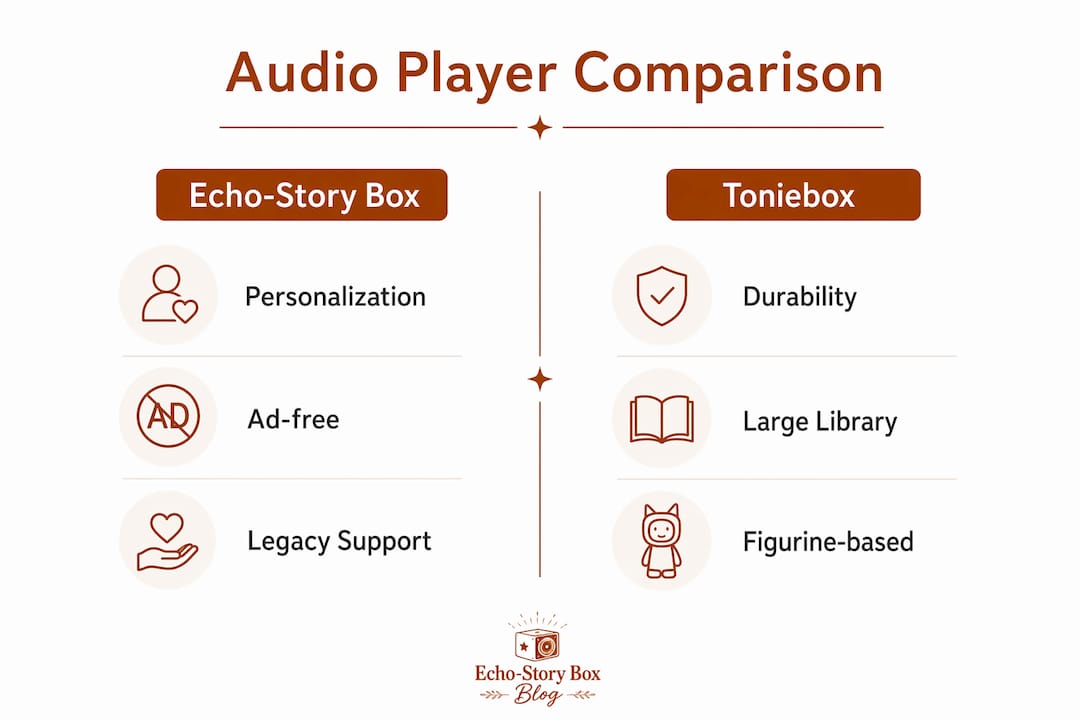
Device prices are approximate and subject to change. Verify current pricing at each brand's official site before purchasing.
How to choose the right screen-free audio player for your child
Start with age and how your child plays. A two-year-old who throws things needs a soft, padded device like the Toniebox. A six-year-old who loves organizing her books will thrive with Yoto's card system. Age fit and play style are the two criteria that narrow your list fastest.
After that, work through these questions before you buy:
- Can I upload my own MP3s or record my voice? Devices that support custom family recordings become keepsakes. Those that don't may lose your child's interest once the novelty fades.
- Is there a subscription, and what does it cost long-term? A $79 device with $20-per-figure ongoing costs adds up quickly.
- What happens if my child loses a card or figure? Some ecosystems let you re-download content; others require a full repurchase.
- Is the content library available in the US? A few devices have stronger European libraries; confirm US availability before ordering.
- Does it play offline? All five devices on this list do, which matters for car trips and travel.
- Who will set it up? If grandparents are the primary caregivers, choose a device with a simple, one-step tap or place interaction.
Red flags to watch for: ecosystems with no path to add personal recordings, unclear data or advertising policies, and thin plastic shells marketed to toddlers. Durable, padded designs consistently outlast fragile enclosures in toddler households.
Pro Tip: Pick a device that supports open formats or personal recordings from day one. If the brand ever changes its business model, your family's recorded stories stay safe and playable.
A closer look at each device
Echo-Story Box
Echo-Story Box is built around one idea: your family's voice matters as much as any published story. Children tap an NFC card and audio begins, no menus, no ads, no scrolling. Parents and grandparents can record bedtime stories, life lessons, or holiday messages directly onto cards, creating something no other device on this list offers at the same depth. Original educational adventures featuring characters like Theo the Rabbit blend history, vocabulary, and values into stories that feel warm rather than academic. A monthly mailed story-card subscription keeps fresh content arriving without any screen interaction. For homeschool families and faith-based households especially, the content flexibility is hard to match.
Strengths: Deep personalization, legacy recording support, ad-free, US-available, DIY or ready-made options. Trade-off: Smaller out-of-the-box licensed library compared to Yoto or Tonies.
Toniebox (Tonies)
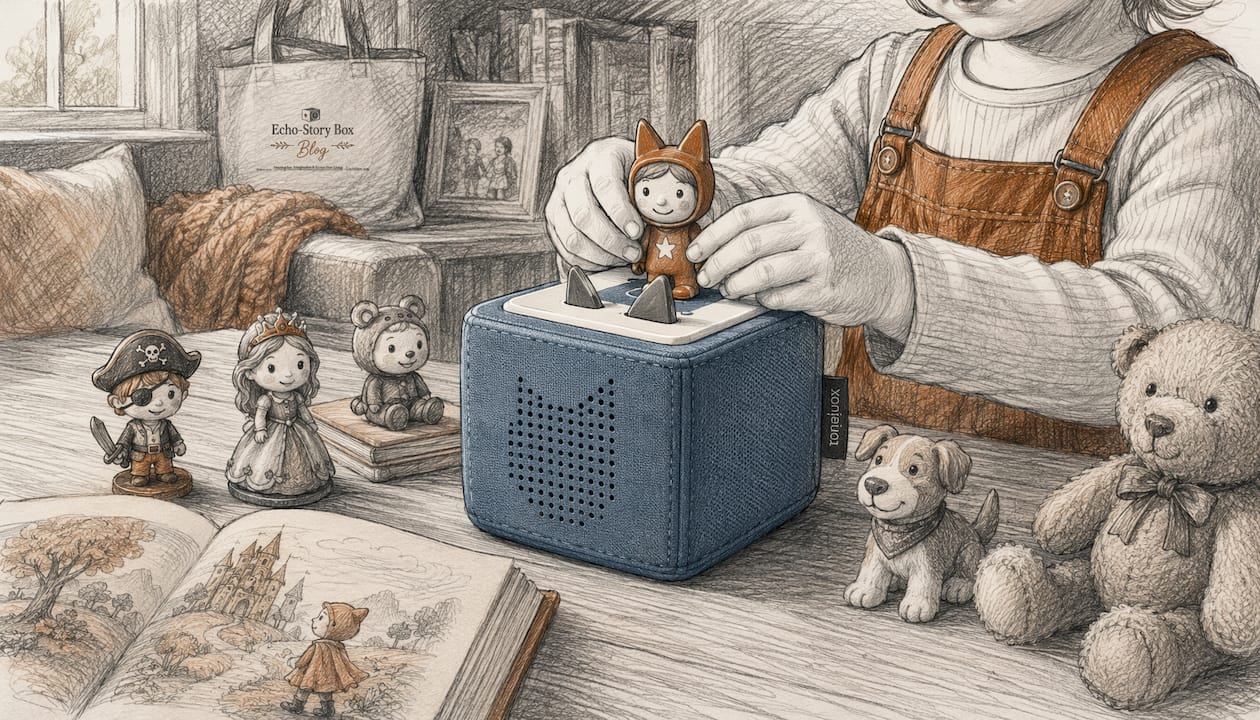
The Toniebox uses soft figurines instead of cards. Your child places a character on top of the box and the story plays. That physical interaction is genuinely intuitive for toddlers, and the padded, rounded shell survives drops and throws better than most. The licensed library is large and well-curated. The main limitation is personalization: the Creative Tonie figure lets you record up to 90 minutes of audio, but the system is not built around family recordings the way Echo-Story Box is. Tactile figurine play gives preschoolers a real sense of agency, which supports independent listening habits.
Strengths: Extremely durable, toddler-friendly, large library. Trade-off: Per-figure costs accumulate; limited custom recording support.
Yoto Player
Yoto's card system is the most organized of the group. Cards slot into the player and display a simple pixel image on screen, which helps older kids self-select content. The library spans audiobooks, music, podcasts, and sleep sounds, all licensed and ad-free. "Make Your Own" cards allow some customization, though the process is more technical than Echo-Story Box's recording workflow. Setup is straightforward, and the player doubles as a night light and clock, making it genuinely useful at bedtime.
Strengths: Large organized library, versatile features, solid build. Trade-off: Custom recording support is limited compared to Echo-Story Box.
Lunii (My Fabulous Storyteller)
Lunii takes a different approach: children use a dial to choose a character, a setting, and an object, then the device generates a unique story from those choices. It encourages creative thinking in a way the other devices don't. The US content library is growing but smaller than Yoto or Tonies. There's no support for family voice recordings. At roughly $69, it's the most affordable device on this list, which makes it a reasonable starting point for families unsure whether their child will engage with audio-only play.
Strengths: Interactive story creation, affordable entry price. Trade-off: No personalization or family recordings; smaller US library.
Storypod
Storypod uses collectible character pods that children place on the device to trigger stories and songs. A parent-facing app manages content and settings. The marketplace is growing, and a subscription option adds regular new content. It suits families who enjoy the collectible aspect of building a character set over time. Custom recordings are not supported.
Strengths: Collectible appeal, growing content marketplace. Trade-off: No family recording support; subscription adds ongoing cost.
Pro Tip: For children ages 3–5, prioritize the tactile interface above all else. A child who can independently tap a card or place a figure will use the device daily. One that requires app navigation will collect dust.
| Device | Interface type | Custom recordings | Approx. battery life | Offline playback |
|---|---|---|---|---|
| Echo-Story Box | NFC card tap | ✅ Yes | Varies by build | ✅ Yes |
| Toniebox | Figurine placement | Limited | Battery life varies by model | ✅ Yes |
| Yoto Player | Card slot | Limited | Battery life varies by model | ✅ Yes |
| Lunii | Dial + buttons | ❌ No | Battery life varies by model | ✅ Yes |
| Storypod | Character pod | ❌ No | Battery life varies by model | ✅ Yes |
Battery life figures are approximate manufacturer estimates.
Why audio-only story players genuinely help young children
Research from The Conversation finds that audio-only formats encourage "voluntary imagination," requiring children to visualize scenes rather than passively receive images. That active construction builds concentration, language development, and executive function, with benefits beginning around age 3.5.
Audio storytelling asks children to build the world in their own minds. That mental effort, repeated daily, strengthens attention and imagination in ways that passive video simply cannot replicate.
Audio also tends to use richer vocabulary and more complex sentence structures than most preschool video programs, giving children greater language exposure through natural listening. The American Academy of Pediatrics notes that audiobooks and audio players can be a genuinely engaging screen-free format, while emphasizing that the greatest learning gains come when parents listen alongside and discuss the story.
Audio players are a complement to conversation, not a replacement for it.
Practical ways to use a story player every day
The best results come from weaving the device into routines your family already has.
- Bedtime: Replace the last 20 minutes of screen time with a story card. The benefits of audio at bedtime include calmer transitions and better sleep onset for many children.
- Car rides: Audio during transitions is one of the smoothest ways to reduce screen dependence. Children who might resist a tablet-free car ride often accept a story player without complaint.
- Independent play: Set a card and let your child listen during tidy-up time or quiet play. Tactile control gives preschoolers a sense of ownership over the experience.
- Co-listening sessions: Sit together and pause the story to ask, "What do you think happens next?" Children learn more vocabulary through guided listening when adults pause to discuss.
- Multilingual exposure: Several devices support non-English content. Yoto and Lunii both offer some multilingual story packs.
For grandparents managing the device: keep cards in a small labeled box near the player, charge overnight on a simple USB cable, and show them the one-step tap or place action once. Most grandparents are comfortable within minutes.
Pro Tip: After a story ends, ask your child to retell it using their own words or draw one scene. That short follow-up doubles the vocabulary and comprehension benefit of the listening session.
Key takeaways
For families choosing among screen-free audio players, Echo-Story Box stands out as the strongest option for personalization, legacy recordings, and ad-free listening in the US.
| Point | Details |
|---|---|
| Echo-Story Box leads on personalization | It's the only device built around family voice recordings and custom NFC story cards. |
| Toniebox suits the youngest children | Its padded shell and figurine interface make it the most toddler-proof option on the list. |
| Yoto Player offers the largest library | Card-based organization and a broad licensed catalog suit families who want variety. |
| Co-listening amplifies every device | AAP guidance confirms children gain more vocabulary when adults pause and discuss stories. |
| Choose open formats for longevity | Devices supporting personal recordings stay useful even if the brand's content model changes. |
Why tactile story players deserve more credit than they get
The conversation around kids and screens tends to focus on reduction, as if the goal is simply less. But the families who get the most from devices like these aren't thinking about subtraction. They're thinking about replacement: what fills the space when the tablet goes away?
A story player with a physical card or figure gives a child something to hold, choose, and control. That agency matters. Child psychologists note that tactile playback gives preschoolers a genuine sense of intentional interaction, which supports independent listening in a way that a voice command or touchscreen never quite does. The child who walks to the shelf, picks a card, and taps it has made a real decision.
The deeper point is this: the best screen-free audio player isn't the one with the biggest library or the lowest price. It's the one that carries your family's voice. A grandparent's recorded bedtime story, played back on a quiet Tuesday afternoon, is something no licensed content catalog can replicate.
Echostory-box is the screen-free storytelling system built for your family
If you want a tactile, personalized, ad-free storytelling experience for your children, Echostory-box is the option that goes furthest. While Toniebox, Yoto, Lunii, and Storypod each offer strong licensed libraries, none of them are built around your family's own voice the way Echostory-box is.
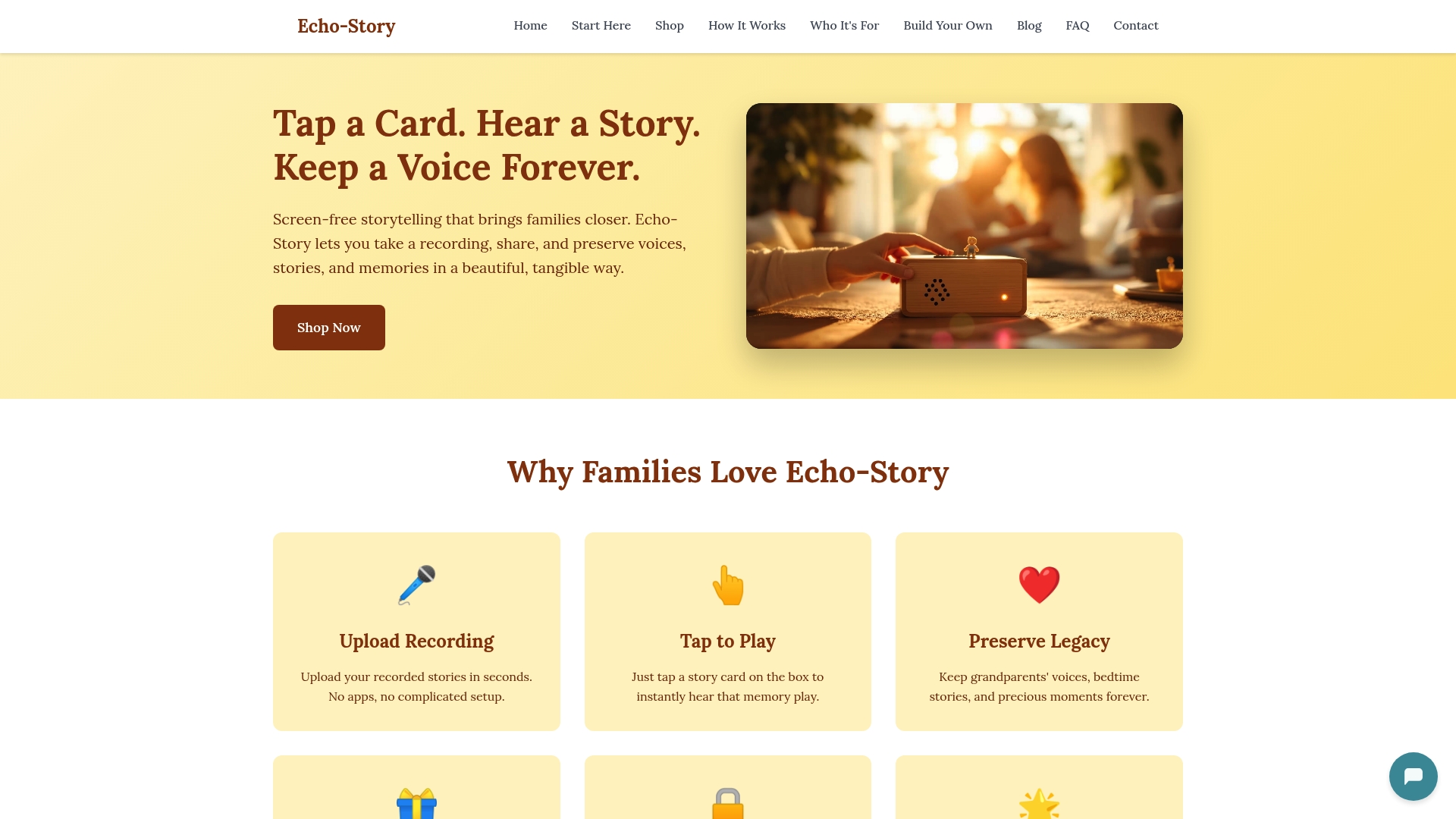
Here's what sets it apart for U.S. families:
- NFC story cards: Children tap a card and audio begins. No menus, no passwords, no ads.
- Family voice recordings: Record a grandparent's story, a bedtime message, or a faith testimony directly onto a card.
- Monthly mailed story cards: Fresh content arrives by mail, no screen required to access it.
- Original educational content: Adventures featuring Theo the Rabbit and other characters blend history, values, and imagination.
- DIY or ready-made: Buy an assembled box or build your own with step-by-step guides.
- Ad-free and private: No tracking, no recommendations, no notifications.
Shipping is available across the US. Visit the Echo-Story Box shop to explore starter kits, story card packs, and subscription options, and find the setup that fits your family.
Research and further reading
- Want to spur your child's intellectual development? Use audiobooks instead of videos — The Conversation. Supports claims about voluntary imagination and audio-only cognitive benefits.
- Audiobooks, audio players, and child development — American Academy of Pediatrics. Covers co-listening, scaffolding, and the limits of audio-only play.
- Screen Time vs Audio for Kids: What Research Says for Ages 2–5 — Cucutime. Covers vocabulary exposure, pacing benefits, and transition routines.
- Can audio players keep kids away from screens? — HuffPost Life. Explains tactile playback and ecosystem content models.
- A Parent's Guide to Choosing the Right Audio Player for Kids — Hike Insights. Covers durability, tactile interface, and buying criteria.
- Best kids audio players — Reviewed. Covers personalization, ecosystem lock-in, and open-format recommendations.
- Ultimate guide to kids audio players — Busy Busy Learning. Covers durability choices by child age and behavior.